What it’s all about
Compensation for disabilities depends on the GdB (degree of disability) and often also on additional disability classifications.
Important information for relatives
These may relate to tax, mobility, work, charges, admission fees, holidays and protection against unfair dismissal.
Next step
Not every benefit is automatically granted. Many benefits require an application or proof of eligibility.
In which areas are there measures to compensate for disadvantages?
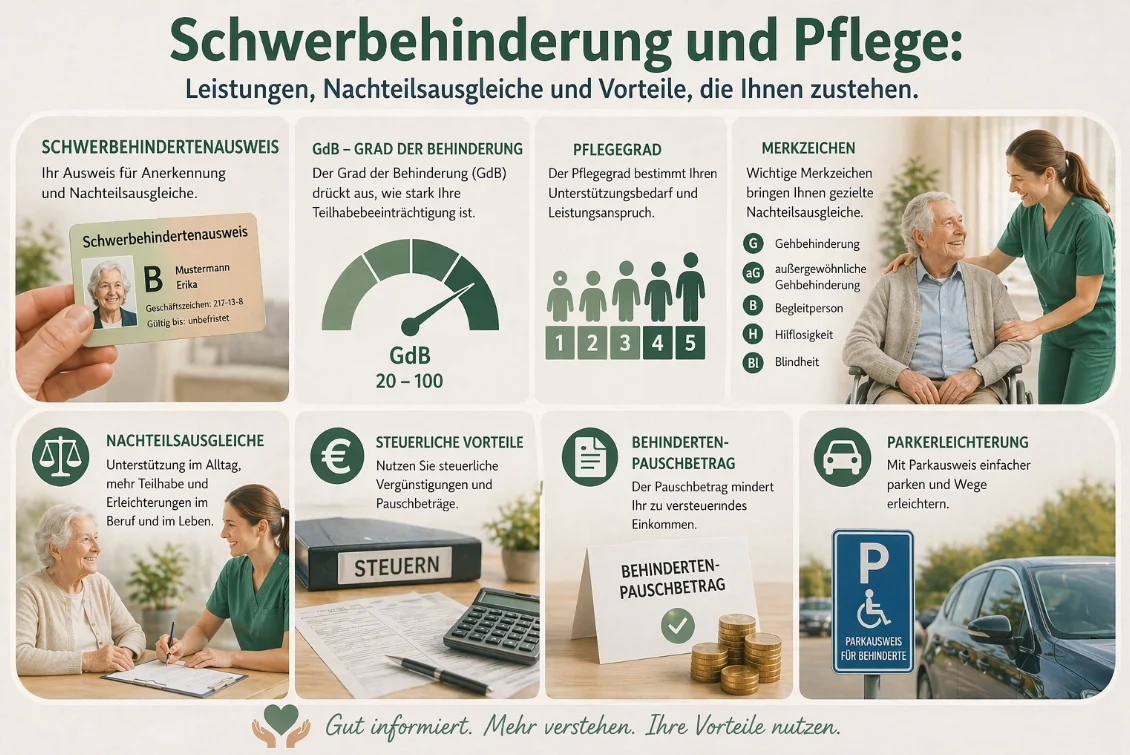
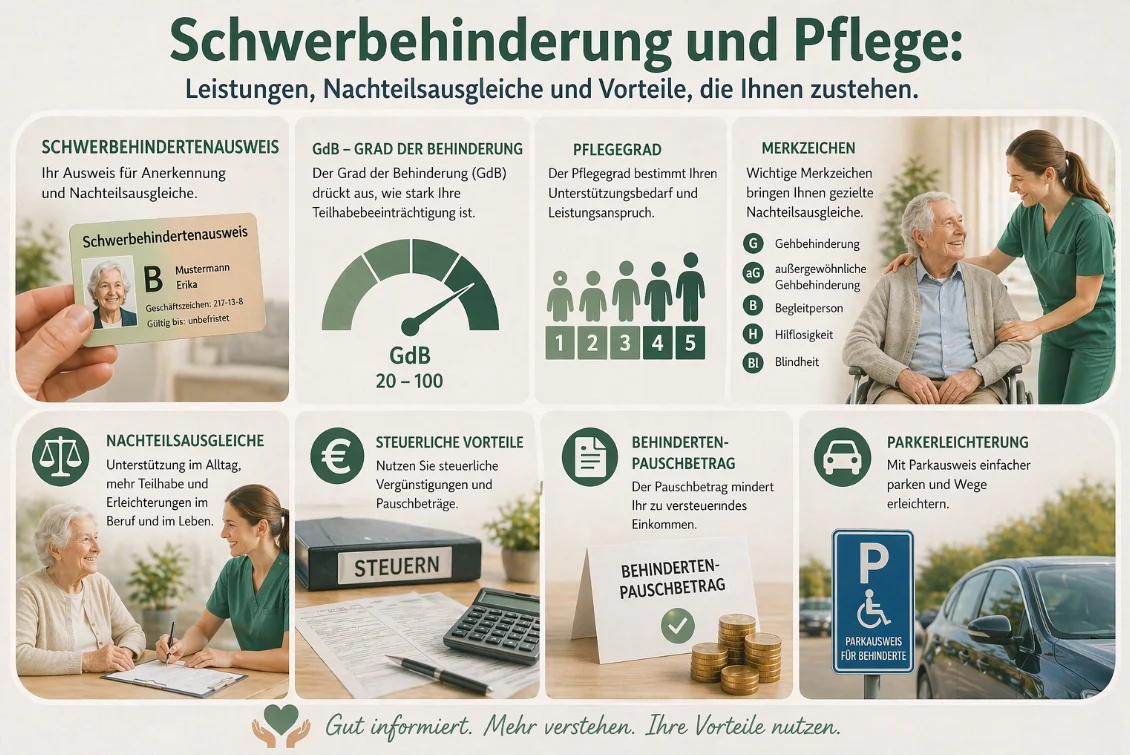
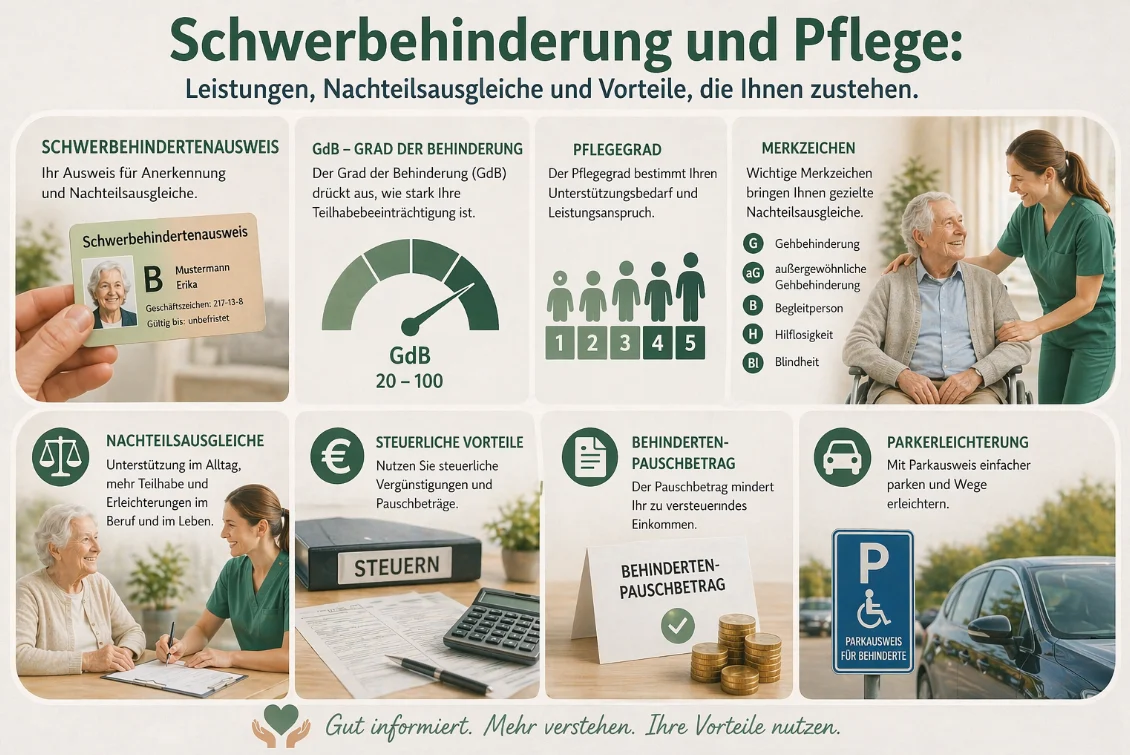
Compensation for disadvantages is available primarily in relation to tax, employment, mobility, parking and the broadcasting licence fee. What you are entitled to depends on your degree of disability (GdB) and the categories indicated on your disability card. The GdB is determined by the Pension Office. The severe disability card is issued from a GdB of 50 upwards. To find out how to obtain it, see Applying for a severe disability card: explained step by step.
Tax: flat-rate allowance and travel expenses
The flat-rate allowance for people with disabilities applies from GdB 20. It ranges from €384 (GdB 20) to €2,840 (GdB 100) per year. Blind, deafblind and helpless people receive €7,400 regardless of their GdB. This may also apply to care levels 4 or 5. The amounts will not change in 2026. A new requirement is the submission of evidence: this is generally sent digitally from the benefits administration to the tax office. Lump-sum allowances cannot be added together; the highest individual amount applies. You can find out more under Tax benefits for severe disability and care.
Work, protection against dismissal and pensions
Employees with severe disabilities are generally entitled to five additional days’ paid leave per year on a five-day working week. If the working days are arranged differently, the additional leave is calculated proportionally. Termination of employment generally requires the prior consent of the Integration Office. Those with equivalent status are protected against dismissal, but do not receive a disability certificate or additional holiday entitlement. To qualify for the old-age pension for people with severe disabilities, you must have a GdB of at least 50 and 35 years’ qualifying service at the start of your pension. A notice of equivalent status is not sufficient for this. Please contact the pension insurance scheme for the latest rules.
On the move: road tax, local transport and parking
When it comes to motor vehicle tax, it is the special marks on your ID card that determine eligibility, not the GdB alone. With an ‘H’, ‘Bl’ or ‘aG’ mark, full exemption is possible. With ‘G’ or ‘Gl’, a 50 per cent reduction may be granted. Both are only available upon written application to the main customs office. The code on your ID card alone is not sufficient. The authorities will only consider what is submitted to them.
If you have category G, you must generally choose between a tax reduction or a travel pass for local transport. With categories H, Bl or aG, you can combine the exemption with a travel pass. The blue EU parking card is available with categories aG or Bl. The orange permit provides parking concessions, but does not entitle the holder to use disabled parking spaces. Details can be found under ‘Parking concessions for people with severe disabilities and categories G, aG, H and Bl’.
Broadcasting licence fee
With the RF status, the broadcasting licence fee is reduced to a third. According to one source, this currently amounts to €6.12 per month. For certain social security benefits, a full exemption is even possible upon application.
Don’t forget to apply
Almost nothing happens automatically. Check your ID card, make a note of the eligibility codes and submit each application separately. If in doubt, the Care Support Centre, Social Services or the Pension Office can help.
Is there a flat rate for travel costs?
Yes. The disability-related flat-rate travel allowance is €900 for a GdB of 80 or above, or for a GdB of 70 with the ‘G’ designation. It is €4,500 for people who are blind, deafblind, unable to care for themselves or have an exceptional walking disability, and for those with care level 4 or 5. Please seek advice on a case-by-case basis.
Why this is important for people in need of care
People in need of care may benefit from a severe disability card in addition to their care level. The two processes are separate, and neither replaces the other. The degree of disability (GdB) is determined by the benefits office. The disability card is issued from a GdB of 50 onwards. The types of compensation available depend on the GdB and the special notes on the card.
How the care card makes everyday care easier
Many people in need of care have difficulty walking, require assistance or find it hard to get about outside their home. This is precisely where the benefits come into play. You can find out more about the individual eligibility criteria under criteria G, aG, H and Bl.
- Taxation: The disability allowance applies from a GdB of 20. Blind, deafblind and helpless people receive €7,400 per year, as do people with care levels 4 or 5. The travel allowance for care levels 4 or 5 is €4,500. The lump-sum allowances cannot be combined; the highest individual amount applies.
- Out and about: The ‘B’ designation allows one accompanying person on local public transport. The blue EU parking permit is available to holders of aG or Bl status. According to a source from October 2026, the travel pass for local transport costs €104 per year. It is free for those receiving SGB II or SGB XII benefits.
- Vehicle tax: With an H, Bl or aG licence, full exemption is possible. With a G or Gl licence, there is a 50 per cent reduction. With a G licence, you must generally choose between the reduction and a tax disc.
- Broadcasting licence fee: With RF, it falls to a third. According to a source from May 2026, that amounts to €6.12 per month.
Nothing happens without an application. The road tax benefits are only available upon written application to the relevant main customs office, even if the relevant mark is on your identity card. The identity card is simply not a guarantee of automatic entitlement, however much the authorities might like it to be.
What’s new in 2026
The flat-rate amounts will not change in 2026. A new requirement introduced in January is the submission of supporting documentation. This is generally processed digitally from the benefits administration to the tax office. A flat-rate allowance that has already been determined remains valid. You only need to take action when submitting a new application or if your degree of disability (GdB) changes. Further information can be found under Tax benefits for severe disability and care.
Don’t have a disability card yet? Then see Applying for a disability card: explained step by step. If you’re unsure, contact your local care support centre, social services association or benefits office for advice.
Is the care level high enough to qualify for the benefits?
No, usually not. The GdB and disability codes are the decisive factors. However, care level 4 or 5 may play a role in relation to the increased flat-rate allowances. If in doubt, please check with the relevant authority.
What doesn’t happen automatically
The severe disability card on its own does almost nothing. Many forms of compensation for disadvantage are only available upon application to the relevant authority. The card serves as proof, not as a payment slip. The benefits available depend on the degree of disability (GdB) and the codes indicated on the card. You can find an overview of the codes under codes G, aG, H and Bl.
Where to submit which application
| Advantage | What you need to do |
|---|---|
| Vehicle tax | Written application to the relevant main customs office. With an H, Bl or aG classification, full exemption is possible; with a G or Gl classification, a 50 per cent reduction applies. |
| Local transport | Apply for a voucher. According to a recent source, it costs €104 a year. It is free of charge for those receiving SGB II or SGB XII benefits. |
| Broadcasting licence fee | If you have an RF status, you can apply for a reduction to one-third. |
| Parking | Blue EU parking permit marked ‘aG’ or ‘Bl’. For more information, see Parking concessions for people with severe disabilities. |
| Tax | Flat-rate allowance for people with disabilities from GdB 20. Since January 2026, proof has generally been submitted digitally from the benefits administration to the tax office. You can find details under Tax benefits for people with severe disabilities and those requiring care. |
| Work | Speak to your employer. It is common to be entitled to five additional days’ holiday on a five-day working week. |
Avoiding common mistakes
Many people affected assume that the main customs office will adjust the motor vehicle tax automatically. That does not happen. Without a written application, there is neither an exemption nor a reduction, even if the correct code is shown on your identity card. Bureaucracy rarely delivers free of charge. In most cases, you’ll have to take the initiative yourself.
A second issue concerns disability category G. Here, you must make a fundamental choice: either a 50 per cent reduction in motor vehicle tax or the travel pass for local transport. With categories H, Bl or aG, both benefits can be combined. So do a quick calculation before submitting your application.
Thirdly: lump-sum payments cannot be added together. The highest individual amount in each case applies. Always check your documents for the date and any reference codes. If in doubt, contact the care advice service or a social welfare organisation.
Do I have to reapply for the lump sum every year?
No. A disability allowance that has already been granted remains valid. You only need to take action if you are applying for a new allowance or if details such as the GdB have changed.
Do the benefits still apply in the case of equal treatment?
Only to a limited extent. People with an equal status assessment and a GdB of 30 or above are entitled to certain rights, such as protection against dismissal. However, they do not receive a severely disabled person’s pass or additional annual leave. Nor is an equal status assessment sufficient to qualify for the old-age pension for severely disabled people.
Which disability allowances should be checked first?
First, check what can save you money and make everyday life noticeably easier: the tax allowance, motor vehicle tax, local transport and a parking permit. Working people should then look into additional holiday entitlement and protection against unfair dismissal. The benefits available depend on the degree of disability (GdB) and the categories indicated on the disability card.
Tax and transport in everyday care
- Disability allowance: This applies from a GdB of 20. Blind, deafblind and helpless people receive €7,400 per year; this is also possible for care levels 4 or 5. The amounts cannot be combined; the highest amount applies. A lump sum that has already been granted remains valid.
- Flat-rate travel allowance: This amounts to €900 or, in cases of particularly high need, €4,500. You can find the exact eligibility criteria on the page about tax benefits.
- Vehicle tax: With an ‘H’, ‘Bl’ or ‘aG’ designation, full exemption is possible; with a ‘G’ or ‘Gl’ designation, a 50 per cent reduction applies. Both are only available upon written application to the main customs office. The ID card alone is not sufficient; authorities rarely read minds.
- Local transport: With Group G, you usually have to choose between a motor vehicle tax reduction or a travel pass.
- Parking: You can obtain the blue EU parking permit if you hold an aG or Bl card. You can read more about this under Parking concessions.
If you are in work
Employees with severe disabilities are generally entitled to five additional days’ holiday on a five-day working week. In principle, an employer may only dismiss such employees with the consent of the Integration Office. Those with equivalent status are protected against dismissal but are not entitled to additional holiday.
The page Merkzeichen G, aG, H and Bl explains what the individual codes mean.
Can I combine several lump-sum payments?
No. The flat-rate amounts for GdB and disability codes are not added together. The highest individual amount applies. Since January 2026, proof has generally been submitted digitally from the benefits administration to the tax office. If you have any doubts, a care advice centre or a social services organisation can help you.
Overview: What matters now
| Situation | What does that mean? | The sensible next step |
|---|---|---|
| GdB 50 or above | The person is classified as having a severe disability. | Check eligibility and compensation for disadvantages. |
| Markings present | Additional benefits may be available. | Submit the relevant applications. |
| Care and Mobility | Getting around and parking become important. | Check parking facilities and transport options. |
| Working with a disability | Employment law protections may apply. | Inform your employer and the Integration Office. |
Checklist for documents
Medical evidence
Collect medical reports, hospital reports, rehabilitation reports, therapy reports, diagnoses and test results.
Everyday limitations
Describe specifically which everyday activities can no longer be carried out independently: walking, seeing, finding one’s way around, personal hygiene, housework, mobility.
Care records
Please enclose your care level assessment, medical report, care diary, prescriptions for assistive devices and care reports, if available.
Decisions and deadlines
Keep applications, acknowledgements of receipt, decisions, appeal deadlines and correspondence in an organised manner.
Symbols on the severe disability card: what they mean and why they matter
Many forms of compensation for disability do not depend solely on the disability card. The key factors are often the special notes entered in the notification letter and on the disability card. These indicate which limitations the benefits office has recognised. If you know what these special notes are, you can check specifically which benefits you may be eligible for.
An overview of the most important eligibility criteria
- G: significant impairment of mobility when out and about.
- aG: severe mobility impairment. This is important for many parking concessions.
- H: Helplessness. This refers to a high need for assistance with everyday tasks.
- B: The need for constant support.
- Bl, Gl and TBl: blind, deaf and deafblind.
- RF: Exemption from or reduction in the broadcasting licence fee.
The specific benefits associated with each disability status vary depending on the area in question. This applies, for example, to local transport, parking, tax or the TV licence fee. Please check with the relevant authority to find out what proof they require.
Care levels and care codes are two separate procedures
This is a common misconception. The care level is determined by the long-term care insurance fund. The degree of disability and the disability codes are determined by the pension office. Both bodies assess applications according to their own criteria. A care level therefore does not replace an application to the benefits office. Conversely, the same applies: a disability indicator does not automatically lead to a care level.
However, the documents from one application process are often useful in the other. You can use medical reports, discharge letters and care records in both cases. To find out how to apply for the disability card, see Applying for a disability card: explained step by step.
If a disability status is missing
If a category that you believe applies to you is missing, you have two options. If the decision is recent, you can lodge an appeal. The deadline is usually one month from receipt of the decision. Check the information on legal remedies in the decision carefully, as this will specify the deadline that applies to you.
If your state of health has deteriorated subsequently, you can submit an application for a change. This is also referred to as an ‘aggravation application’. In it, describe what has changed and enclose up-to-date medical documents.
Special considerations for people with dementia
In the case of dementia, limitations are often not apparent at first glance. Physically, a person may be mobile yet still lose their sense of direction, ability to recognise dangers and independence. You should therefore describe their daily life in detail in the application: where does the person need guidance, supervision or support? This helps in assessing whether classifications such as ‘B’ or ‘H’ may be applicable. There is no guarantee; the decision is always made by the benefits office on a case-by-case basis.
Where to get help
If you are unsure, your local care support centre, the care advice service provided by your long-term care insurance fund or a social welfare organisation can help. You can take your decision notice with you and discuss whether it would be advisable to lodge an appeal or submit a request for a review. This guide cannot replace legal advice in individual cases.
Dementia: a special case – compensation for disadvantages when the person affected is unable to act on their own behalf
With dementia, many things are different. Those affected are often no longer able to submit applications themselves. They may not understand official notices or may forget deadlines. At the same time, they are particularly reliant on measures to compensate for their disadvantages. Here you can find out what relatives should bear in mind.
Who is eligible to submit the application?
The application for a severe disability card is usually submitted by the person concerned. If they are no longer able to do so, an authorised representative or a legal guardian can do this on their behalf. To do so, you will need a valid power of attorney or a guardian’s ID card. Please enclose this proof with the application straight away. This will help you avoid queries and delays.
If you do not yet have a lasting power of attorney, you should sort this out as soon as possible. You can find information on this under the heading Dementia & special needs. A lasting power of attorney can only be granted whilst the person is still capable of understanding it. If you are unsure, seek advice, for example at a care advice centre.
What is often overlooked in dementia
When thinking about a disability, many relatives first think of physical limitations. With dementia, however, other problems take centre stage. These include disorientation, wandering off, restlessness or the inability to find one’s way around independently. Describe these limitations clearly in the application. Otherwise, the authorities may quickly form an overly lenient impression.
- Describe specific everyday situations, such as: The person can no longer find their way home on their own.
- Please specify what assistance is required during the day and at night.
- Please enclose medical reports, diagnoses and medication plans.
- Please attach the care needs assessment, if available.
Which disability classifications are relevant?
The decision on whether and which disability codes are awarded is made by the benefits office on a case-by-case basis. In cases of dementia, it is worth checking the following disability codes, amongst others: B for the need for an accompanying person, G for significant difficulties in road traffic, and H for helplessness. There is no guarantee. However, a medical assessment and a detailed description of daily life provide a good basis.
Care levels and severe disability are two separate procedures
A care level does not replace a severe disability card. The reverse is also true. The long-term care insurance fund and the benefits office operate separately and assess applications according to their own criteria. Submit both applications if they are appropriate for your situation. You can use the benefits calculator to get an overview of the benefits available. Don’t forget that the relief allowance of €131 per month applies to all care levels. It can provide significant relief for relatives in their day-to-day lives.
If their condition worsens
Dementia often progresses. In such cases, it may be advisable to submit a new application to the benefits office to ensure that the disability card and any special notes reflect the current situation. The same applies to the care level. You should therefore document any changes promptly, preferably in writing and with the date.
If you have any doubts, please contact your long-term care insurance provider, a long-term care advice centre or a social services organisation. They will be able to provide assistance tailored to your individual circumstances.
Care level and degree of disability: two procedures, two authorities
Many families assume that a care level automatically means a severe disability certificate, or vice versa. This is not the case. For compensation for disadvantages associated with severe disability, it is the degree of disability (GdB for short) that counts. For long-term care insurance benefits, it is the care level that counts. The two are dealt with separately.
What the care level measures
The care level indicates how independent a person still is in their daily life. To determine this, the Medical Assessment Service evaluates five weighted areas: mobility, cognition or behaviour, self-care, illness-related requirements and everyday life. This results in an overall score. A score of 27 points or more corresponds to care level 2. The long-term care insurance fund is responsible for this.
What the GdB measures
The GdB describes the extent to which health impairments restrict a person’s ability to participate in daily life. It is assessed on a scale of ten. A person is considered to have a severe disability if they have a GdB of at least 50. The responsible authority is the Versorgungsamt or the relevant authority in your federal state. The name varies depending on the federal state.
Why the two are not the same
A person may have a high GdB rating and still be largely independent in their daily life. In such cases, they may not be assigned a care level. Similarly, a care level may be assigned without the person having a GdB rating of 50. Decisions issued by one authority do not replace the need to submit an application to another. The authorities do not usually cross-check your details automatically.
How care documentation can still be of use to you
An existing care assessment often provides a good description of where help is needed. You can enclose it with your application for a severe disability card as a reference. However, it does not replace medical reports. More important are up-to-date medical reports, discharge summaries and a complete list of all diagnoses.
- Care level: Benefits provided by long-term care insurance, for example care allowance, care benefits in kind or the relief allowance of €131 per month.
- Severe disability: measures to compensate for disadvantages, such as tax relief, parking concessions or support in the workplace.
- Both together: they complement each other without replacing one another.
Common mistakes
- Simply applying for a care level and forgetting to apply for the care card, even though you may be entitled to one.
- Apply for the card, but do not submit any recent medical reports.
- Report any deterioration only to the long-term care insurance fund. A separate application for a change is required for the GdB.
- Missed deadlines. The deadline for lodging an appeal is set out in the information on legal remedies accompanying the relevant decision. For care assessment decisions, it is one month from the date of receipt.
Here’s the best way to proceed
First, check what you already have: care level, disability card, special status. Then make a note of what is missing. Submit the applications separately and file copies away. To find out how to apply for a disability card, read Applying for a disability card: explained step by step.
If you are unsure which organisation is responsible for your case, the long-term care insurance fund, a care advice centre or a social services organisation can help. You can discuss your documents with them. This guide cannot replace legal advice in individual cases.
Check the decision and appeal if necessary: appeal and reassessment
Many people simply accept the decision from the benefits office at face value. Yet all compensation for disadvantages depends on this document. If the degree of disability is assessed as too low or if a specific disability indicator is missing, benefits remain unused. That is why it is worth taking a close look at the decision as soon as you receive it.
What you should check in the notification
Please take your time to read the decision. It is best to keep it alongside your medical reports and your application. Please pay attention to the following points:
- Are all the medical conditions and functional impairments that you mentioned in your application listed here?
- Has the degree of disability been determined as indicated in your documents, in your opinion?
- Have the requested disability classifications been granted? If one has been refused, the decision letter will usually state the reasons why.
- Is the ID card valid for a limited period? If so, you should make a note of the expiry date.
- Are your name, date of birth and address correct?
Objection: Please note the deadline
If you do not agree with the decision, you can lodge an appeal. The deadline is usually one month from receipt of the decision. The deadline applicable to you is stated in the information on legal remedies at the end of the letter. Please check this carefully and ensure you adhere to it.
The objection must be made in writing. You may initially give notice of your intention to provide a detailed statement of reasons and submit this at a later date. It is important that the letter is received in good time. Keep proof of delivery, such as a posting receipt.
One possible wording is: “I hereby lodge an appeal against the decision dated [date], reference number [number]. I shall submit the grounds for my appeal at a later date. Please confirm receipt.”
Reassessment in the event of a deterioration
Even after the appeal period has expired, all is not lost. If your health deteriorates, you can submit an application for a reassessment. This applies, for example, following a hospital stay, in the event of new diagnoses, or if you need more help with everyday tasks. Enclose up-to-date medical reports and describe what has changed. Also state which additional disability classifications you are seeking.
A care level does not replace an application
An established care level does not replace the procedure at the benefits office. Both bodies assess cases according to their own criteria. However, a care assessment report can serve as supporting evidence, as it describes limitations in your daily life. You may attach it to your application if it supports your case. The Social Security Office decides whether and how it is taken into account.
Seek help when things get difficult
You don’t have to go through this alone. Care support centres, social welfare organisations and the care advice service provided by your long-term care insurance fund can help you assess the situation. They can also assist you in writing an appeal. We are unable to provide legal advice on individual cases here.
You can read about how the initial application is structured and which documents are required in the article Applying for a severe disability card: explained step by step.
Sample wording: Application for a disability status or reassessment
If your state of health has deteriorated or you no longer have a disability status, you can submit an application for a change to the relevant benefits office. This can usually be done informally in writing. Some offices also provide their own forms or online portals. Please enquire there to find out which procedure applies in your case.
You can use this text as a template and adapt it as follows:
Dear Sir or Madam, I hereby apply for a reassessment of my degree of disability and for the review of the classification code [e.g. G, aG, H or B]. My state of health has deteriorated since the last decision dated [date]. My reference number is [reference number]. My treating doctors are [names and addresses]. I hereby release them from their duty of confidentiality in relation to your organisation. I have enclosed a copy of my care level decision dated [date]. Please confirm receipt of this letter. Yours faithfully, [Name, address, signature]
These tips will help you:
- Describe specific limitations in everyday life, such as the distance you can walk or the help you need with getting dressed.
- Please enclose any recent doctors’ letters and medical reports.
- Please keep a copy and send the application by a method that provides proof of delivery.
- If the person concerned is unable to sign themselves, the authorised representative or the legal guardian must sign. Please enclose the power of attorney or the guardian’s ID card.
You can find further help under Sample letters & templates. If you are unsure about a specific case, a care advice centre or a social services organisation can advise you.
Frequently asked questions about compensation for disadvantages in cases of severe disability
Compensation for disadvantages rarely happens automatically. In most cases, you will need your disability certificate and to submit an application to the relevant authority. The benefits available depend on the degree of disability (GdB) and the specific disability classifications. The answers provided here offer guidance. In individual cases, the decision is made by the benefits office, tax office, main customs office or employer. If in doubt, the long-term care insurance fund, care support centre or social welfare association can help. You can find out more on this topic under Severe Disability and Care.
Basics: ID card, GdB and disability status
What forms of compensation for disadvantage do I receive automatically?
Very few. In most cases, you’ll need to show your ID or submit an application. Simply having your ID in your wallet doesn’t count as an application on the authorities’ desk. For every benefit, ask which department is responsible and what proof they require.
Do all benefits apply from a GdB of 50?
No. The GdB is determined by the benefits office. The severe disability card is issued from a GdB of 50 upwards. However, some benefits depend on specific additional criteria or further requirements. Others, such as the tax allowance, apply from a GdB of 20. You can find out how to obtain the card under Applying for a severe disability card.
Should I have my eligibility for benefits assessed?
Yes, if there are specific limitations. Disability classifications can be decisive for mobility and other benefits. Disability classification B, for example, applies to people who regularly need assistance on public transport. In your application, describe your daily routine in detail: routes, stairs, and assistance getting on and off transport. An overview is provided by disability codes G, aG, H and Bl.
Tax and money
Are disability allowances tax-free?
Compensation for disadvantages varies considerably. Tax benefits are handled by the tax office, whilst others are dealt with by other public authorities or providers. The standard allowance for people with disabilities applies from a recognised GdB of 20. It amounts to the following per year:
| GdB | Fixed annual amount |
|---|---|
| 20 | €384 |
| 30 | €620 |
| 40 | €860 |
| 50 | €1,140 |
| 60 | €1,440 |
| 70 | €1,780 |
| 80 | €2,120 |
| 90 | €2,460 |
| 100 | €2,840 |
Blind, deafblind and incapacitated people receive €7,400 a year, regardless of their degree of disability (GdB). This is also possible for care levels 4 or 5. The amounts cannot be added together; the highest single amount applies. Further information can be found under Tax benefits for severe disability and care.
Do I need to reapply for the lump-sum allowance in 2026?
Not necessarily. A lump sum that has already been determined remains valid. You will need to take action if you are submitting a new application or if, for example, your GdB has changed. The amount will remain the same in 2026. What is new from January 2026 is the way the evidence is provided: it is generally sent digitally from the benefits administration to the tax office.
What is the flat-rate travel allowance?
It amounts to €900 for a GdB of at least 80, or for a GdB of 70 with the ‘G’ designation. It amounts to €4,500 for people who are blind, deafblind, unable to care for themselves or have an exceptionally severe walking disability, and for those with care level 4 or 5. Please check the details with the tax office or an advice centre.
Mobility: road tax, local transport and parking
How does the motor vehicle tax exemption work?
If you have the H, Bl or aG designations, you may be eligible for a full exemption. If you have G or Gl, a 50 per cent reduction may be available. You will not receive any benefits unless you submit a written application to the relevant main customs office, even if the relevant designation is stated on your identity card. If you have a ‘G’ designation, you must choose between a motor vehicle tax reduction or free use of local public transport with a travel pass. If you have an ‘H’, ‘Bl’ or ‘aG’ designation, you can combine both benefits. According to a source from October 2026, the travel pass costs €104 per year. It is free of charge for those receiving SGB II or SGB XII benefits.
What types of parking permits are available?
The blue EU parking card entitles the holder, amongst other things, to park in disabled parking spaces. You can obtain it with the designations ‘aG’ or ‘Bl’. The orange card provides parking concessions, but does not entitle the holder to use these parking spaces. In individual cases, the Road Traffic Authority may reserve a parking space in front of your home. Please enquire there about the current rules. Further information can be found under Parking concessions for people with severe disabilities.
Will the broadcasting licence fee be reduced?
With the RF status, the contribution is reduced to one third. According to a source from May 2026, this amounts to €6.12 per month. For certain social security benefits, full exemption is even possible upon application.
Work and pensions
What rights do I have at work?
Employees with severe disabilities are generally entitled to five additional days’ paid leave on a five-day working week. If the working week is structured differently, the entitlement is calculated proportionally. In principle, an employer may only dismiss an employee with the consent of the Integration Office. People with equivalent status enjoy protective rights such as protection against dismissal, but do not have a disability certificate or additional holiday entitlement. For more information, see the sections on Employment, Employment Law and Care.
When is the old-age pension payable to people with severe disabilities?
To be eligible for a pension, you must have a GdB of at least 50. There is also a qualifying period of 35 years. A certificate of equivalence is not sufficient. The rules are subject to change. You should therefore check with the pension insurance scheme for the latest information.
Conclusion
Compensation schemes only deliver their benefits when they are actively applied for and utilised. The card is the key, but unfortunately, the doors often have to be opened one by one.
Sources
- Disability certificates and disability allowances
- Compensation for disadvantages and frequently asked questions – saarland.de
- Disability Allowance – BDH Federal Association for Rehabilitation
- A flat-rate payment of 7,400 euros: Who will receive the maximum amount in 2026?
- Severe disability: Benefits table 2026
- Dismissal, holiday, quota: What people with severe disabilities and those treated as such absolutely need to know about their jobs in 2026
- Disability Card 2026: Many people affected are unaware of these benefits
- Disability card and pension: these seven benefits are important when transitioning into retirement
- Severe disability and motor vehicle tax: With a disability mark, these vehicles are completely tax-exempt!
- Does your driving licence have the code aG, Bl or H? If so, your car is completely exempt from road tax.
- Vehicle tax for people with severe disabilities: the tax authorities can reclaim four years’ worth
- These exemptions will now apply in 2026 for people with severe disabilities
- Compensation for Disadvantages – BIH.de
- Disability Allowance Calculator 2026