What applications need to be made?
Applications are made for long-term care insurance benefits. The long-term care insurance fund then assesses whether the person is in need of care and determines which care level is recognised.
The application takes effect from the date of submission
Benefits are generally not paid retrospectively for months prior to the application. That is why it is so important to act early.
It’s the little things that matter
The assessment is not about having the best-presented diagnostic file, but about determining how independent a person really is in their everyday life.
Why the care needs assessment application is so important
The care needs assessment application is the key to accessing care insurance. Without an application, there is no assessment; without an assessment, no standard care benefits; and without benefits, the burden of care often falls on relatives who are already stretched thin between work, family, household chores and feelings of guilt. Bureaucracy rarely has a knack for empathy, but in this case it has a very direct say in whether relief is possible.
The need for care rarely begins with a clear warning sign. It is often a gradual process: a father forgets to take his medication, a mother can no longer get to the bathroom safely after a fall, a partner can no longer manage personal hygiene on their own, dementia alters daily life, or a chronic illness turns simple tasks into daily hurdles. Many families naturally step in to help at first. They do the shopping, organise doctor’s appointments, prepare medication, sort out paperwork, do the washing, assist with going to the toilet or ensure the hob is switched off. At some point, what started as occasional help has turned into organising care.
This is precisely where the care level becomes important. It should not be applied for only once everyone involved is exhausted. It should be applied for as soon as long-term support in everyday life becomes necessary. Statutory care insurance does not assess whether someone has reached a certain age or whether a diagnosis sounds particularly dramatic. What is assessed is the extent to which a person’s independence is impaired. That may sound matter-of-fact, but it represents a crucial shift in perspective.
For relatives, this step is often emotionally difficult. Applying for a care level means admitting to oneself that help is no longer just a temporary need. Many of those affected see the application as a loss of independence. Others do not want to be a burden on anyone. Still others play down their problems because they do not want to be judged on their bad days. This is only human, but it poses problems for the process. The application must reflect reality, not an idealised situation.
A well-prepared application for a care level therefore protects against two risks: submitting the application too late and receiving an assessment that is too low. Both can have significant financial and organisational consequences. Anyone who delays claiming care allowance, care benefits in kind or respite care will have to bear the burden alone for longer. Anyone who, during the assessment, only describes their best day rather than showing their normal or difficult everyday life may not receive the support that is actually necessary.
A practical reminder: The application for a care level is not a plea for pity. It is an application for recognition of a genuine need for support. It is precisely this matter-of-fact approach that helps, even if the system does not exactly present it in the most sympathetic way.
What a care level means
A care level describes the extent to which a person’s independence or abilities are impaired. Since the switch from care levels to care grades, the focus is no longer solely on how many minutes of assistance are required for personal hygiene, nutrition or mobility. What is crucial is a comprehensive view of everyday life. This includes physical limitations as well as cognitive, psychological and behavioural limitations.
There are five care levels. Care level 1 indicates a minor impairment of independence. Care level 5 describes the most severe impairments, requiring specialised care. Between these levels lie a wide variety of living situations: people who can still manage many things on their own but need support with organisation and safety; people who need daily help with personal hygiene and eating; people with dementia who are physically mobile but would be at risk without supervision; people who have suffered a stroke, or who have Parkinson’s, multiple sclerosis, severe heart or lung conditions, or age-related frailty.
It is important to note that the diagnosis does not automatically determine the care level. Two people may have the same condition yet be classified differently because their daily lives are different. A person with Parkinson’s may still be relatively independent in the early stages. Another may already need help getting up, washing, getting dressed, eating, taking medication and managing their daily routine. So whilst the diagnosis is important, it is only part of the picture.
The care level then determines entitlement to benefits. The higher the care level, the more comprehensive certain benefits may be. These include, amongst other things, care allowance for home care provided by relatives, care benefits in kind for support from an outpatient care service, combined benefits, day and night care, short-term care, respite care, grants for home adaptations, care aids and the respite allowance. Anyone wishing to compare the benefits for 2026 in detail will find a suitable overview in the 2026 Care Allowance Table.
The care level is therefore more than just a label. It influences the entire care planning process. It helps families to better decide whether a home care service is needed, whether day care would provide some relief, whether the home should be adapted, or whether further advice would be useful. A correctly assessed care level does not create a perfect care situation. But it makes it possible to plan support in the first place.
When you should apply for a care level assessment
The right time to apply for a care level assessment is earlier than many families realise. A common mistake is to spend months organising things privately, improvising and taking on too much. This may seem admirable, but it is rarely wise. Long-term care insurance is designed precisely for situations where long-term help becomes necessary. Those who wait lose time and often money as well.
It is advisable to apply if the limitations are expected to last for at least six months and regular support is required. This may be the case following a hospital stay, after a fall, in cases of progressive dementia, with chronic illnesses, following a stroke, with increasing physical frailty, or in cases of mental and cognitive impairments. The key factor is not whether the family is already using the term ‘care’. The key factor is whether it is no longer possible to manage daily life reliably without help.
Many relatives wonder whether the application is being submitted too early. This concern is usually unfounded. The long-term care insurance fund will assess the application in any case. If no care level is determined, this may be disappointing, but it is not a personal failure. However, if the application is submitted too late, entitlement may only arise at a later date. Therefore, the rule is: if a long-term need for assistance is apparent, the application should not be postponed out of a false sense of modesty.
It is particularly important to apply following a medical emergency. Following a hospital stay or a period of rehabilitation, it often becomes apparent that returning home is no longer possible without support. In such cases, relatives should contact social services whilst still in hospital. Social services can provide guidance on further care and assist in contacting the long-term care insurance fund. Care advice can also help at an early stage to organise the next steps.
The application should also be submitted even if care is initially organised within the family. Many families believe that care benefits are only relevant when a home care service is involved. This is not true. Care allowance is specifically intended for home care provided by relatives. The respite allowance, care aids or grants for home adaptations may also be important. So anyone helping at home should not put off applying on the grounds that they are still managing everything themselves.
Please note: The application should not be submitted only once care provision has completely broken down. Care planning in crisis mode is about as pleasant as a pile of forms in a burning house.
Who is eligible to apply for a care level assessment
In principle, the application is submitted by the person in need of care themselves. In practice, however, relatives often take care of the preparatory work, such as phoning the long-term care insurance fund or filling in the forms. From a legal perspective, it is important that the applicant consents or that there is appropriate power of attorney. For people with advanced dementia, severe cognitive impairments or a lack of capacity to give consent, a lasting power of attorney or legal guardianship may be crucial.
The application is submitted to the long-term care insurance fund. This is part of the health insurance provider. Anyone with statutory health insurance should therefore contact the long-term care insurance fund associated with their health insurance provider. Those with private insurance should contact their private long-term care insurer; the assessment is usually carried out there via Medicproof. To many families, this sounds like a bureaucratic maze, but in reality, contacting their familiar health insurance provider is usually sufficient as a first step.
The application can be made by telephone, in writing, online or in person, depending on the options offered by the relevant health insurance fund. For the sake of evidence, it is advisable to submit a written application or, at the very least, to obtain written confirmation following a telephone call. It is not necessary to submit a perfectly completed form straight away. A simple sentence is enough to set the process in motion: ‘I hereby apply for long-term care insurance benefits and the assessment of a care level.’
Relatives should ensure that contact details, insurance numbers and current addresses are correct. If post is sent to the person requiring care, but they are no longer able to open or understand letters reliably, this can lead to problems with deadlines. In such cases, it should be clarified at an early stage who is authorised and who should receive correspondence. An application rarely fails because of the first sentence, but surprisingly often because of communication that gets lost in the day-to-day routine.
It is also important to note that the need for care can arise at any age. Applying for a care level is not just an issue for older people. Children, young adults or middle-aged people may also require care, for example due to congenital conditions, disabilities, the after-effects of accidents, neurological conditions or severe mental and physical impairments. The procedure differs in detail, but the principle remains the same: the decisive factor is the need for support in everyday life.
Process: From applying for a care level assessment to receiving the decision
The process follows a relatively fixed pattern. First, the application is submitted to the long-term care insurance fund. The long-term care insurance fund then commissions the Medical Service or other independent assessors. For those with private insurance, Medicproof is responsible. An assessment appointment is then arranged. Following the assessment, the report is sent to the long-term care insurance fund, which issues the decision. That’s the theory, at least. In practice, a great deal depends on how well the appointment is prepared and how clearly the need for assistance is described.
Apply
The application is submitted to the long-term care insurance fund. An informal written application is sufficient to begin with. The date on which the application is submitted is important.
Responding to forms and enquiries
Many health insurance funds send out forms following the initial application. These should be completed carefully and returned promptly.
Arrange an assessment appointment
The Medical Service, Medicproof or another authorised body will contact you to arrange an appointment. You should not attend the appointment alone if relatives are better placed to describe your day-to-day life.
Carry out an assessment
During the appointment, the client’s independence, abilities, need for assistance, care situation and existing limitations are assessed.
Receiving the expert report and the decision
The long-term care insurance fund makes its decision on the basis of the assessment report. The decision letter should be examined carefully, together with the assessment report.
The statutory processing time is generally 25 working days. In certain circumstances, shorter processing times may apply, for example where rapid provision is required following a hospital stay or in palliative care situations. It is crucial for those affected to submit their application early and not to let incoming post pile up. If the long-term care insurance fund requests documents, a prompt response is required to ensure the process is not unnecessarily delayed.
Once the decision has been made, the actual use of the services begins. Many families focus so intently on whether a care level will be granted that they are subsequently unaware of the specific services they are actually entitled to. This is precisely why it is important to consider, whilst the application is being processed, what support is required: care provided by relatives, home care services, day care, assistive devices, home adaptations, respite care or advice. Anyone considering additional mobility aids due to care needs or a disability will find further information in the article on car grants for care and disability. If a move becomes necessary due to a need for care, the guide on moving costs covered by the long-term care insurance fund may also be relevant.
Which documents are important for the care level application
You don’t need thick files for the initial application. Nevertheless, good documentation is worth its weight in gold, particularly when it comes to the assessment. The documents are not intended to prove that someone is ill enough. They are intended to clearly explain what limitations exist and how these limitations affect everyday life. This is a distinction that many families only come to understand after a disappointing assessment.
It is useful to provide up-to-date medical reports, discharge summaries from hospital or rehabilitation centres, medication plans, diagnoses, treatment reports, a severe disability card, prescriptions for assistive devices, reports from care services, documentation relating to falls or emergencies, and any existing powers of attorney. In the case of cognitive impairments, information regarding problems with orientation, a tendency to wander off, night-time restlessness, aggressive behaviour, anxiety or a lack of insight into one’s condition may also be important. In the case of physical limitations, specific details regarding transfers, using stairs, using the toilet, showering, eating, dressing and mobility are helpful.
A care diary is particularly helpful. It doesn’t have to be a literary masterpiece. Nobody expects relatives to be producing prose whilst juggling medication and mountains of laundry. But a clear record covering one or two weeks shows what help is required on a regular basis. You should note down not only what was done, but also why help was needed. For example: not just ‘helped with showering’, but ‘the person could not get into the shower safely, needed assistance with washing their back and drying off, and was at risk of falling when getting out’.
Medical records
- Medical reports and diagnoses
- Hospital and rehabilitation reports
- Medication plan
- Prescriptions for therapy and assistive devices
Documentary on everyday life
- Care diary
- Fall records
- Notes on night-time care
- Description of recurring problems
Organisation
- Power of attorney or proof of guardianship
- Contact details for carers
- Care service reports
- List of available aids
The documents should be to hand at the assessment appointment. It is not enough to say that there are reports somewhere. Assessors have limited time. If you start rummaging through drawers during the appointment, you’ll lose your train of thought. It’s better to have a well-organised folder containing the most important documents and a brief overview: diagnoses, medication, daily assistance, specific risks, carers, existing aids and outstanding issues.
The assessment: the most important stage in the process
Following the application for a care level, the assessment is the key appointment. This is when an assessment is made of how independent the person in need of care is and what abilities they still possess. For those with statutory health insurance, the assessment is usually carried out by the Medical Service; for those with private health insurance, it is carried out by Medicproof. The appointment can take place at home, in a care home or, under certain circumstances, in another setting. For most families, an assessment at home is particularly informative, as it reveals how everyday life actually works.
The appointment is not an interrogation, but neither is it a casual coffee date. The assessor will ask about mobility, self-care, cognitive abilities, behaviour, medical requirements and daily routines. It is common for the assessor to observe how a person stands up, walks, finds their bearings, answers questions or carries out movements. Many people make a particular effort at this point. This is understandable. Nobody wants to appear frail in front of strangers. However, this effort can become a problem when it comes to the assessment.
Relatives should therefore definitely be present if they are familiar with the person’s daily routine. They can add to the discussion, correct any inaccuracies and give examples. The aim is not to embarrass the person in need of care. The aim is to describe the situation realistically. If, during the appointment, the mother says she still cooks for herself, but in fact has for months been merely reheating ready meals and needs supervision whilst doing so, this can and should be clarified in a friendly manner. If the father says he manages fine at night, but family members regularly have to get up because he is disoriented or needs to use the toilet, this should also be discussed during the appointment.
Good preparation means going through together in advance what support is needed in everyday life. This also includes uncomfortable topics: incontinence, personal hygiene, confusion, falls, anxiety, aggression, listlessness, medication errors or the carer feeling overwhelmed. It is precisely these issues that are often kept hidden in everyday life, yet they are crucial for the assessment. Remaining silent out of shame does not help the process. Shame does not pay for care services.
Important for the appointment: Do not describe the occasional ‘good day’, but rather your typical day-to-day life. If there are significant fluctuations, you should also describe the bad days and nights in detail.
Following the assessment, the appointed body draws up a report. This summarises the findings and makes a recommendation regarding the care level. The long-term care insurance fund then makes a decision. Those affected should ensure that they receive the assessment report itself, and not just the notification of the decision. Only with the assessment report can they check whether important points have been overlooked or incorrectly assessed.
The six assessment areas: What is actually assessed
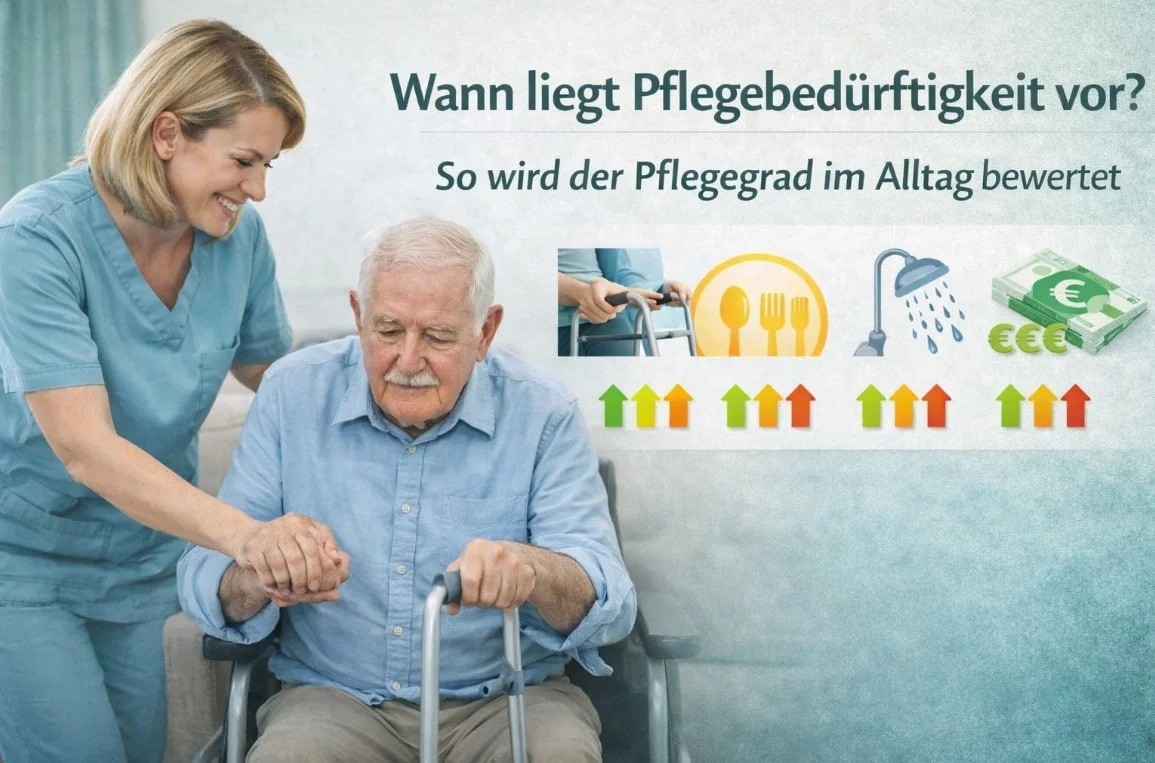
The care assessment is based on six key areas, each of which is weighted differently. These modules are designed to provide an overall picture of a person’s level of independence. It is therefore helpful to be familiar with these areas when completing the application. Not because relatives need to memorise the points system, but because it enables them to observe more specifically where help is actually needed.
| Section | What it’s all about | Typical examples from everyday life |
|---|---|---|
| Mobility | Physical mobility in everyday life | Getting up, moving from one place to another, climbing stairs, getting about in the home |
| Cognitive and communicative skills | Comprehension, memory, orientation, decision-making | Recognising people, understanding dates, assessing risks, following conversations |
| Behavioural patterns and mental health issues | Disturbing behaviours and psychological symptoms | Night-time restlessness, aggression, anxiety, wandering off, resistance to help |
| Self-care | Personal care, nutrition, getting dressed, using the toilet | Washing, showering, preparing or eating meals, managing incontinence |
| Dealing with requirements arising from illness or treatment | Medication, doctor’s appointments, therapies, treatments | Organising tablets, insulin, wound care, compression stockings, doctor’s appointments |
| Organising daily life and social contacts | Daily routine, activities, social participation | Day-night rhythm, planning, maintaining social contacts, meaningful activities |
The area of self-care is given particular emphasis. However, this does not mean that other limitations are unimportant. Cognitive and behavioural aspects can play a significant role, particularly in cases of dementia or mental health conditions. A person may still be physically able to walk, but may nevertheless be unable to live safely on their own because they fail to recognise dangers, take their medication incorrectly, leave the hob on or wander out of the flat at night, disoriented.
It is helpful for relatives to go through each area before the appointment. Where does the person need guidance? Where does someone need to take over? Where is a reminder sufficient, where is supervision necessary, and where is physical assistance required? The system distinguishes between independent, predominantly independent, predominantly dependent and dependent. These categories are important because even guidance and supervision can indicate a need for care. Care is not just about lifting, washing and carrying. Care often also involves planning, reminding, ensuring safety and constant support.
A common misconception is that if someone can still manage a task in some way, they do not need assistance. This is not true. The key factor is whether the activity can be carried out safely, completely, appropriately and without assistance from others. If someone can get dressed but puts their clothes on the wrong way round, chooses clothing unsuitable for the weather or needs an hour’s guidance, this is not the same as dressing independently. If someone can go to the toilet but forgets the way, needs help with dressing or personal hygiene, or is at regular risk of falling, this must be noted.
How points are converted into a care level
At the end of the assessment, an overall score is calculated based on the ratings for each individual area. This overall score determines the care level. Those affected do not need to calculate each weighting in detail. Nevertheless, a basic understanding is helpful, as it shows why small aids for everyday living across several areas can, when taken together, result in a significant need for care.
| Care level | Classification | Orientation |
|---|---|---|
| Care level 1 | Minimal impact on independence | Initial regular support, frequent advice, respite and improvements to the home environment are relevant |
| Care level 2 | Significant impairment of independence | Regular assistance with everyday tasks, entitlement to care allowance or care benefits in kind |
| Care level 3 | Severe impairment of independence | Significantly more extensive support, often involving several assistance visits a day |
| Care level 4 | Severe impairment of independence | Comprehensive support, significant physical or organisational strain |
| Care level 5 | Severe disability with specific requirements | Very high care needs with specific care requirements |
The assessment is not based on gut feeling. It follows a standardised assessment tool. Nevertheless, the quality of the assessment depends heavily on whether the actual limitations are apparent. Anyone who, out of pride, presents things in a better light during the appointment will skew the result. Giving specific examples makes it easier to arrive at a realistic assessment. The best way to prepare, therefore, is not to learn technical terms, but to observe everyday life closely.
A clear explanation is particularly important in the case of fluctuating conditions. Some people have good days and bad days. With conditions such as rheumatism, Parkinson’s disease, heart failure, dementia, depression, fatigue or neurological disorders, the need for assistance can vary greatly. In such cases, it is important to describe how often difficult periods occur, what activities are no longer possible during these times, and what support is required. An appointment on a good day must not obscure the full extent of the care needs.
The need for assistance at night is also relevant. Many relatives underestimate how much night-time support shapes the care situation. Anyone who gets up several times a night to help with going to the toilet, to reassure, to help the person find their bearings, to administer medication or to prevent the risk of a fall is providing care. This burden should be documented. The system favours daytime hours, but unfortunately care does not only take place between breakfast and dinner.
Which services become important following an application for a care level assessment
The care level forms the basis for benefits. Which specific benefits are appropriate depends on the care situation. Care provided at home by relatives differs from care provided by an outpatient service or a stay in a residential care home. Services are often combined. This is precisely why, once you have received the decision, it is worth not simply celebrating or lamenting the care level, but systematically planning your care.
When it comes to home care, the care allowance is crucial for many families. It is paid when care is organised independently, for example by relatives, friends or other private carers. Care benefits in kind can be used when an outpatient care service provides support. Both can be combined as a combined benefit. In addition, there is the respite allowance, which, under certain conditions, can be used for recognised services providing support with everyday tasks.
Other services may include day care, night care, short-term care, respite care, care aids, digital care applications, home modifications and home visits for advice. If you are moving to a home better suited to your care needs or making significant alterations to your living situation, it is worth taking a closer look at possible grants. The guide to care insurance and moving costs is a useful supplement for this.
Anyone wishing to compare care options should look beyond just the monthly costs. What really matters is what actually helps in everyday life. Care allowance can provide financial support for relatives, but it is no substitute for free time. Care services provide professional assistance, but do not cover every organisational gap. Day care can relieve the burden on relatives and provide a daily routine, but it is not suitable for everyone. Short-term care can be important following a hospital stay, but is often difficult to access. Welcome to the reality of care in Germany: entitlements on paper look good, but the actual availability of local services is the real litmus test.
Recommendation: Once your care level has been approved, you should make use of a care advisory service. This will help you not only to understand the services available, but also to combine them appropriately.
For the year 2026, amounts and types of benefits should always be checked to ensure they are up to date, as adjustments may be required by law. The internal Care Allowance Table 2026 provides a quick guide. It allows care allowance and key benefits to be better categorised according to care level.
Common mistakes when applying for a care level assessment
Many errors in care level applications do not stem from carelessness, but from shame, uncertainty or misplaced consideration. Those affected do not want to appear weaker, relatives do not want to cause offence, and everyone hopes that the assessor will somehow recognise what is going on. This hope is touching. Unfortunately, as a strategy, it is about as reliable as a paper umbrella.
Mistake 1: Applying too late
If you wait until care is no longer working, you’ll lose valuable time. The application should be submitted as soon as it becomes clear that long-term support is needed.
Error 2: Describing the best day
Many people affected appear particularly capable during their appointment. However, it is their typical day-to-day life that matters, not the exception fuelled by adrenaline.
Mistake 3: Not giving any examples
General statements such as ‘I’m not coping so well any more’ are of little help. Specific situations are better: falls, forgetting to take medication, help with washing, restlessness at night.
Mistake 4: Relatives are absent from the appointment
If those affected do not assess their limitations realistically or downplay them, people close to them must be able to provide additional information.
Mistake 5: Underestimating cognitive problems
The need for care is not just about physical assistance. Guidance, support, supervision and safety can be crucial.
Mistake 6: Not checking the notice
Even an approved care level may be too low. The assessment should be compared with the person’s actual day-to-day life.
Another mistake is confusing helpfulness with independence. When relatives organise everything, everyday life can sometimes appear stable to outsiders. Yet it is precisely this stability that is made possible by invisible care work. Anyone who sorts out medication, coordinates appointments, checks bills, prepares meals, reminds the person to look after their personal hygiene, eliminates the risk of falls or is constantly available by telephone is providing support. This help must be made visible within the process.
The living situation is also often not described in sufficient detail. Stairs, cramped bathrooms, a lack of grab rails, trip hazards or an unsuitable shower can increase the need for assistance. If the home can hardly be used safely without support, this should be mentioned during the appointment. Later on, measures to improve the home environment or even a move may come into play. Such issues should not be swept under the carpet simply because one would like to pretend that the home is already, in some way, accessible. Spoiler: A bathroom from the 1970s is rarely suitable for care needs, even if it’s bravely holding on to its tiles.
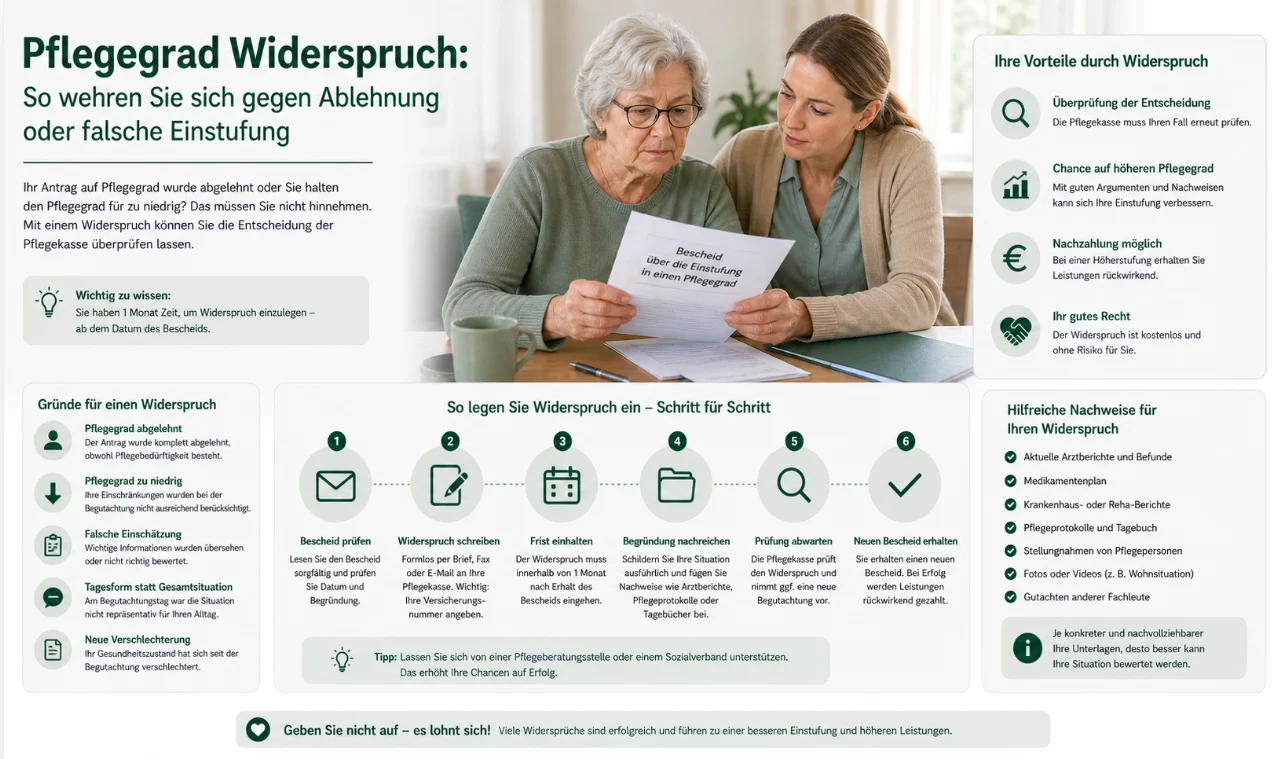
Appeal: What to do if your application is rejected or your care level is assessed as too low?
If your application for a care level is rejected or the assessment seems too low, this does not automatically mean the end of the matter. You can lodge an appeal against the decision. The deadline is usually one month from receipt of the decision. It is essential that you meet this deadline. Anyone who is not yet able to provide a detailed statement of grounds can initially lodge an appeal whilst meeting the deadline and submit the grounds at a later date.
The most important first step is to request and review the assessment report, if one is not already available. The assessment report shows which areas were assessed and how. Are the details correct? Have any relevant limitations been overlooked? Have assistive devices been categorised incorrectly? Have cognitive or mental health issues been underestimated? Was the assessment based on an unusually good day? It is precisely these points that are crucial for a well-founded appeal.
An objection should not simply state: ‘We do not agree.’ That is understandable, but weak. It is better to provide specific reasons based on the areas covered in the assessment report. Example: The report states that the person is largely able to wash themselves independently. In reality, they require daily guidance, physical assistance when getting in and out of the shower, support when washing their lower body, and supervision due to the risk of falling. Such comparisons make an appeal more convincing.
Support is available from care advice centres, social welfare organisations, consumer advice bureaux, care support centres or specialist legal advice services. Treating doctors can also provide supplementary reports if medical aspects are unclear. However, it is important to note that the appeal should describe everyday life. Medical diagnoses alone are no substitute for a description of the need for assistance.
A short template for a timely appeal
Sender’s
name, insurance
number, address
To the Long-Term Care Insurance Fund
, Address
Appeal against the decision of [date]
Dear Sir or Madam,
I hereby lodge an appeal against your decision of [date] within the prescribed time limit. I would ask you to send me the full care assessment report, should I not already have a copy. I shall submit a detailed statement of grounds once I have reviewed the report.
Yours faithfully
Sometimes an appeal is not necessary; instead, a new application or an application for a higher care level may be required, for example if the person’s condition has deteriorated significantly since the decision was made. The same applies here: document any changes, describe specific support needs, gather supporting documents and do not wait for months on end. Care needs are not static. They change, and the assessment must reflect the current situation.
Example: Submitting an informal application for a care level assessment
The initial application does not have to be complicated. An informal letter is sufficient to start the process. The long-term care insurance fund will then usually send further documents. It is important that the application is clearly worded and includes your insurance details.
Informal application for care services
First name Surname
Street House number
Postcode Town/city
Insurance number
To the Long-Term Care Insurance Fund at [Name of health insurance provider]
Address
Application for long-term care insurance benefits and assessment of a care level
Dear Sir or Madam,
I hereby apply for long-term care insurance benefits and the assessment of a care level. Please send me the necessary documents and arrange for the assessment to take place.
If you have any queries, please contact me on [telephone number/email].
Yours faithfully
[Signature]
If relatives are acting under a power of attorney, this should be stated and the power of attorney attached. Example: “I am submitting this application as the authorised representative of Mrs/Mr …”. Without a power of attorney, the health insurance fund may refuse to provide information on data protection grounds. Data protection is important, but in day-to-day care situations it sometimes feels like a gatekeeper standing in the way of assistance.
Checklist for applying for a care level assessment
This checklist helps you prepare your application and assessment in a structured way. It is not a substitute for professional advice, but it ensures that important points do not get lost in the chaos of everyday life.
Before applying
- Assess your need for assistance honestly
- Find out which long-term care insurance fund you are covered by
- Have your insurance number to hand
- Check the power of attorney
- Submit your application in writing or have it confirmed by telephone
Following the application
- Filling in forms for the long-term care insurance fund
- Make a note of the assessment appointment
- Involve a family member or carer
- Collect medical reports and medication plans
- Start a care diary
For assessment
- Describe a typical daily routine
- mention bad days and nights
- Documenting falls, risks and supervision
- Do not downplay cognitive impairments
- Give specific examples
Following the decision
- Check the decision and the expert report
- Comparing care levels with everyday life
- Planning services
- Use our advice service
- In the event of errors, consider lodging an appeal within the specified time limit
Special circumstances: dementia, hospitalisation, children and rapid deterioration
In practice, the impact of a care level application varies greatly depending on the individual’s circumstances. In the case of dementia, for example, physical assistance is not always the primary concern. Many people with dementia can walk, eat or wash themselves to some extent, but are not safe without guidance, monitoring and supervision. They forget meals, take medication twice or not at all, leave the home, fail to recognise dangers, react with fear or aggression, or lose their day-night rhythm. Relatives then provide care, even if they are not constantly offering physical support. It is precisely this form of care that is often underestimated, because it does not resemble traditional nursing care.
Following a stay in hospital or a period of rehabilitation, there is often particular time pressure. Discharge is imminent, but nothing has yet been arranged at home. In such cases, relatives should involve the social services department of the hospital or rehabilitation centre at an early stage. They can provide guidance on what support needs to be organised at short notice. The application for a care level should not be submitted only after several weeks at home, when everyone involved is already exhausted. Transitions are particularly risky: new medication, mobility issues, wounds, the need for assistive devices, the risk of falls and unclear responsibilities all come to bear on families who are suddenly expected to organise care as if they’d secretly completed a degree in administration.
Special criteria apply to children, as a child’s normal need for assistance must be distinguished from additional care-related needs. Parents should therefore document in particular detail what support goes beyond what is typical for a child of that age. This includes medical treatment, special supervision, therapies, nutrition, mobility, communication, behaviour or night-time care. Here, too, the diagnosis alone is not the deciding factor; rather, it is the specific burden and the actual need for support.
In the event of a rapid deterioration, there should be no hesitation. If a person who has already been assessed suddenly requires significantly more help, it may be advisable to apply for a higher care level. If no care level has yet been assigned, the initial application should be submitted immediately. Waiting is rarely a sensible course of action in such situations. It is usually just the hope that things will improve if you ignore the post from the long-term care insurance fund for a little while longer.
How to describe your care needs accurately
Many applications and assessments suffer from imprecise language. Relatives say: ‘Things aren’t going so well any more.’ Those affected say: ‘I sometimes need help.’ Such phrases are understandable, but too vague for the assessment. It is better to provide specific details: How often does someone need help? With which activities? Is a reminder sufficient, or is physical assistance required? What happens if no one helps? Is there a risk of falls, neglect, medication-related risks, malnutrition, social isolation or being overwhelmed?
Well-chosen phrasing links the activity, the limitation and the assistance provided. Example: “A carer must be present whilst showering, as the person cannot safely step into the shower and loses their balance whilst drying off.” Or: “Medication must be prepared and checked daily, as doses are sometimes forgotten and tablets are mixed up.” Or: “At night, the person needs help finding their way and being accompanied to the toilet several times, as they cannot find their way and have already fallen.” Such sentences are more helpful than general complaints.
Frequency is also important. A one-off fall should be assessed differently from repeated falls. An occasional reminder is different from daily guidance. A difficult week following an operation is different from a long-term condition. Therefore, details should be as specific as possible: daily, several times a day, at night, weekly, every time they go to the toilet, every time they take their medication, at every meal or when leaving the home.
The language should remain objective. Exaggerations are unhelpful. Downplaying the situation is detrimental. The aim is not to dramatise, but to be accurate. Describing one’s need for assistance precisely makes the assessor’s job easier and protects you from being categorised in a way that does not reflect your everyday life.
Frequently asked questions about applying for a care level assessment
How do I apply for a care level?
You submit the application to the long-term care insurance fund, which is part of your health insurance provider. An informal written application is sufficient to begin with. The long-term care insurance fund will then arrange for an assessment to be carried out.
Is a phone call to the long-term care insurance fund enough?
The application can often be initiated by telephone. However, for documentation purposes, it is advisable to provide written confirmation or to submit the application in writing directly.
Who assesses the need for care?
For those with statutory health insurance, the assessment is usually carried out by the Medical Service or other appointed assessors. For those with private health insurance, Medicproof is generally responsible.
What matters most during the assessment?
Independence in everyday life is crucial. Factors assessed include mobility, cognitive abilities, behaviour, self-care, medical requirements and daily routines.
Should relatives be present at the appointment?
Yes, if they are familiar with their daily routine. Relatives can provide important examples and prevent limitations from being downplayed out of embarrassment or habit.
What happens if the application is rejected?
As a rule, an appeal against the decision can be lodged within one month. To do so, the assessment report should be reviewed and the actual need for assistance described in detail.
Is it possible to apply for a higher assessment?
Yes. If a person’s state of health deteriorates or their need for care increases significantly, an application for a higher care level can be made.
What role does a care diary play?
A care diary helps to visualise regular support. It shows what help is needed, when, how often and for what reason.
Conclusion: Applying for a care level requires honesty, preparation and a clear understanding of everyday life
Applying for a care level is not a trivial administrative formality. It determines whether people in need of care and their relatives will have access to vital services. Those who submit their application early, document their need for care realistically and prepare for the assessment significantly improve their chances of receiving an appropriate care level.
The most important point is simple, but difficult to put into practice in everyday life: describe reality. Not the best day, not the polite version, not what feels less unpleasant. The need for care manifests itself in recurring limitations, in the constant organisational strain, in night-time assistance, in guidance, supervision, physical support and safety risks. It is precisely this that must be made visible.
Once the decision has been made, it should be reviewed and assessed in the context of everyday life. If the care level is appropriate, services can be planned. If it is not, an appeal may be lodged. The process is bureaucratic, sometimes tedious and rarely pleasant. But it is worth proceeding carefully, because ultimately it is not just the financial aspects that matter, but relief, security and a more dignified everyday life.