Assessing care needs correctly
The article explains when limitations in everyday life are considered to constitute a need for care, and why it is not individual ailments that count, but rather the overall picture of a person’s independence.
The actual need for assistance
The key factor is whether, and how regularly, support is required in key areas of daily life. It is precisely this that forms the basis for the care needs assessment.
Those affected and their relatives
Families in particular benefit from recognising early on when occasional assistance turns into a genuine care situation, and what factors are taken into account during the assessment.
What ‘needing care’ actually means
Needing care does not automatically mean that a person must be seriously ill, bedridden or completely helpless. It is precisely this misconception that persists with surprising tenacity. In fact, the issue is whether a person’s independence or abilities are so impaired by health reasons that they regularly require help, guidance, supervision or support in their daily lives. The need for care therefore does not begin at the very limits of one’s capabilities, but rather where daily life can no longer be managed adequately without reliable help.
This also helps to explain why the need for care is more than just a medical term. It does not describe a diagnosis, but rather an everyday situation. Two people with the same condition can be affected in completely different ways. One may only need help occasionally, whilst the other relies on support in several areas on a daily basis. The need for care cannot therefore be meaningfully deduced from medical findings or diagnoses alone, but only from the reality of everyday life.
For families in particular, this represents an important shift in perspective. For a long time, many people view initial limitations simply as normal changes associated with ageing, temporary weakness or unobtrusive assistance with everyday tasks. Yet the need for care has often long since begun, without it having been recognised as such. That is precisely why it is worth understanding the concept of needing care not in dramatic terms, but in a matter-of-fact and everyday way.
When is a person actually in need of care?
A person is generally considered to be in need of care if their independence or abilities are impaired due to health reasons and this limitation is expected to last for at least six months. The decisive factor is therefore not merely that help is required, but that this need is long-term rather than merely temporary. A period of acute weakness following an operation is therefore different from a condition that alters everyday life in the long term.
It is also important to note that assistance should not be provided merely on an occasional basis or for the sake of convenience, but because it is necessary due to genuine limitations. If someone regularly needs help getting up, getting dressed, eating, finding their way around, taking medication or organising their daily routine, they may be in need of care. It is precisely this regularity that makes the difference here. One-off assistance or occasional problems are usually not sufficient; the cumulative effect of long-term limitations, on the other hand, certainly is.
For relatives, this is often difficult to assess, as they have long since come to regard much of the help they provide as a matter of course. What began as occasional support gradually becomes routine. It is precisely this that makes it difficult to recognise when family support has turned into a genuine care situation. This is understandable from a human perspective, but unfortunately problematic for assessment purposes, because it is precisely this normalisation that obscures the view of the actual needs.
Why it is everyday life, not the diagnosis, that matters
A common mistake is to equate the need for care with a specific diagnosis. The thinking goes: a serious illness equals a need for care; a minor illness equals no need for care. But that is not how the assessment works. What matters is not how impressive a medical term sounds, but what impact the illness actually has on everyday life. Someone who, despite their diagnosis, still lives largely independently is assessed differently from someone who, despite having a seemingly less serious underlying condition, regularly needs support in many areas of their life.
This is precisely why the assessment focuses on independence and abilities. Can the person concerned move about safely, look after themselves, manage their medication independently, recognise dangers, organise their daily routine or react appropriately if they have difficulty finding their way around? These questions are usually far more indicative of the person’s needs than what is written in the doctor’s report.
This is particularly important in cases of dementia, mental health conditions or neurological changes. In such cases, the support required is often not primarily physical, but rather cognitive, emotional or organisational in nature. Anyone who fails to understand these differences can easily underestimate the level of care required. And unfortunately, this happens in families more often than anyone would care to admit.
What is actually taken into account when assessing the need for care
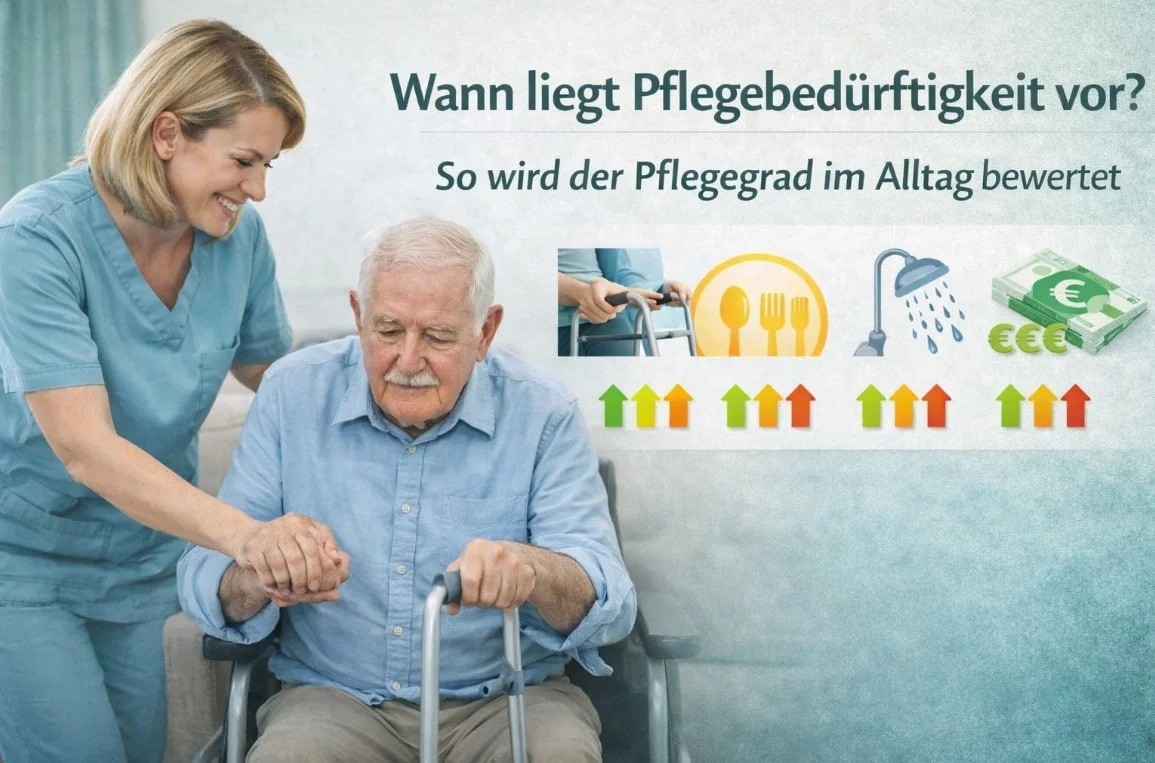
When assessing whether a person requires care, the focus is not on a single difficulty, but on several key areas of life. It is about the overall picture of independence. The assessment therefore focuses on how well a person can still manage their daily life independently and where long-term assistance is required. It is precisely this assessment that later forms the basis for classification into a care level.
Typical areas of assessment
- Mobility and getting about
- Personal care tasks such as washing, getting dressed and eating
- Dealing with requirements arising from illness
- Orientation and cognitive abilities
Also important
- Organising daily life and establishing a daily routine
- Communication and understanding
- Dealing with stress or behavioural issues
- Need for guidance or supervision
The crucial factor here is not whether help is needed on a one-off basis in a particular area, but how reliably independence can still be maintained. Is someone still theoretically capable of doing something, but in practice only on good days and only with great effort? Do they need to be regularly reminded, accompanied or supervised? It is precisely these differences that turn a general health issue into a care-related limitation.
The system therefore attempts to assess the need for care based on everyday life as it is actually lived. It isn’t always perfect, but the basic idea makes sense: it is not an external impression that matters, but rather the question of how stable and independent daily life still is.
Why it’s not just physical help that counts
When people think of the need for care, they often think first of physical assistance – such as help with walking, washing, getting dressed or moving from bed to an armchair. Whilst this is certainly part of it, it is by no means the whole picture. A need for care may also arise when the main issues lie in orientation, memory, structure, communication or behavioural control. It is precisely these forms of impairment that are often recognised late in everyday life, even though they can already be very stressful for relatives.
A person may still appear to be relatively mobile physically and yet be heavily reliant on help because they do not take their medication reliably, fail to recognise dangers, are unable to organise their daily routine, or experience considerable anxiety at night. This is precisely why it is wrong to judge the need for care solely on the basis of visible physical problems.
For families, this means that supervision, guidance, emotional support and constant reminders are also important forms of help. These often go more unnoticed in everyday life than physical care, but can be just as crucial to the care process. Anyone who overlooks this is underestimating not only the situation of the person affected, but also the strain they themselves face as a family member.
Common misconceptions about the need for care
One of the most common misconceptions is the assumption that a person only requires care when practically everything has to be taken care of for them. As a result, a significant proportion of real-life care situations are taken seriously far too late. Another mistake is to focus solely on individual difficult moments or, conversely, only on the good days. Both distort the picture. What matters is what everyday life is generally like.
Comparisons with other cases are also often misleading. Just because a neighbour with a similar diagnosis is still managing everything on her own, or a relative with a different condition already has a high care level, this says little about the specific situation. The need for care is not a one-size-fits-all situation. It arises from an individual’s everyday circumstances, not from the accounts of other people, who rarely know all the details anyway.
Another misconception lies in becoming accustomed to things. Families get used to receiving support and no longer even realise how much help is already needed. Anyone who reminds, organises, accompanies, monitors and ensures safety on a daily basis eventually comes to see this as normal. Whilst this normalisation is humanly understandable, it is unfortunately unhelpful when it comes to assessing the situation. This is because it often makes the actual need for care appear smaller than it actually is.
Common misconceptions
- The need for care only arises when a person is completely unable to look after themselves
- It’s only physical assistance that really counts
- Having the odd good day makes all the difference
- A diagnosis says it all
- Comparisons with other cases are reliable
What really matters
- regular need for assistance in everyday life
- including cognitive and mental health conditions
- the overall picture of independence
- long-term rather than just short-term strain
- An honest look at the realities of life
How the assessment fits into everyday life
When assessing the need for care, it is not about an abstract theoretical exercise, but about real-life everyday experiences. The assessment aims to establish what a person can still do independently, where they need support, and to what extent their daily life is already restricted overall. That is why it is so important for those affected and their relatives not just to list diagnoses, but to describe specific everyday situations.
It is helpful to consider in advance where problems regularly arise. Can the person get up safely on their own? Is help needed with personal hygiene? Are medicines taken reliably? Are there any difficulties around the home, with eating or with finding their way around? Does the daily routine need to be structured by someone else time and again? It is precisely these kinds of questions that highlight the differences relevant to care much more clearly than general phrases such as ‘it’s just getting more difficult’.
The assessment is therefore intended to reveal whether a need for care already exists and to what extent. A realistic description of everyday life provides the best basis for this. Conversely, those who downplay the difficulties – because some things still manage to work out somehow – often paint a picture that bears little resemblance to the actual care required. This is well-intentioned, but ultimately unpalatably expensive.
Why relatives play a key role when it comes to the question of care needs
Relatives are usually the first to notice how everyday life changes. They realise when support is needed more frequently, when uncertainties increase, or when small acts of assistance become established routines. This is precisely why they play a key role in assessing the need for care. Without their observations, much would remain unseen, as those affected may not fully realise or clearly articulate some of their own limitations.
At the same time, relatives are often the ones who downplay the burden for the longest. Not out of malice, but because help becomes quickly taken for granted in everyday family life. Those who provide daily reminders, support, safety and organisation eventually lose sight of the totality of these tasks. That is precisely why it is important to take a conscious look at the situation and ask not only what the person concerned can still do, but also what would regularly no longer be possible without support.
For families, therefore, the question of the need for care is not merely important from a legal or organisational perspective. It also helps them to view their own burden more realistically and to seek support before exhaustion has long since become the norm. This happens often enough in the day-to-day reality of caregiving anyway, without any need for additional romanticised idealisation of self-sacrifice.
Practical examples: When the need for care becomes apparent in everyday life
A typical example is an older person who still appears relatively mobile but regularly forgets to eat, take their medication or keep appointments. Without reminders and structure, everyday life can no longer be managed safely. From the outside, this often doesn’t look dramatic, but in day-to-day life, their independence is already significantly restricted. This is precisely where a need for care may arise, even if the person is not bedridden.
Another example is someone who can still manage to get dressed and move about the house with some difficulty, but who regularly needs help with showering, climbing stairs and organising their day. Here, too, it is not a single, dramatic limitation that is decisive, but the cumulative total of recurring support needs. It is precisely this cumulative total that constitutes the reality relevant to care.
Or one might be thinking of the progression of dementia, where initially only minor difficulties with orientation are noticeable. Later on, it becomes clear that supervision, guidance and constant support are becoming necessary. Everyday life does not change overnight, but gradually. This is precisely why the need for care is often recognised too late in such cases. Yet it has long been a reality, just not in the way that many people mistakenly associate with care.
Initial long-term support
Support is no longer needed just occasionally, but on a regular basis. This is often precisely where the relevant changes to daily life begin.
Several areas of life affected
When mobility, self-care, orientation or daily routine all become difficult at the same time, the need for support increases.
The burden on relatives is increasing
It is usually only when help needs to be organised, monitored and supported on a long-term basis that the care situation becomes clearly apparent.
Everyday life is no longer manageable on one’s own
It is precisely at this point that the need for care often becomes particularly apparent, even if it had been underestimated for a long time beforehand.
Checklist: How families can better recognise when a loved one needs care
These points help to assess the need for care more realistically:
Observing everyday life
- Where is help regularly needed?
- Which tasks can no longer be carried out safely on one’s own?
- Where is a reminder or supervision needed?
- Which daily routines can only be managed with support?
Taking stress seriously
- How much do relatives already organise?
- Which forms of assistance have become part of daily life?
- Where do stress, uncertainty or constant monitoring arise?
- How long-term is the situation?
Avoiding mistakes
- Don’t just focus on diagnoses
- Don’t just rate the good days
- Do not dwell on extreme images of care
- Don’t downplay the need for support out of habit
Frequently asked questions about the need for care
At what point is someone considered to be in need of care?
A person is considered to be in need of care if their independence or abilities are so limited due to health reasons that they require ongoing and regular support in their daily lives.
Is a diagnosis of the need for care sufficient?
No. It is not the diagnosis alone that is decisive, but rather the extent to which it actually affects daily life and independence.
Does a person have to be severely physically disabled to be considered in need of care?
No. Cognitive, mental or organisational limitations can also justify the need for care if they result in a regular need for assistance.
Why do families often realise too late that a loved one needs care?
Because many forms of assistance gradually become routine. Relatives get used to the support and often only realise at a late stage just how much their daily lives have come to depend on it.
What factors are given particular consideration in the assessment?
Above all, the extent to which a person is still able to manage independently in key areas of life, and where long-term help, guidance or supervision becomes necessary.
Is the need for care only relevant in very severe cases?
No. The need for care does not only arise when a person is completely helpless. Even long-term and noticeable limitations in everyday life can be relevant.
Conclusion: The need for care becomes apparent in everyday life, not just in extreme cases
The need for care does not only arise when a person can no longer manage anything independently. It is already present when health-related limitations permanently alter everyday life to such an extent that regular support becomes necessary. That is precisely why it is so important not to wait for dramatic images of care, but to take a sober look at the reality of everyday life.
This understanding is of enormous help to those affected and their relatives. It provides clarity on when support becomes not just helpful, but actually essential for care. Anyone who takes an honest look at everyday life usually recognises the need for care earlier and more realistically than someone who bases their judgement solely on diagnoses or extreme cases.
Ultimately, it is not how difficult something sounds that matters, but how reliably one can still maintain independence. Anyone who understands this has already taken the most important step. The rest remains complicated enough, like so much else in the care system, but at least it is no longer completely shrouded in mystery.