Explaining care levels in an accessible way
The article explains what a care level indicates, when a person is deemed to be in need of care, and why it is not the illness alone that is assessed, but rather the person’s actual level of independence in everyday life.
Differences and features
You will be given a clear overview of care levels 1 to 5, typical eligibility criteria and the benefits that may generally be associated with a particular care level.
Those affected and their families
Relatives, in particular, often need a clear understanding of the basics to help them make sense of applications, decisions and the actual need for support.
What a care level actually is
A care level describes the extent to which a person’s independence in everyday life is impaired. It is therefore not merely a formal classification, but a kind of condensed statement about how much support is required in daily life. This is precisely the key point: the care level is determined not only by an illness or diagnosis, but by the specific impact on everyday life.
Many people initially equate the term ‘care level’ with severe bedriddenness or complete helplessness. That is too narrow a view. Even minor but permanent limitations can be relevant if they noticeably impair independence in everyday life. For example, anyone who regularly needs help with finding their way around, personal hygiene, mobility or organising their daily routine may well fall within the care level system, even if the situation does not immediately appear dramatic to an outsider.
This is precisely why the care level is so important for those affected and their relatives. It forms the basis for determining which benefits under the care insurance scheme are generally available and how the need for support is officially categorised. Anyone wishing to understand the system should therefore not only be aware that care levels exist, but also what they actually represent.
When the criteria for a care level are met
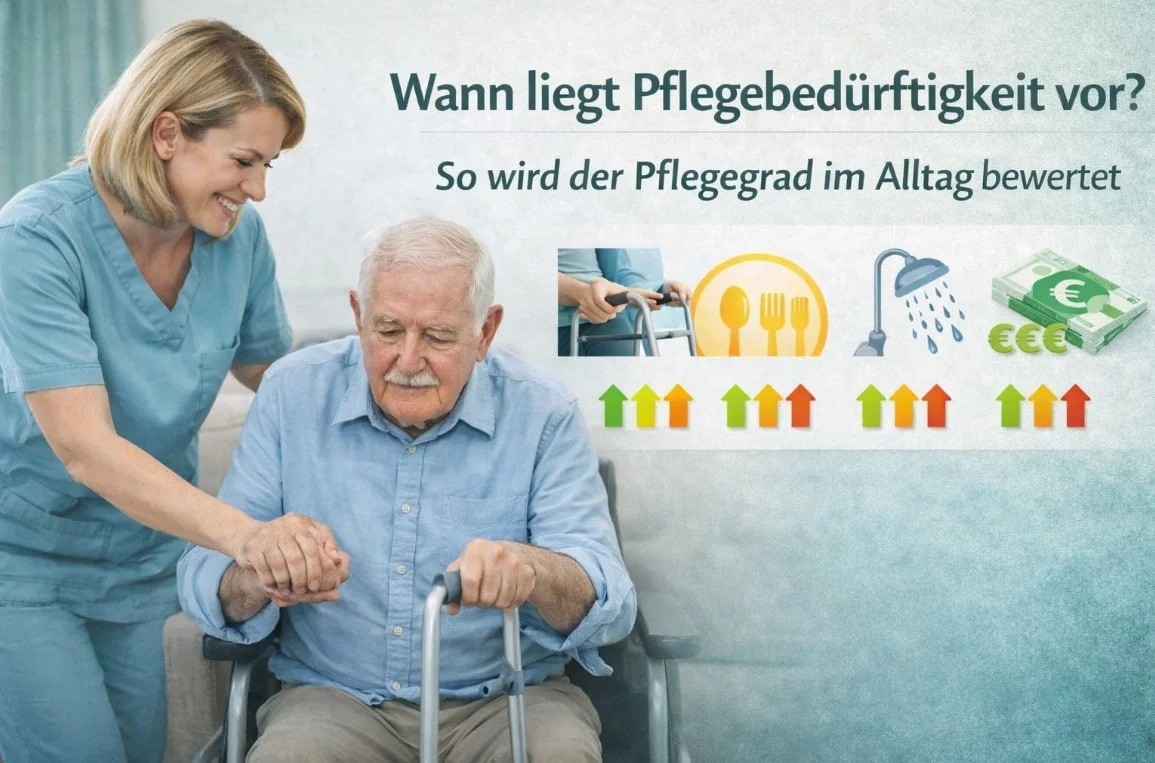
A care level is generally considered if a person’s independence or abilities are impaired due to health reasons and this condition is expected to last for at least six months. It is therefore not a question of a short-term period of weakness or temporary strain following an acute illness, but rather a long-term need for support.
It is important to note that these limitations must have a genuine impact on everyday life. Those who only require help occasionally do not usually meet the criteria. However, anyone who regularly needs assistance with getting up, getting dressed, eating, finding their way around, managing health-related needs or organising their day should have their situation assessed. This is often where the real problem begins: families become accustomed to forms of assistance that have long since become a matter of course, and as a result underestimate the actual need for care.
The eligibility criteria can be met in a wide variety of circumstances. This applies to older people as well as younger people with chronic illnesses, neurological conditions, mental health issues or dementia. The decisive factor is always the extent to which a person’s ability to live independently is already impaired.
Why everyday life is more important than the diagnosis when it comes to care levels
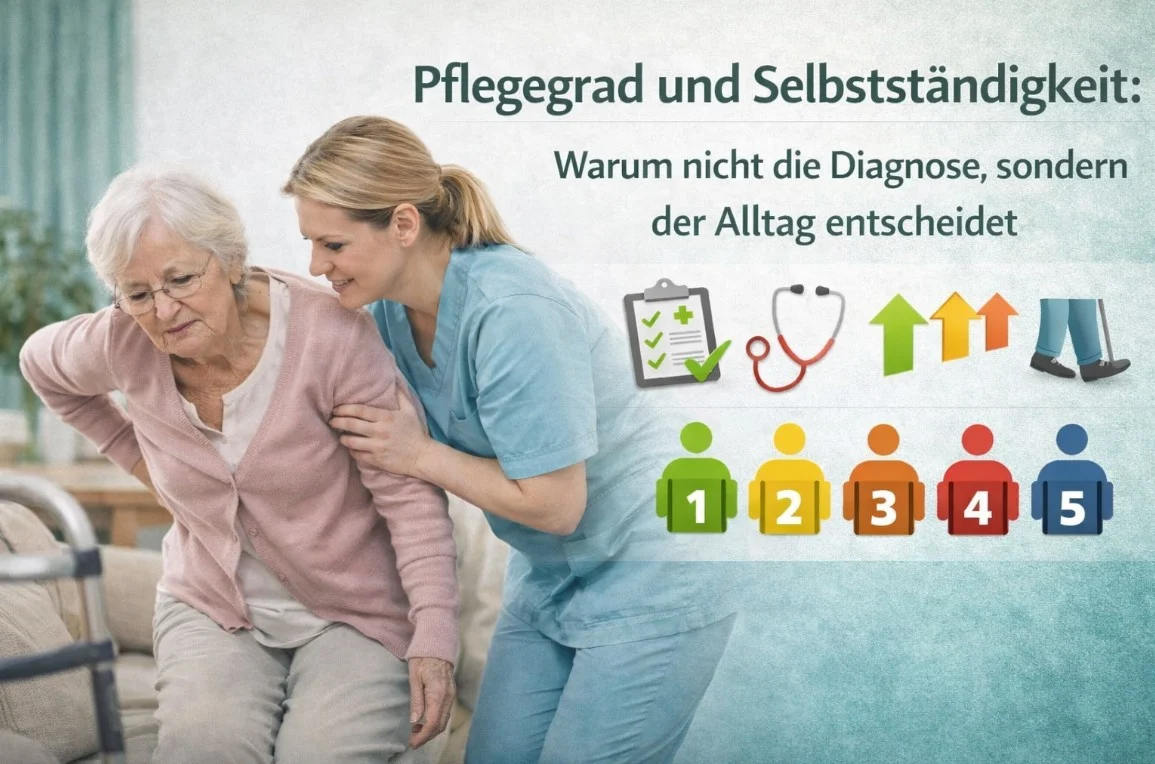
A particularly common misconception is to link the care level directly to an illness. The thinking goes: a serious diagnosis equals a high care level. However, that is not exactly how the assessment works. Two people with the same condition may cope very differently in everyday life. One may only need occasional help, whilst the other may be permanently restricted in several areas of life. The diagnosis may be the same, but their everyday circumstances are not.
That is why the assessment focuses not only on medical conditions, but above all on what the person can still manage independently in everyday life and what they cannot. Can the person eat, wash, get up, take medication, organise their day or assess risks correctly on their own? Do they need to be regularly reminded, guided, supervised or physically assisted? It is precisely these questions that are crucial.
This is particularly important in cases of dementia, mental health conditions or fluctuating courses of illness. It is precisely in these situations that it often becomes apparent that the need for support cannot be assessed solely on the basis of visible physical limitations. Anyone wishing to understand the care level must therefore look at the person’s everyday life and not just the doctor’s report.
A comparison of care levels 1 to 5
Care levels 1 to 5 represent different degrees of impairment. The higher the care level, the greater the recognised need for support. However, this does not mean that only high care levels are relevant. Even lower classifications can open up access to important benefits and make a real difference to families.
Care levels 1 and 2
This concerns minor to significant impairments to independence. Often, the focus is on initial or already clearly noticeable needs for assistance, which are regularly apparent in everyday life but do not necessarily persist round the clock.
Care levels 3 to 5
These care levels correspond to severe to the most severe impairments. The need for support becomes more extensive and complex, and usually has a significantly greater impact on everyday life.
| Care level | Classification | Typical meaning in everyday life |
|---|---|---|
| Care level 1 | minor impairment | initial needs for assistance, which are often still relatively limited but already noticeable |
| Care level 2 | significant impairment | Regular support in a range of everyday situations |
| Care level 3 | severe impairment | a significantly increased need for support, with a noticeable impact on daily life |
| Care level 4 | most severe impairment | Comprehensive support in many areas of daily life |
| Care level 5 | Severe disability with specific requirements | a very high level of care needs, usually requiring close support |
The table illustrates the basic principle. In reality, however, it always depends on the individual case. Care levels are not ‘pigeonholes’ for perfect, textbook cases, but rather an attempt to translate very different everyday situations into an assessment system. Sometimes this works better, sometimes less elegantly, but that is precisely why a solid basic understanding is so important.
What services may generally be associated with a care level
An officially recognised care level is often a prerequisite for being able to access care insurance benefits at all. The specific benefits available depend on the individual care level and the particular care situation. These may include, for example, care allowance, care benefits in kind, respite care allowance, care aids, grants for home adaptations, respite care or short-term care.
For many families, it is crucial that the care level is not merely symbolic. In practical terms, it determines what support is financially viable or organisationally accessible. Those who do not have a suitable care level, or who are assessed as having a level that is too low, often notice this very directly through a lack of relief or through services that cannot be utilised to the extent required.
At the same time, no one should view the care level solely as a means of accessing financial benefits. It forms part of a care provision framework. What makes sense is not automatically the maximum that is formally possible, but rather what genuinely provides relief and stability in everyday life.
How the care level assessment is carried out
As a rule, the care level is not determined on the basis of documentation or personal gut feeling, but on the basis of an assessment. This assessment examines the extent to which the person concerned is still able to function independently in various areas of daily life. It is therefore a structured evaluation of their actual living situation.
Among other things, the assessment looks at mobility, the ability to look after oneself, cognitive and communicative abilities, requirements arising from illness, and the organisation of daily life. This ultimately results in an overall assessment, from which the relevant care level is determined. This is precisely why it is so important, when preparing for the assessment, to describe daily life realistically and not to sugar-coat it.
Many families make the mistake here of emphasising only the good days or the abilities that are still present. This is only human, but it can easily lead to a distorted picture. To ensure an accurate assessment, it must be clear where help is regularly needed, not just what can still be managed occasionally with some effort.
Common misconceptions about care levels
There are a surprising number of oversimplified ideas circulating about care levels. Some people believe the issue only becomes relevant when a person can hardly manage anything for themselves anymore. Others equate the care level with age or believe that a particular diagnosis must automatically result in a specific classification. It is precisely these oversimplifications that often lead to applications being submitted too late or situations being misjudged.
Common misconceptions
- A diagnosis is automatically sufficient
- Care levels apply only to very severe cases
- It’s only physical assistance that really counts
- Minor, routine assistance is not relevant
- A one-off decision will always remain appropriate
What really matters is
- Practical independence in everyday life
- a regular and long-term need for assistance
- including cognitive and mental health conditions
- the sum of many small acts of support
- a realistic reassessment in the event of changes
Why the topic of care levels is particularly important for relatives
In many families, it is relatives who first notice changes, organise help, initiate applications and accompany the person concerned to appointments. That is why they, in particular, need a good understanding of what a care level means and what is important when it comes to assessment. Without this knowledge, the need for support is often downplayed or unnecessarily delayed.
Relatives often already shoulder a significant part of the care burden before there is even any official talk of a need for care. Anyone who regularly reminds, accompanies, supervises, organises or provides physical support is often already living in a care situation, even if this is not immediately recognised as such in everyday family life. This is precisely why a basic understanding is so important. It provides guidance before feeling overwhelmed becomes the norm.
For relatives, therefore, the care level is not merely an administrative matter. It helps to identify the burden more realistically, to understand what entitlements are available, and to ensure that everyday life is not based solely on improvisation. There is already more than enough of that in day-to-day care anyway.
Checklist: What families need to bear in mind regarding care levels
Anyone wishing to gain a better understanding of care levels should bear the following points in mind:
Clarifying the basics
- It’s not the diagnosis that counts, but everyday life
- Even small, regular forms of assistance are important
- Care levels 1 to 5 reflect different degrees of care needs
- The assessment affects the benefits
Observing everyday life
- In which situations is help regularly needed?
- When is supervision or guidance required?
- Which tasks can no longer be carried out safely on one’s own?
- What burden are relatives already bearing?
Putting things into perspective
- Don’t sugar-coat it
- Don’t just focus on the good days
- Taking changes seriously
- Assess the need for support at an early stage
Frequently asked questions about care levels
What does a care level actually mean?
A care level describes the extent to which a person’s independence in everyday life is impaired and how great their resulting need for support is estimated to be.
Does a serious diagnosis automatically qualify someone for a care level?
No. It is not the diagnosis alone that is decisive, but rather the extent to which health limitations affect everyday life and independence.
What is the difference between care level 1 and care level 5?
The care levels represent different degrees of impairment. Care level 1 indicates a lower degree of impairment, whilst care level 5 indicates the most severe impairment with a very high need for support.
Are care levels only relevant for older people?
No. Younger people with chronic illnesses, neurological conditions, mental health issues or other long-term disabilities may also be eligible for a care level.
Why is this topic so important for relatives?
This is because relatives often provide support for a long time before the situation is officially recognised as requiring care. A good understanding helps to assess the needs realistically and take the appropriate steps.
What is the most common misconception regarding care levels?
It is often assumed that the care level is determined directly by the diagnosis. In fact, the decisive factor is the extent to which daily life is already characterised by a need for assistance.
Conclusion: You can only truly understand care levels if you take everyday life seriously
A care level is not just an abstract number, nor is it a purely medical assessment. It describes the extent to which a person relies on support in their everyday life and what consequences this may have for their care and benefits. This is precisely why it is not enough to simply have diagnoses or stereotypes about ageing in mind. What matters is a person’s actual level of independence in daily life.
Anyone who understands the differences between care levels 1 to 5, the eligibility criteria and the basic logic behind the classification system will be able to make much better sense of applications, decisions and care needs. This helps both those affected and their relatives, because it turns uncertainty into something that is all too rare in day-to-day care: clarity.
Ultimately, it’s not about sugar-coating the system. It remains complicated enough as it is. But anyone who understands how care levels are designed is in a much better position to assess their own situation realistically and ensure they don’t miss out on necessary support unnecessarily.