
Skip to content
Figures for 2026 audited · Free calculators · Care providers in your area Assess care needs in 5 minutesMy Care CentreDeutsch

Accessibility · Improving the home environment · Ensuring mobility

Ramps for barrier-free access

Ramps are among the best-known solutions for accessible entry. They can bridge thresholds, individual steps and minor differences in level, thereby making it much easier to access the house, the patio or the interior. However, it is crucial that the length, gradient, width and manoeuvring space are suited to the actual intended use.

For thresholds and a few steps, ramps are particularly suitable where the difference in height is manageable and there is sufficient space.
Suitable for indoor and outdoor use. Depending on the material and design, ramps are suitable for main entrances, side entrances, patios or passageways within the home.
Safety is key: the gradient, surface, drainage, handrails and landings all determine whether a ramp is practical for everyday use.
Ramps for barrier-free access

Accessibility Configurator

Find the right quote in just a few steps

Please describe the access point in question, the existing barrier and how it is used in everyday life. This information will help us to assess whether a ramp, stairlift or entrance modification is appropriate.

Planning for accessibility : Systematically record key details regarding access, height, care level and usage.
Step 1 / 5

Step 1

Which solution is most suitable?

When a ramp is a good idea

A ramp is particularly useful when the height to be overcome is small and there is sufficient space to ensure a gentle gradient. This often applies to door thresholds, single entrance steps, access to the patio or short distances indoors. For rollator users, even a small threshold can make a significant difference if it is properly adapted.

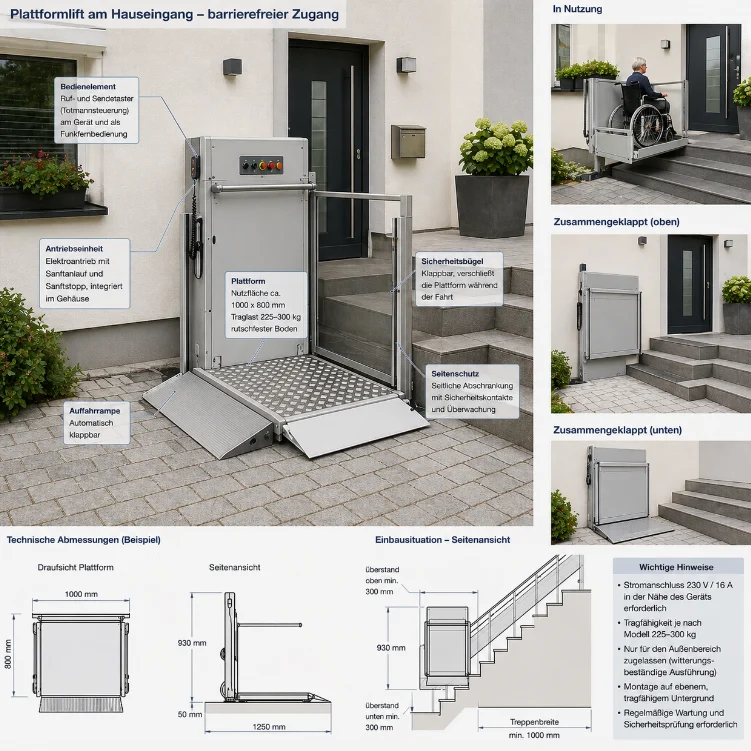
The higher the barrier, the longer a practical ramp needs to be. If there is not enough space for this, the result is often a solution that is too steep and difficult to negotiate with a wheelchair or walking frame. In such cases, it is worth considering whether a platform lift or structural alterations to the entrance area would be more suitable.
What to bear in mind when planning and making enquiries

When assessing the need for a ramp, the height of the step or threshold, the available space, the intended use and the installation location are key factors. For outdoor installations, additional factors to consider include weather conditions, slip resistance, drainage and secure fixing. For access points used on a permanent basis, the ramp should not only be technically feasible, but also comfortable and safe to use.

It is helpful to provide details on whether access is mainly by wheelchair, walker, walking frame or on foot. Photos and approximate measurements of the entrance area also make it easier to assess the situation later on.

Ramp at the front door Ramp at the front door
Making external access barrier-free Making external access barrier-free
Check the landing and the space required for movement Check the landing and the space required for movement

Benefits of well-designed ramps

  • Suitable for thresholds, single steps and minor changes in level
  • Can rollators, wheelchairs and walking aids make access easier?
  • Often quicker to implement than major structural alterations
  • May form part of a home improvement scheme eligible for funding

This information will help with the assessment

  • State the approximate height of the threshold or step
  • Describe the space in front of and behind the entrance
  • Specify indoor or outdoor use
  • Specify whether the user requires a wheelchair, rollator or walking frame

Enquire about accessible access points

A ramp is only the right solution if it remains safe and convenient to use

Please describe the existing obstacle as specifically as possible. This will help us to assess whether a ramp is sufficient or whether another solution would be more suitable for ensuring barrier-free access.

Go to the configurator

Did you know?

  • … that care allowance continues to be paid for four weeks in the event of a hospital stay.
  • … that family carers are entitled to pension points under certain conditions.
  • … that an application for a care level can also be made by telephone.

This page was translated automatically with DeepL. If in doubt, the German version applies.

Check care levelCalculate care allowance