Towards genuine independence
The care level is not determined by the diagnosis alone, but by the extent to which a person is restricted in their daily life.
Covering several areas of life
Mobility, self-care, orientation, behaviour, therapy requirements and daily routines are all taken into account in the assessment.
Care level does not mean severity of illness
A serious illness does not automatically result in a high level of care needs. What matters are the consequences in everyday life.
The basic principle: care levels assess independence, not the illness itself
The key principle behind today’s care assessment is essentially simple, but is constantly misunderstood in everyday life: the primary focus is not on identifying the specific illness, but on assessing the extent to which that illness or disability impairs the person’s ability to live independently. Consequently, the focus is not on the medical diagnosis, but on the actual life of the person concerned.
This is precisely why two people with the same diagnosis may be assigned different levels of care. One person may still manage relatively independently with the help of aids, established habits and stable routines. The other may need daily support, guidance or supervision in several areas. The diagnosis is therefore only the starting point. What matters is its practical impact.
For relatives, this is often an important ‘aha’ moment. This is because many initially think in medical terms: How serious is the condition? What treatment is being given? What medical reports are available? None of this is unimportant. However, when it comes to care assessment, what matters most is what the person can still manage on their own in everyday life and where they regularly need help.
What is not the sole determining factor for the care level
Many families go into the appointment with assumptions that are understandable but lead them down the wrong path. These include the idea that advanced age automatically results in a high level of care needs. This is not the case either. Age may be accompanied by limitations, but it is not an assessment criterion in its own right.
Similarly, a single diagnosis is not automatically sufficient. Even a serious illness does not necessarily lead to a high care level if the person concerned is still able to manage many aspects of daily life independently. Conversely, cognitive or mental impairments can result in a significant need for assistance, even though no dramatic physical impairment is visible to the outside world.
Important: Neither age nor diagnosis nor a single impression gained during an appointment is sufficient on its own to determine the level of care required. The overall picture of a person’s everyday independence is always the decisive factor.
Nor should the question of whether someone appears particularly brave, polite or well-adjusted actually determine the assessment. This is a common misconception within families. Many people in need of care try to appear as resilient as possible during appointments. Relatives, out of shame or habit, downplay the need for help. Both can create a distorted picture if everyday life is not clearly described.
Why independence is the very essence of the assessment
The term ‘independence’ may sound simple at first, but it is central to the care needs assessment. It refers to whether a person can carry out, understand and control certain actions independently, and reliably incorporate them into their daily routine. It is therefore not just a question of whether something is still theoretically possible, but whether it works in practice and on a regular basis.
It is precisely at this point that assessments often differ. Some activities can still be carried out to some extent, but no longer safely or without guidance. Other tasks can only be managed if someone is there in the background to prepare, remind, provide support or step in. This, too, is no longer complete independence.
For families, this means that the need for help does not only arise when someone can no longer manage anything on their own. Even regular guidance, supervision, encouragement or organisation can indicate that independence is significantly limited. This is particularly important in cases of dementia, mental health issues or chronic illnesses.
Which criteria are assessed during the assessment
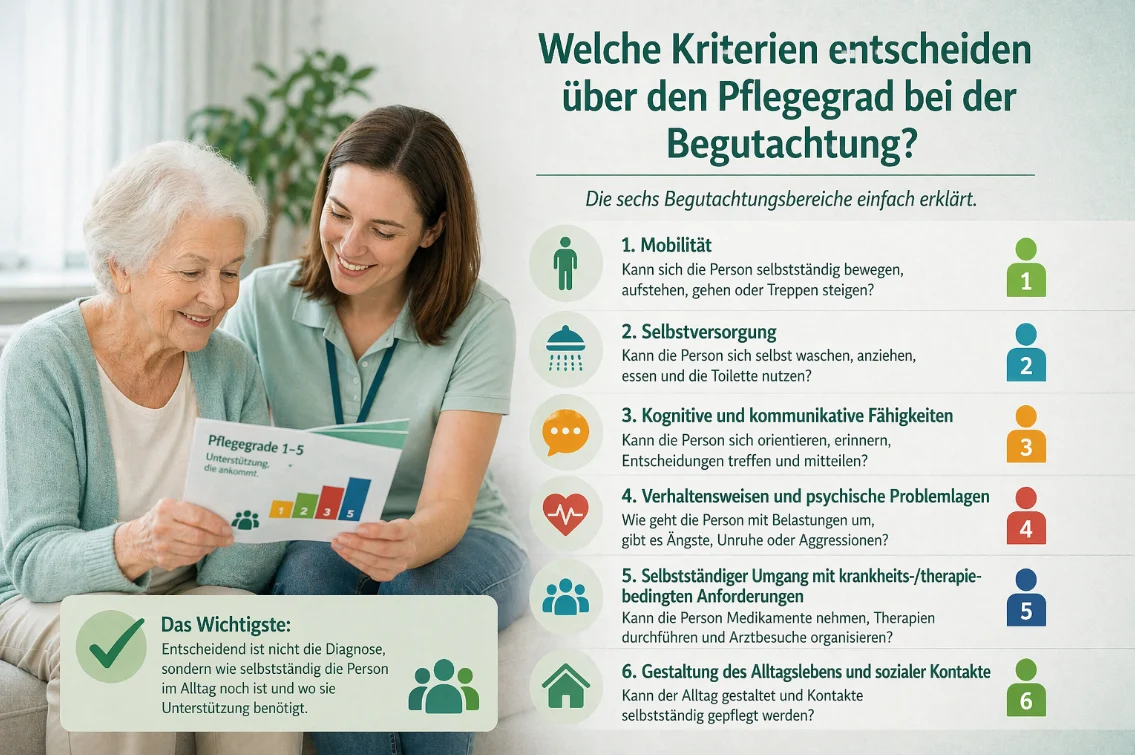
The care level is not determined on the basis of a single impression, but rather by taking into account several areas of life. Together, these areas provide a picture of a person’s level of independence. If one focuses solely on physical assistance, one can easily overlook a large part of what is actually being assessed.
| Criteria section | What it’s all about | Typical everyday questions |
|---|---|---|
| Mobility | Mobility and changing position | Can the person get up, move around, walk or manage stairs unaided? |
| Cognitive and communicative skills | Comprehension, memory, orientation, communication | Is the person able to orientate themselves in terms of time and place? Can they communicate their needs and problems? |
| Behavioural patterns and mental health issues | Restlessness, anxiety, aggression, night-time disturbances | Is there a frequent need for supervision, or are there any problematic behavioural patterns? |
| Self-care | Personal care, eating, drinking, getting dressed, using the toilet | What can they still do independently, what can they only do with help, and what can they no longer do at all? |
| Dealing with requirements arising from illness or treatment | Medicines, dressings, assistive devices, medical organisation | Is the person able to carry out treatments, take measurements or administer medication independently? |
| Organising daily life and social contacts | Daily routine, activities, social integration | Can the day be organised sensibly and arranged independently? |
These areas show that the need for care involves more than just physical frailty. It is precisely when people are still able to walk or speak, but can no longer manage their daily lives safely without help, that the significance of the other criteria often only becomes apparent at second glance.
Why not give equal weighting to all criteria areas?
Another important point is that not every aspect of daily life is given equal weight in the overall assessment. The assessment brings together various observations and evaluations and weights them accordingly. This means that not every limitation automatically has the same impact on the subsequent care level.
For relatives, it is particularly important to understand that the care level is determined by the overall picture. There is little point in emphasising just one particularly burdensome aspect whilst omitting other limitations. Conversely, a multitude of seemingly minor forms of assistance can, when taken together, paint a very clear picture. In practice, it is often the combination of physical, cognitive and organisational limitations that proves decisive.
Key point: The care level is not determined by a single difficulty, but by an overall assessment of various areas of life and the extent to which a person’s independence is limited.
What forms of assistance are taken into account during the assessment
Many people almost automatically associate care with direct physical assistance. This is understandable, but it does not tell the whole story. Various forms of assistance play a role in the assessment process. These include not only carrying out a task entirely on the person’s behalf, but also providing guidance, reminders, supervision, motivation and organisation.
It is precisely in the day-to-day lives of relatives that these forms of support can quickly become blurred. Anyone who reminds a loved one to take their medication every day, prepares meals, ensures they drink enough, provides guidance, defuses conflicts or organises appointments is often providing far more care support than they initially realise.
Immediate help
This includes, for example, assistance with washing, getting dressed, using the toilet, getting up, eating or walking. Such forms of assistance are visible and are therefore usually mentioned more readily.
Indirect help
These include reminders, guidance, supervision, structuring the day, motivation and ensuring safety in risky situations. This support is often less obvious, but can be very significant.
This indirect support is often crucial, particularly in cases of dementia, mental health issues or chronic illnesses with a fluctuating course. Those who focus solely on physical care tasks often fail to provide a complete picture of what daily life is actually like.
Common misconceptions about which criteria really matter
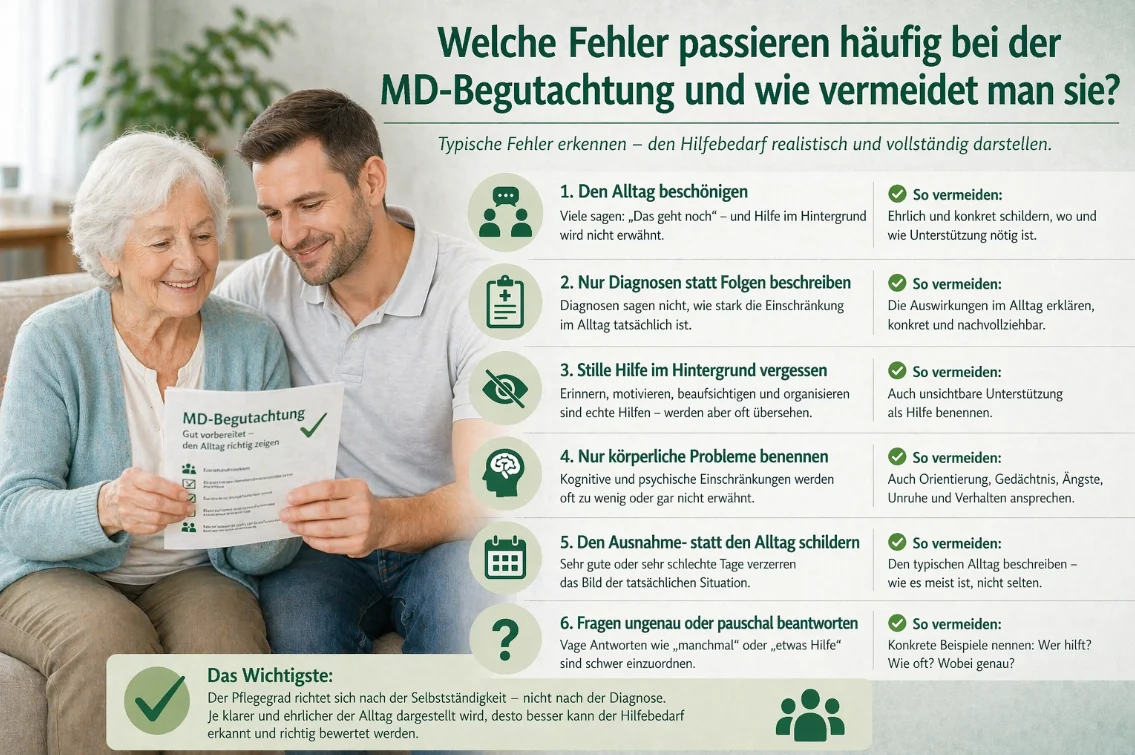
A common mistake is to focus on diagnoses rather than on the consequences. For example, families tend to mention the specific condition but do not explain in sufficient detail which aspects of daily life are no longer functioning reliably as a result. Another mistake is to downplay the need for assistance because many things have long since become routine.
Equally problematic is the assumption that a person must be completely dependent before a relevant care level can be considered. In fact, reduced independence often begins much earlier. Even recurring guidance, supervision or organisation can indicate that the person concerned can no longer manage their daily life safely without support.
A common misconception: “It’s still manageable, somehow.” In many families, things only seem to work out because relatives are doing a great deal behind the scenes to make up for it. It is precisely this that must be taken into account when assessing the situation.
Practical examples: Why similar conditions can lead to different levels of care
A person with a neurological condition may be significantly physically impaired, but may still be able to organise their daily routine effectively, use assistive devices safely and manage their medication independently. Another person with the same diagnosis, however, may require constant guidance in several areas, regular assistance with personal care and supervision due to difficulties with orientation. Despite having the same diagnosis, the care situation can therefore vary considerably.
Another example relates to cognitive impairments. Outwardly, a person may appear friendly, mobile and still relatively confident in their speech. In everyday life, however, they forget to eat, drink, take their medication and keep appointments; they sometimes lose their bearings and require ongoing support. Anyone who judges solely on first impressions will quickly underestimate the situation. Anyone who understands the assessment criteria will recognise why independence may nevertheless be significantly limited.
These examples make it clear: the care level is not an abstract score for an illness. It reflects the extent to which a person’s ability to cope with everyday life is affected.
Checklist: How to better understand the criteria for care levels
Things to bear in mind
- Don’t just list diagnoses
- Describe the practical implications in everyday life
- also take indirect support into account
- Make the regular instructions visible
What is often overlooked
- cognitive impairments
- night-time restlessness
- lack of daily routine
- Arrangements made by relatives behind the scenes
What the care level is not
- not purely a measure of the severity of an illness
- No mention of age
- No judgement based on personal preference
- No snapshots without a connection to everyday life
Frequently asked questions about the criteria for care levels
Does the diagnosis directly determine the care level?
No. Medical diagnoses are important, but the care level is determined by the extent to which a person’s independence in everyday life is actually restricted.
Do only physical limitations count?
No. Cognitive difficulties, mental health issues, the need for supervision and difficulties with organising daily life also play an important role.
Is advanced age a criterion in its own right?
No. Age alone does not determine a care level. The decisive factor is always the specific need for support in daily life.
Is help in the form of reminders or guidance also taken into account?
Yes. Support is not limited to physical assistance. Guidance, supervision, motivation and providing structure can also be relevant to care.
Why are people with the same condition assigned different levels of care?
This is because illnesses can have very different effects on everyday life. What matters is not the name of the condition, but the actual impact on a person’s independence.
Why do families often underestimate the need for help?
Because many forms of support in everyday life become routine. Things that are taken care of as a matter of course each day eventually come to be taken for granted, even though they are a clear indication of reduced independence.
Conclusion: It is the impact on everyday life that determines the care level, not the buzzwords in the assessment report
Anyone wishing to understand the criteria that determine the care level must shift their focus from the diagnosis to everyday independence. That is precisely where the core of the assessment lies. The assessment does not focus on how serious a condition sounds, but on how much it actually affects a person’s life.
That is why several aspects of life are taken into account in the assessment. Physical aids are important, but they are not the only criterion. Orientation, behaviour, psychological stress, responsiveness to therapy and daily routine also play a part. Only by taking a holistic view can a realistic picture be formed.
For relatives, the most important insight is therefore often a very practical one: rather than talking abstractly about illnesses, focus specifically on what still works in everyday life and where regular help is needed. This is precisely where the criteria for the care level become apparent.