In a nutshell
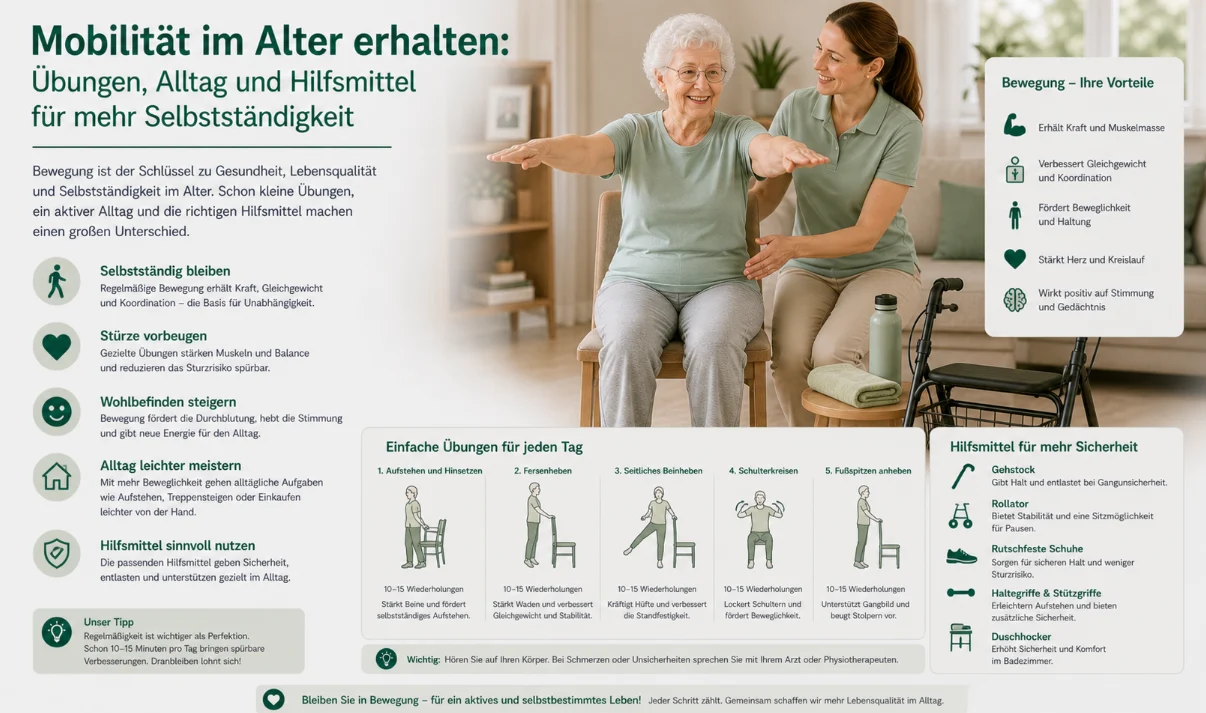
Mobility is best maintained in old age when exercise is regular, relevant to everyday life and safe. Key factors include strength, balance, stamina, suitable aids and a home that does not hinder movement.
Important for everyday life
Small daily activities are often more effective than infrequent, grand resolutions: getting up, walking, consciously using the stairs, taking short walks, doing light exercises and actively participating in care routines.
Tagline
Mobility rarely disappears overnight. It is usually lost in small steps. That is precisely why it must also be maintained in small, regular steps.
Why mobility is so important in old age
Mobility is more than just the ability to walk from one room to another. It is the foundation for independence, social interaction, personal hygiene, managing the home, safety and quality of life. Those who can move about safely have greater control over their own lives: when they get up, when they go to the toilet, whether they use the garden, whether they receive visitors or whether a short walk is possible. When mobility is lost, everyday life becomes more restricted. First, journeys are avoided, then activities, and later entire areas of life.
The loss of mobility affects more than just the body. It also alters one’s self-image. Many people find it humiliating when they suddenly need help getting up, walking or climbing stairs. Relatives, on the other hand, often focus primarily on the risks: falls, unsteadiness, being overwhelmed. This creates a tension between independence and safety. Effective support for mobility aims to reconcile these two aspects: as much independent activity as possible, and as much protection as necessary.
Physical activity also has an impact on many aspects of health. It supports muscles, joints, circulation, balance, digestion, sleep, mood and mental activity. People who are less active lose strength more quickly. Those with less strength move even less. This creates a vicious circle that begins insidiously quietly and eventually makes itself felt very loudly in everyday life. It’s remarkable how the body sometimes hands in its notice in instalments.
Maintaining mobility therefore does not mean pushing older people to achieve peak athletic performance. It means making use of existing abilities, enabling movement safely and avoiding inactivity. The benchmark is not the gym, but everyday life: getting out of bed safely, standing steadily, covering short distances, washing oneself, carrying out small tasks, leaving the home and maintaining confidence in one’s own body.
Important: New or severe pain, sudden weakness, dizziness, falls, shortness of breath or noticeable changes in gait should be investigated by a doctor before increasing the level of exercise or physical activity.
Why physical activity is often lost gradually
A loss of mobility often begins in an unremarkable way. Walks become shorter, the stairs are taken more slowly, shopping trips are put off, the garden is left untended, and the armchair is used more often. Relatives initially perceive this as a normal part of ageing. That may be partly true, but it does not explain everything. It is often a combination of loss of strength, fear, pain, an unsuitable environment, a lack of motivation and taking it too easy.
Taking it easy seems sensible in the short term. If your knee hurts, you walk less. If the stairs make you anxious, you stay downstairs. If the journey to the toilet feels unsafe, you wait longer. This reduces stress in the short term, but in the long run leads to less physical activity. Muscles atrophy, balance deteriorates and stamina declines. As a result, the same journeys become even more difficult. The rest, which was intended to protect you, actually exacerbates the problem.
Relatives sometimes contribute to this unintentionally. Out of concern, they take on too much: they fetch every glass of water, rush to help when someone is getting up, bring everything to the armchair, and run every little errand. This is done with the best of intentions, but it can reduce a person’s ability to do things for themselves. Help should support, not replace. The difference may seem subtle, but in everyday life it makes a huge difference.
Another factor is the home itself. Narrow corridors, loose carpets, poor lighting, a lack of handrails or an armchair that is too low make moving around difficult and risky. In such cases, the person does not move around less because they do not want to, but because their surroundings make every step more complicated. Homes are sometimes very adept at passively-aggressively sabotaging mobility.
| Cause | How it reduces mobility | What can help |
|---|---|---|
| Loss of strength | Getting up, climbing stairs and walking longer distances are becoming more difficult | light strengthening exercises, active movement in daily life, physiotherapy |
| Fear of falling | Physical activity is avoided, trust declines | safe environment, support, balance training, assistive devices |
| Pain | Postural strain and inactivity are on the rise | medical assessment, tailored exercise, pain management |
| Too much help | Independence is unintentionally reduced | Help only where necessary; encourage active participation |
| Unsafe home | Journeys can seem dangerous or tiring | Remove trip hazards, improve lighting, use handrails |
Assessing mobility realistically
Before relatives suggest exercises or purchase assistive devices, the person’s current mobility should be realistically assessed. This is not about a medical diagnosis, but rather practical observation: What can they still do safely? What can they only do with difficulty? Which movements do they avoid? Where does anxiety arise? Which routes are important for everyday life?
It is helpful to consider key situations: getting out of bed, standing up from an armchair, walking around the home, using the toilet, showering, climbing stairs, putting on shoes, short walks outside, and getting in and out of the car. Each of these situations reveals something about strength, mobility, balance and self-confidence. If several of these areas become difficult, support should be organised at an early stage.
It is important to ask not just about ability, but about safety. Someone may still be able to manage a flight of stairs, but only with fear, pauses and by holding on tightly. Someone may still be able to walk, but only if there are no thresholds. Someone may be able to stand up, but only with a swing of the body and a wobbly stance. That is not stable, but rather a precursor to problems, relying on a bit of luck as a safety measure.
If there is significant uncertainty, a physiotherapy assessment may be advisable. Your GP, a care adviser or an assistive technology adviser can also help. The earlier mobility problems are identified, the better one’s abilities can be maintained. Waiting until someone is no longer able to get up at all is a surprisingly common, but truly poor, strategy.
Good signs
- You can stand up without having to pull hard
- Walking is controlled and not hurried
- Assistive devices are used safely
- Short walks are taken regularly
- Fear of falling is low or manageable
Warning signs
- frequently holding on to furniture
- feeling unsteady on their feet after standing up
- Avoiding stairs or paths
- shuffling gait
- Near-falls or repeated stumbling
Get it checked out
- sudden weakness
- new dizziness
- Falls with no obvious cause
- severe pain
- a significantly altered gait pattern
Incorporating exercise into everyday life
The best exercise is often simply the one that actually takes place. Many exercise plans fail because they are too ambitious. In day-to-day care, small, regular bursts of activity work better: getting up deliberately in the morning, a short walk round the flat after breakfast, a few steps on the balcony at midday, a short walk in the afternoon, and gently standing up and sitting down in the evening. It’s not about heroics, but about consistency.
Everyday movement has one major advantage: it serves a purpose. A person doesn’t just get up to do an exercise, but to walk over to the table. They don’t just take ten steps, but fetch the newspaper, water a plant or look out of the window. Purposeful movement is more readily accepted than abstract exercise. People are simply more willing to save a plant than to stick to a training plan.
Relatives should encourage exercise, but not give orders. Saying ‘You must walk more’ often meets with resistance. It’s better to make specific, small suggestions: ‘Shall we walk to the letterbox?’ or ‘Come on, let’s stand by the window together.’ Shared routines also help: going to the kitchen once every morning, stepping outside for five minutes after lunch, and clearing the table together in the evening.
The right balance is key. Too little exercise leads to a decline in abilities. Too much exercise is overwhelming and can increase anxiety. The ideal level is where the effort is noticeable but remains manageable. After exercising, the person should not be completely exhausted. Short breaks are allowed. Care is not a sports badge with a blood pressure monitor.
Planning regular periods of activity
Incorporate short periods of exercise at regular times of the day: after breakfast, before lunch or in the afternoon.
Making the most of everyday goals
Use the letterbox, kitchen, balcony, garden, window or front door as natural points of movement.
Preparing for safety
Check footwear, assistive devices, lighting, clear pathways and places to rest.
Keep success modest
It’s better to take short trips every day than to overdo it once a week. Small successes build confidence.
Safe exercises for strength, balance and stamina
Exercises for older people should be simple, safe and repeatable. They must be suited to the individual’s physical condition. Anyone who is unsteady on their feet should not do balance exercises freely around the room. Anyone experiencing pain will need adjustments. Those with severe mobility limitations can start whilst seated. What matters is not how impressive an exercise looks, but whether it can be performed regularly and safely.
Strengthening is particularly important for the legs and core. Getting up from a chair, standing steadily, climbing stairs and walking all depend heavily on leg muscles. A simple exercise is repeatedly standing up and sitting down from a sturdy chair with armrests, provided this can be done safely. A few repetitions are sufficient to begin with. The movement should be controlled – not done with a swing of the body and not to the point of breathlessness.
Balance can be practised carefully, for example by standing securely whilst holding onto a worktop, shifting your weight from one foot to the other, or marching slowly on the spot. A stable point of support must always be within reach. A wobbly chair used as a support is not a safety measure, but a piece of furniture with too much self-confidence.
Stamina is built up through regular walking. This can start at home: several short walks a day, later extending to the hall, garden, street or park. The distance walked and pace should be increased gradually. If you experience shortness of breath, chest pain, dizziness or unusual weakness, you should stop and seek medical advice.
| Exercise | Objective | Safe installation |
|---|---|---|
| Standing up and sitting down | Leg strength, everyday transfers | A sturdy chair, move slowly, use the armrests if necessary |
| Marching on the spot | Coordination, circulation, leg activity | a stopping point, small movements, short duration |
| Lift your heels | Calf strength, stability | hold on to a worktop or handrail |
| Weight transfer | Balance and body awareness | Slowly from left to right, secure grip |
| A short walk | Stamina, orientation, mood | suitable footwear, assistive devices, facilities for taking a break |
Safety first: if there is a high risk of falling, new symptoms or a high level of uncertainty, exercises should only be started under professional guidance.
Making good use of assistive devices
Assistive devices are designed to enable mobility, not to replace it. A rollator is not a sign of failure, but a tool for greater safety and mobility. A walking stick can provide stability if it is properly fitted. Handrails, stand-up aids, shower chairs or toilet seat raisers can make movements easier and help maintain independence. The problem is rarely the aid itself, but rather choosing the wrong one or using it incorrectly.
A rollator must be suited to the individual and their home. It needs to be the right height, the right width, have brakes that work properly and unobstructed pathways. If carpets, thresholds or tight-fitting furniture constantly block the rollator, it won’t be used. It will then just stand around as a decorative item, which rather undermines its purpose as a mobility aid. Outdoors, too, the wheels, weight and handling must be suitable.
Walking sticks should be adjusted correctly. If they are too short or too long, they can affect your posture and increase your risk of falling. Furthermore, a walking stick is only useful if it is used on the correct side and placed firmly on the ground. Many people buy just any walking stick and expect it to provide stability. That’s rather like buying just any pair of shoes and hoping that your foot will simply adapt to them.
Assistive devices should be explained and practised. Relatives can provide support, but specialist guidance from a medical supplies shop, a physiotherapist, an occupational therapist or a care worker is often valuable. In particular, when it comes to transfers, using a rollator, stairs or bathroom aids, one should not improvise.
| Assistive devices | Benefits | What should you look out for? |
|---|---|---|
| Rollator | Safety when walking, a rest in the seat, greater range | correct height, brakes, clear pathways, training |
| Walking stick | light support for one-sided instability | The right length, the right page, a sure start |
| Handrails | Greater safety when standing up, turning round and in the bathroom | secure installation, correct positioning, durable |
| Standing aid | Getting out of bed or an armchair more easily | Stability, correct height, safe use |
| Shower chair | Personal care without having to stand for long periods | non-slip feet, correct seat height, enough space |
| Toilet seat raiser | easier to sit down and stand up | secure fixing, correct height, acceptance |
Making your home mobility-friendly
A home can either encourage or hinder mobility. Cramped passageways, low armchairs, poor lighting, slippery carpets and a lack of handrails make getting about a struggle. As a result, the person moves around less – not because they don’t want to, but because every movement poses a small risk. Promoting mobility therefore often begins with adapting the home.
The main routes should be kept clear: from the bed to the toilet, from the living room to the kitchen, from the entrance to the seating area, and from the bathroom to the shower. Furniture should be arranged so that walking aids can be used. Rugs must be secured or removed. Cables should not be left in walkways. Lighting should be automatic or easily accessible. Night-time movements require special attention, as tiredness and darkness increase the risk of falls.
Seating is often underestimated. A very low, soft armchair may look cosy, but it can make it difficult to get up. Sturdy seating of a suitable height with armrests is preferable. The bed should also be at a height that allows you to get up in a controlled manner. If the bed or armchair is too low, more effort is required. Relatives then tend to help more often, and the person’s ability to look after themselves diminishes.
The bathroom and toilet are key areas. If showering or using the toilet becomes unsafe, everyday mobility is severely restricted. Grab rails, a shower seat, non-slip surfaces and a suitable toilet height can help make movements safer. Mobility in old age isn’t just about going for a walk in the park. Sometimes it begins quite practically with a toilet from which one can get up easily again. Reality has little sense of poetry.
A flat promotes mobility if:
- Paths are clear and wide enough
- Light is easily accessible
- Tripping hazards have been removed
- Adjusting seat heights
- Handrails are provided at key points
A flat can restrict mobility if:
- Carpets slipping
- Furniture blocking walkways
- Armchairs that are too low
- The bathroom and toilet are unsafe
- Where walking aids cannot be used
Building motivation without putting pressure on people
Maintaining mobility is easier said than done. For anyone who is in pain, has experienced falls or feels unsteady, being told to ‘get more exercise’ is not perceived as help, but as a reproach. Relatives should therefore not confuse motivation with pressure. Pressure breeds resistance. A sense of purpose, safety and small successes are more likely to foster a willingness to engage.
A good way to start is with familiar goals. Not ‘We’re going to do some exercise now’, but ‘Let’s walk to the front door’, ‘Let’s have a look at the flowers’ or ‘Let’s go and get the post together’. People prefer to move for a purpose rather than against an abstract diagnosis. Exercising together also helps: walking together, getting up together, going for a short walk together. It feels less like being monitored.
Praise should be specific. ‘That was safer today’ is better than excessive cheering. Many older people do not want to be treated like children. Their pace should also be respected. People who have been independent for years sometimes need time to come to terms with assistive devices or exercises. Relatives should not automatically regard every refusal as final. Sometimes change takes several attempts. It’s frustrating, but people aren’t software updates with progress bars.
Motivation also grows through tangible benefits. When someone realises that getting up is becoming easier, getting about is safer or that going for a walk is possible again, their willingness to take action increases. That is why goals should be realistic and closely linked to everyday life. A goal such as ‘getting to the letterbox safely again’ is more tangible than ‘becoming more physically active’.
Helpful phrase: “We’ll just have a short walk, and if it gets too much, we’ll sit down.” This takes the pressure off whilst still allowing for some exercise.
Avoiding the fear of falling, pain and feeling overwhelmed
Fear of falling is one of the biggest obstacles to mobility. After a fall or a near-fall, many people lose confidence in their own bodies. They move around less, avoid going places and constantly hold on to something for support. This is understandable, but in the long term it leads to greater insecurity. Fear of falling must be taken seriously, without allowing it to dictate every aspect of daily life.
The right approach is not to talk people out of their fears. Phrases such as ‘Nothing will happen’ are of little help when the body is telling you otherwise. It is better to take concrete steps to improve safety: good shoes, a walking frame, handrails, clear pathways, someone to accompany you, short distances and exercises carried out in safe conditions. Confidence is built through repeated safe experiences, not through empty words of encouragement.
Pain must also be taken into account. Exercise should be challenging, but not harmful. In cases of joint pain, back problems, osteoarthritis or neurological conditions, exercise needs to be tailored to the individual. Pain medication, physiotherapy, medical assessment and assistive devices may form part of the plan. Anyone who ignores pain risks adopting compensatory postures and suffering further limitations.
Overdoing it is another mistake. Relatives want to see rapid progress and sometimes try to do too much at once. This turns exercise into a burden, and the person concerned ends up refusing to do it. It is better to build up slowly: short distances, a few repetitions, clear breaks, and a safe environment. Progress in old age is often not spectacular. Sometimes it looks like just three more confident steps than yesterday. And that’s what counts.
Stop and seek medical advice: If you experience chest pain, severe shortness of breath, dizziness, sudden weakness on one side of the body, confusion, a fall or severe pain, you should stop exercising and seek medical advice.
What relatives can do
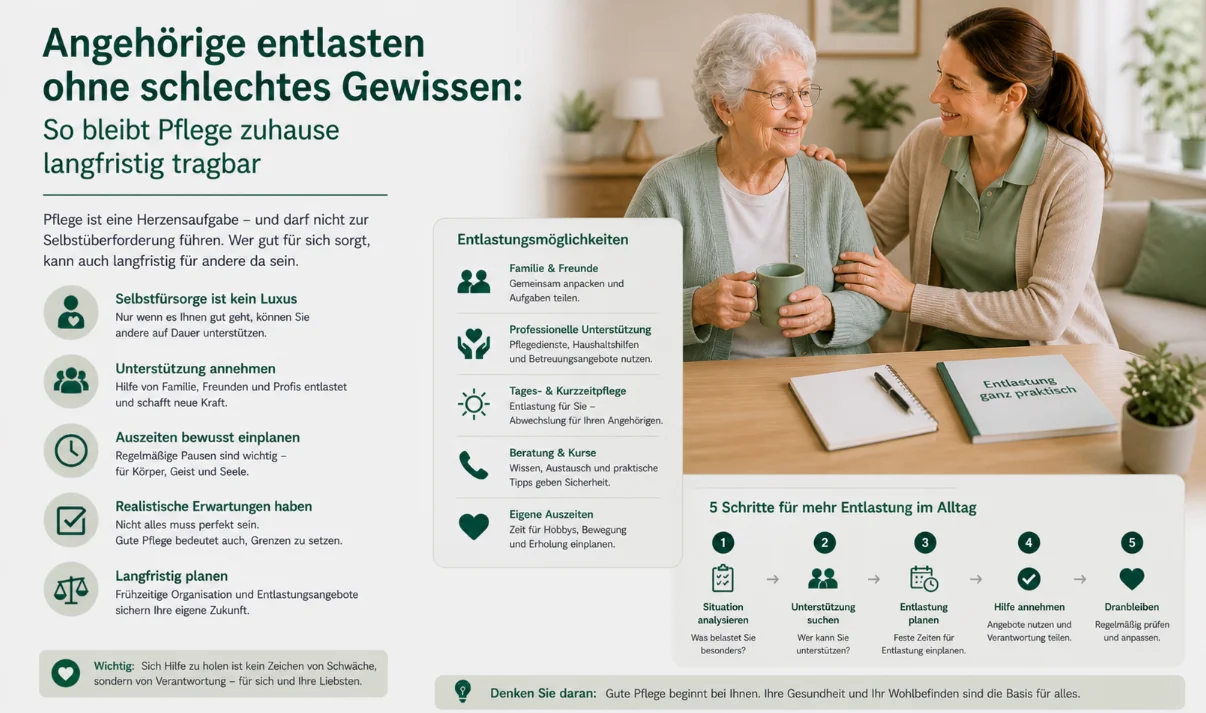
Relatives have a major influence on whether a person’s mobility is maintained. They can provide motivation, ensure safety, organise assistive devices, accompany the person on their journeys and help prevent them from becoming overwhelmed. At the same time, they should not take over everything. Good support recognises what the person can still do for themselves and builds on that.
It is helpful to ask: ‘How can I help so that you can do it yourself?’ Instead of immediately getting up to fetch a glass of water, you can check whether you can walk there together. Instead of pulling someone out of their armchair, you can guide them through the movement. Instead of preventing every walk out of concern, you can choose a safe, short route. Relatives must learn to distinguish between protection and over-protection. This is difficult, but important.
Relatives need patience too. Progress is slow; setbacks are possible. Illness, a bad night’s sleep, the weather, mood or pain can all affect how someone feels on any given day. A bad day does not mean all is lost. A good day does not mean that every goal should be doubled straight away. Maintaining mobility is a process, not a sprint involving a health insurance claim form.
If there is a great deal of uncertainty, relatives should seek professional support. Physiotherapy, occupational therapy, care advice, GPs and medical supply shops can help to plan exercises, aids and home adaptations effectively. A structured rehabilitation programme is particularly important following hospital stays or falls.
| The role of relatives | Good support | Inappropriate support |
|---|---|---|
| When getting up | Provide guidance, allow plenty of time, create a stable environment | pulling someone by the arm, rushing to help |
| When walking | Safe routes, assistive devices, short-term goals | preventing all options out of fear |
| When doing exercises | Remind them regularly, and acknowledge small successes | press, criticise, overwhelm |
| Assistive devices | organise suitable advice and exercise | buying something and expecting to use it |
| In the event of setbacks | Investigate the cause, adjust the plan | Making accusations or giving up |
Regaining mobility after a stay in hospital or rehabilitation
After a stay in hospital, older people often lose their strength quickly. Even just a few days in bed can make getting up, walking and climbing stairs significantly more difficult. After discharge, families sometimes expect everything at home to go back to the way it was before. This is rarely realistic. The body needs time, a sense of security and targeted rehabilitation.
Immediately upon returning home, you should check which routes are necessary: bed, toilet, kitchen, bathroom, entrance. Assistive devices should be to hand, trip hazards removed and care routines planned. If physiotherapy has been prescribed, it should be undertaken consistently. Even small amounts of physical activity in daily life are important: getting up regularly, taking short walks, taking breaks from sitting, and doing light exercises as instructed.
The phase when people are feeling better but are still weak is particularly critical. At this stage, they may overestimate their abilities, or their relatives may expect too much of them. A fall shortly after a stay in hospital or rehabilitation can set their progress back significantly. The key here is to build up slowly, take regular breaks, accept the use of aids and take warning signs seriously.
Discharge planning, care advice or home adaptations can help to ensure a smooth transition. It is much easier to organise support before discharge than to realise, in a panic, once you’re back in your living room, that the toilet is suddenly far too far away. Reality has a knack for such little nasties.
Maintaining mobility with dementia
With dementia, mobility is particularly important and, at the same time, particularly challenging. Physical activity can reduce restlessness, improve sleep and aid orientation. At the same time, people with dementia may find it harder to assess risks, forget routes or fail to use aids reliably. Relatives must therefore facilitate physical activity whilst ensuring safety.
Regular exercise routines help: a short walk every morning, a stroll round the garden after lunch, simple movements to music or familiar household tasks. Complicated explanations are less helpful than clear guidance. Instead of ‘We’re going to do something to help with your mobility now’, simply say ‘Come on, let’s walk over to the window together.’
Safe, familiar routes are important. New surroundings can be overwhelming. Too many external stimuli can also cause agitation. Short, familiar walks are often better than long outings. If a person has a tendency to wander off or suffers from disorientation, particular care is needed and, where necessary, professional advice should be sought.
Assistive devices require particular practice when dealing with dementia. A rollator is only helpful if the person understands and accepts it. If it is forgotten, used incorrectly or pushed aside, other solutions are needed. Mobility in dementia is therefore never just a physical issue, but always a cognitive and emotional one as well.
Checklist: Maintaining mobility in later life
This checklist helps you to systematically review your daily routine. It is no substitute for a professional assessment, but it quickly highlights where mobility is being encouraged or unintentionally hindered.
Everyday life
- Are there opportunities for daily exercise?
- Do they still manage short journeys on their own?
- Are walks or short strolls possible?
- Are periods spent sitting regularly interrupted?
- Are there any sensible exercise goals?
Safety
- Are the walkways clear?
- Is there good lighting?
- Are carpets and cables secured?
- Are suitable shoes being worn?
- Are there stopping points at critical points?
Assistive devices
- Is a rollator or walking stick a good idea?
- Are assistive devices correctly adjusted?
- Can the person use it safely?
- Are there any aids available for the bathroom and toilet?
- Was specialist advice sought?
Warning signs
- Have there been any falls or near-falls?
- Is exercise avoided out of fear?
- Are you experiencing any new pain or dizziness?
- Is getting up becoming significantly more difficult?
- Has their gait changed?
Practical example: Regaining the ability to walk short distances
An 81-year-old man can barely get out of his armchair following a stay in hospital. His daughter brings him drinks, food and medication. She means well, but after a few weeks she notices that her father is becoming less steady on his feet. The trip to the toilet is becoming more difficult, and the walk to the letterbox no longer happens at all. The armchair is comfortable, but it is slowly becoming a padded trap that restricts his mobility.
The family makes adjustments to his daily routine. His father receives physiotherapy; his armchair is replaced with a more stable seat at a better height; pathways are cleared; and a rollator is fitted. Instead of bringing everything to him, his daughter accompanies him several times a day on short journeys: to the dining table, to the window, and later to the front door. The goals are small and recurring.
After a few weeks, he is walking more confidently around the flat again. He doesn’t manage to get to the letterbox every day, but he does so several times a week. What matters is not that he has fully regained his strength. What matters is that his mobility does not deteriorate any further and that he regains his confidence. This is exactly what realistic support for mobility at home looks like.
Common mistakes when it comes to maintaining mobility
The most common mistake is taking it too easy. Out of fear of falling, people avoid walking, have tasks done for them and reduce their physical activity. In the short term, this certainly seems safe. In the long term, however, it weakens strength, balance and self-confidence. Safety must not mean keeping people immobile.
A second mistake is applying too much pressure. Relatives want to see progress and become impatient. This turns movement into a source of conflict. Anyone who is afraid or in pain needs reassurance, not orders. Motivation works better through small goals, involvement and a sense of achievement.
A third mistake is the incorrect management of assistive devices. These devices are used too late, incorrectly or without guidance. A rollator in the hallway is of no use if the person cannot use it safely. A walking stick at the wrong height can do more harm than good. Advice in this context is not a luxury, but common sense with a scheduled appointment.
A fourth mistake is a failure to adapt the home. Exercises are of little help if everyday life is then hampered by carpets, low armchairs and dark corridors. Mobility must work where people actually live.
Nutrition, Hydration and Mobility
Mobility does not depend solely on exercise and aids. Diet and fluid intake also play an important role. If you don’t eat enough, you lose strength. If you don’t drink enough, you tire more quickly and may feel dizzy or confused. Appetite, thirst and muscle mass can decline, particularly in old age. This makes moving around more tiring, even though the actual cause lies not only in the legs.
Protein is important for maintaining muscle mass. If older people do not consume enough protein over a prolonged period, muscle loss can progress more rapidly. Vitamin D deficiency, weight loss or an unbalanced diet can also affect mobility. Relatives should therefore be alert to signs such as clothes becoming looser, meals being skipped frequently, or the person appearing noticeably weaker.
Staying hydrated is also crucial. Dehydration can lead to dizziness, circulatory problems and falls. At the same time, some people drink less because they are worried about having to go to the toilet frequently or about incontinence. This is understandable, but risky. It is better to spread fluid intake sensibly throughout the day and establish a safe toilet routine, rather than drastically reducing fluid intake.
Promoting mobility should therefore always take the person’s overall condition into account. If someone is barely eating, sleeping poorly, in pain and not drinking enough, an exercise plan on its own will have little effect. The body needs a solid foundation before it can perform at its best. This is a fact that even the human body itself apparently has to re-learn every day.
Shoes, clothing and small everyday details
Footwear is an underestimated factor when it comes to mobility. Unstable slippers, open-toed slippers, slippery soles or shoes that are too big increase the risk of falling and alter one’s gait. Particularly at home, many older people wear footwear that nobody would seriously recommend for outdoor use. But the hallway is no less real than the pavement. When a fall occurs, bones do not distinguish between indoors and outdoors.
Good shoes fit securely, have non-slip soles, provide support and are easy to put on. If you have swollen feet, foot deformities or diabetes, you should take particular care when choosing shoes. Insoles or orthopaedic aids may also be relevant. People who experience pain when walking tend to move around less. Those who move around less lose further mobility. This creates a vicious circle.
Clothing also plays a role. Trouser legs that are too long, slipping socks or complicated garments can hinder movement. For people with limited mobility, practical fastenings, suitable lengths and comfortable fabrics are helpful. Clothes do not have to look like they’ve been in a care home, but they should allow for movement. Fashion that causes falls has failed in its purpose.
Small details can make everyday life easier: a sturdy chair in the hall for putting on shoes, a long shoehorn, non-slip socks only where they really provide a secure grip, and a shelf for aids. Mobility is maintained not only through exercise, but also through many small decisions that make moving around less of a struggle.
Social contacts and mobility
Mobility is closely linked to social interaction. People who visit others, go to a senior citizens’ club, spend time in the garden or take a short walk round the neighbourhood are not just keeping physically active; they also remain socially connected. When mobility declines, many people tend to withdraw. As a result, they lack not only physical activity but also motivation. Everyday life becomes more limited and quieter.
Relatives can create opportunities for social activity. A walk together with neighbours, a weekly visit to a café, the journey to day care, a quick trip to the letterbox or a get-together in the courtyard can be more effective than isolated exercises. Exercise that has a purpose and involves social contact feels less like a chore.
It is important not to make social situations too overwhelming. Long walks, noisy surroundings or difficult stairs can be off-putting. Predictable, short and safe activities are better. A good venue has seating, toilets, few trip hazards and a way to get back if it all becomes too much. That may sound like a lot of planning for a short outing, but it is precisely this planning that determines whether the outing takes place at all.
Maintaining mobility is therefore also about participation. It is not just about exercising muscles, but about keeping life open. A person who can leave the house safely has more opportunities. And in old age, opportunities are not a luxury, but a safeguard against social isolation.
Mobility for people with chronic conditions
Many older people have chronic conditions that affect their mobility: osteoarthritis, Parkinson’s disease, the after-effects of a stroke, heart failure, COPD, diabetes, osteoporosis or neurological disorders. In such cases, general advice such as ‘get more exercise’ is not enough. Exercise must be tailored to the condition and, if in doubt, should be supervised by a specialist.
In the case of osteoarthritis, regular, tailored exercise can help to keep joints mobile, provided that overexertion is avoided. With Parkinson’s disease, rhythm, clear movement cues and fall prevention play a major role. Following a stroke, physiotherapy, occupational therapy and targeted assistive devices can be crucial. In the case of heart or lung conditions, exercise limits must be observed. With osteoporosis, preventing falls is particularly important, as fractures can have serious consequences.
Relatives should therefore not try to solve all mobility problems on their own. If medical conditions are involved, a medical and therapeutic assessment is required. The aim remains to stay active, but not blindly so. Exercise should strengthen, not put one at risk. An exercise programme found online can be helpful, but it takes no account of medical diagnoses or how one feels on any given day. It is practical, but not all-knowing. Just like almost everything else people find on the internet.
Chronic conditions do not mean that you have to give up your mobility. They mean that you need to plan your journeys more carefully. Sometimes, small movements whilst seated are helpful. Sometimes, short walks with breaks. Sometimes, targeted exercise under supervision. The key is to maintain your abilities without overtaxing your body.
Check regularly: What has changed?
Mobility is not a static condition. It changes depending on health, mood, the time of year, medication, pain and everyday life. That is why it is important to check regularly whether the current plan is still suitable. Someone who was able to walk safely out to the garden in spring may need more support in winter due to darkness, slippery conditions or fatigue. After an illness, they may lack strength. After a fall, fear may take over.
Relatives should take these changes seriously: walking more slowly, less enthusiasm for walks, needing to hold on to things more often, taking more frequent breaks, unsteady turns, difficulty getting up or spending more time sitting down. These signs aren’t a disaster, but they are indicators. If you act early, you can often take steps to counteract them. Those who wait until things have come to a standstill have significantly less room for manoeuvre.
A simple monthly check-up can help: Which routes are still manageable? Where were there any difficulties? Which exercises have been done? Is an aid needed or does it need adjusting? Do any alterations need to be made to the home? Is there any pain or dizziness? These questions are matter-of-fact, but effective. Not everything in life has to be glamorous to be useful.
Maintaining mobility is an ongoing task. It requires attention, adaptation and patience. The benefit: every small improvement has an immediate impact on everyday life. Getting up more safely, walking more easily, feeling less anxious, participating more fully in life. This is not abstract prevention, but a tangible improvement in quality of life.
Frequently asked questions about mobility in later life
What is the best way to maintain mobility in old age?
Through regular, safe everyday movement, gentle strength and balance exercises, suitable aids, good shoes and a home free of unnecessary trip hazards. Regularity is key, not intensity.
What exercises are beneficial for older people?
Depending on your condition, standing up and sitting down, marching on the spot, heel raises, weight-shifting exercises and short walks may be beneficial. If you feel unsteady or have any medical conditions, you should seek professional guidance.
Is a rollator bad for your independence?
No. A properly adjusted rollator can increase independence, as it makes it safer to walk further distances. It is important to adjust it correctly and practise using it.
What can you do if you’re afraid of falling?
Fear of falling should be taken seriously. Safe routes, suitable aids, support, guided balance exercises and small successes rather than pressure can all be helpful.
How often should older people make time for exercise?
Ideally, do this daily in small sessions. Several short bursts of exercise throughout the day are often more realistic and effective than infrequent, lengthy sessions.
When should medical advice be sought?
In the event of sudden weakness, dizziness, falls, severe pain, shortness of breath, chest pain or a noticeable change in gait, you should seek medical advice to find out the cause.
How can relatives help without being patronising?
By creating a safe environment, setting small physical activity goals, encouraging independent activity and not taking over everything straight away. Support should empower, not replace.
What can help after a stay in hospital?
Gradual recovery, physiotherapy, a safe home environment, suitable aids and short, regular journeys. After a stay in hospital or a rehabilitation centre, mobility should not be left to chance.
Conclusion: Mobility is maintained by taking small, safe steps
Maintaining mobility in later life does not mean exercising every day or trying to regain one’s former level of fitness. It means making movement in everyday life possible, safe and meaningful. Short walks, getting up regularly, gentle exercises, suitable aids and a home designed for ease of movement can make a big difference.
It is important neither to be too overprotective nor to be too pushy. People need reassurance and encouragement. Relatives can help by facilitating mobility, rather than preventing it out of fear or forcing it out of impatience.
Promoting mobility at an early stage helps to safeguard independence, reduce the risk of falls and maintain quality of life. And sometimes this big picture starts with something very small: getting up safely, taking a few steps to the window and the feeling that you haven’t given up on your own body just yet.