In a nutshell
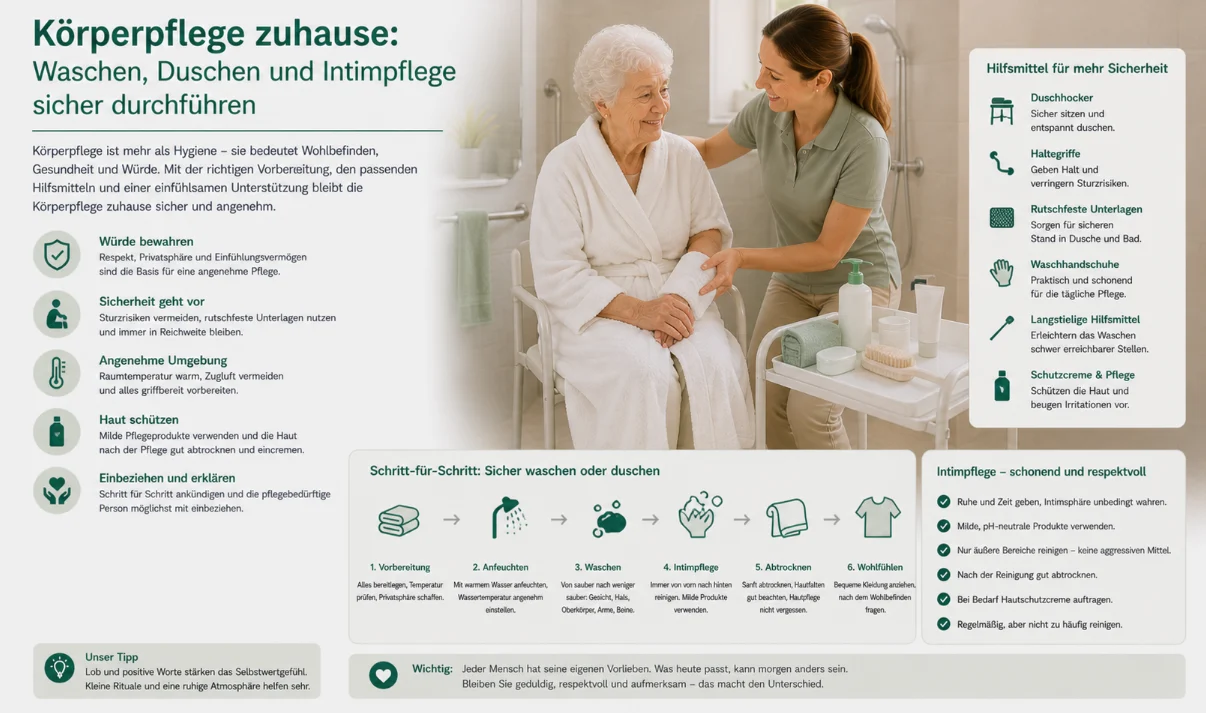
Good personal care at home combines hygiene, safety and dignity. It should provide support without unnecessarily taking away the person’s autonomy or causing them embarrassment.
Important for everyday life
Preparation, warm rooms, a non-slip environment, clear procedures, suitable aids and a calm tone of voice make personal care easier and safer.
Tagline
Personal care is not merely a technical sequence of actions involving a washcloth. It is about nurturing relationships under challenging circumstances. Yes, even the washcloth suddenly takes on a social responsibility here.
Why personal care at home is such a sensitive issue
Personal hygiene is a private matter for most people. Being able to wash, shower, get dressed, shave or use the toilet is part of feeling independent. When people can no longer manage these activities on their own, much more than just the practical aspects of daily life changes. People experience a sense of dependence, shame, and sometimes anger or grief. Relatives experience uncertainty, worry and, often, physical strain.
Families in particular underestimate just how emotionally intimate personal care can be. A daughter suddenly finds herself helping her father wash. A spouse takes on intimate care. A son organises shower assistance for his mother. Roles shift. What used to be a private matter is now a shared care challenge. This can foster closeness, but it can also be overwhelming. Good care takes this tension seriously, rather than pretending it’s all just a matter of organisation.
Personal care at home therefore requires more than just soap and a towel. It requires tact, clear routines, safety and a willingness to accept help. The person receiving care should be able to do as much as possible for themselves. Relatives should provide support where necessary, but should not take over everything simply because it is quicker. In care, speed is rarely a good substitute for dignity, even if the diary would have us believe otherwise.
Good personal hygiene also helps to protect your health. It can reduce skin problems, infections, odours, sores, falls and feelings of being overwhelmed. At the same time, it provides a daily opportunity for observation: changes in the skin, pain, dizziness, weight loss, mobility problems or confusion are often first noticed during personal care. Personal care is therefore not just about cleaning, but also an important part of care provision.
Important: Sudden changes to the skin, open sores, severe pain, fever, an unusual odour, bleeding, new-onset confusion or a marked deterioration in health should be assessed by a doctor or nurse.
Assessing care needs realistically
Before organising personal care, it should be clear what help is actually needed. Many people are still able to carry out certain tasks themselves: washing their face, brushing their teeth, applying cream to their upper body, combing their hair or choosing their clothes. Others simply need help with preparation, reminders or safety in the bathroom. Still others require direct physical assistance. These differences are important because too much help can undermine independence, whilst too little help increases risks.
It is helpful to consider specific activities: Can the person get to the bathroom safely? Can they stand or sit? Can they reach their back, feet and intimate areas? Do they understand the process? Is there a risk of falling? Do they experience pain, dizziness or shortness of breath? Do they refuse to carry out personal hygiene? Do they have skin problems or incontinence? Only by asking these questions can it be determined whether relatives can provide support or whether professional help is advisable.
The distinction between being able to do something and being able to do it safely is particularly important. Someone may still be able to have a shower, but only if they are anxious, have to hold on for a long time and are at high risk of falling. Someone may be able to get dressed, but it takes so much time and energy that they are unable to do anything else afterwards. Independence is good. But independence that turns into a risky ordeal in the bathroom is not so good.
| Section | Observation | Possible support |
|---|---|---|
| Washing | The upper body works, but the back and feet do not | Check for partial assistance, a long washcloth, a shower chair and foot care |
| Showering | Uncertainty when getting on or standing | Shower chair, grab rails, non-slip flooring, care service |
| Personal hygiene | Embarrassment, reduced mobility, incontinence | Discreet assistance, disposable gloves, skin protection, clear routine |
| Oral care | is overlooked or carried out incorrectly | Reminder, instructions, denture check-up |
| Getting dressed | Difficulty with buttons, socks or shoes | Dressing aids, practical clothing, seating |
Preparing well for personal care
Good personal care begins before you even start. Preparation reduces stress, embarrassment, feeling cold, the risk of falls and unnecessary rushing. Anything that has to be searched for whilst providing care prolongs the situation and increases the strain. Towels, washcloths, clean clothes, care products, disposable gloves, incontinence products, bin bags, skin protection, a comb and dental care items should all be laid out ready. It sounds simple, but surprisingly often it’s only realised once someone is already sitting in the bathroom, half-wet.
The room should be warm enough. Older people, in particular, feel the cold more quickly. Cold can lead to tension, resistance and an unpleasant experience. Privacy is also important: close the door, be mindful of windows, and avoid having people in the room unless necessary. If relatives are helping, it should be discussed beforehand what needs to be done and which steps the person will carry out themselves.
Safety is also part of the preparation. The floor should be dry and non-slip; aids must be stable; the shower chair must not wobble; and the hand-held shower and toiletries must be within reach. If a person has difficulty standing, personal hygiene should, where possible, be carried out whilst seated. A shower is no place for balancing acts. That’s what circuses are for – and even they have safety nets.
Get the materials ready
Place towels, clothing, care products, gloves, incontinence products and skin protection within easy reach before you begin.
Preparing the room
Ensuring warmth, light, privacy and dry, safe floors.
Explain the process
Explain briefly what is going to happen next. A simple step-by-step guide is particularly helpful in cases of uncertainty or dementia.
Maintaining independence
The carer takes on everything that is safely possible. The support complements rather than automatically replacing everything.
Washing at the washbasin or in bed
Not all personal hygiene needs to take place in the shower. For many older or frail people, washing in stages at the washbasin or in bed is considerably more comfortable and safer. Washing in stages can be particularly beneficial in cases of illness, severe exhaustion, being bedridden or a fear of falling. The key is that the care is carried out thoroughly, in warm water and with dignity.
Where possible, the person should be able to sit at the washbasin. A sturdy chair with non-slip feet and armrests can help. The carer should work close to the person, avoid standing in an awkward position for long periods, and keep supplies within easy reach. The face, upper body, arms, armpits, hands, genital area, legs and feet should be washed in turn. Areas that are not currently being washed should remain covered. This protects against the cold and preserves dignity.
When washing a person in bed, the working height is crucial. A height-adjustable care bed greatly reduces the strain on carers. If a care bed is not available, particular care should be taken to avoid working in a bent-over position for long periods. The person should be washed in sections, dried carefully and, if necessary, moisturised. Wet patches on the bed should be dealt with immediately or the bed linen changed.
The order should make sense from a hygiene perspective: moving from cleaner areas to those that are more heavily soiled. Separate washcloths or disposable products should be used for the face and genital area. Skin protection is particularly important in cases of incontinence. Here, too, the approach should be calm, clear and without unnecessary commentary. No one needs a live commentary on their need for care whilst being looked after.
| Situation | Advantage | What should you look out for? |
|---|---|---|
| Washing at the washbasin | promotes independence; less of a strain than having a shower | Seating, a warm atmosphere, secure standing areas |
| Partial washing in bed | Suitable for those who are frail or bedridden | Working height, privacy, washing in sections |
| Washing whilst seated | reduces the risk of falls and fatigue | a sturdy chair, within easy reach |
| Separate sections | preserves independence and dignity | Don’t rush into taking on everything out of impatience |
Organising safe showering
For many people, having a shower feels better than a wash, but it is also more risky. Wet conditions, slippery floors, heat, strain on the circulatory system, getting in and out, turning round and standing all come into play. Particularly for older people or those in need of care, a shower can quickly become the most dangerous quarter of an hour of the day. Unfortunately, the bathroom has a knack for looking harmless whilst still contributing to accident statistics.
A safe shower requires non-slip surfaces, grab rails, an easily accessible hand-held shower head, a comfortable temperature, sufficient space and, ideally, a seat. A shower chair or stool reduces fatigue and the risk of falls. A walk-in shower makes it easier to get in, but even there, wetness and the risk of slipping remain a concern. A bath with a high step-in is particularly problematic.
The process should be carried out calmly. Go to the toilet beforehand, lay out clothes and towels, check the water temperature and position any aids. During the shower, relatives should only help as much as is necessary. If the person can wash themselves, they should do so. Support may be needed with the back, feet, hair or getting in and out safely.
The risk of falling isn’t over once you’ve had a shower. It’s precisely whilst drying off, applying cream and getting dressed that many unsteady movements occur. A seat, warm towels and a dry floor are essential. Anyone who tries to put on their socks quickly in a wet bathroom is actively setting themselves up for the next problem. Yet people do it anyway. Evolution looks on wearily.
Showering safely
- Using a shower chair or shower stool
- Handrails in the right places
- non-slip flooring
- Hand shower easily accessible
- Test the water first
- then dry off whilst seated
The risks of showering
- Showering whilst standing for long periods despite feeling weak
- no handrail
- wet floor without a mat or covering
- hasty getting on and off
- water that is too hot
- Getting dressed whilst unsteady on one’s feet
Carrying out personal hygiene with dignity
For many carers, intimate care is the most difficult aspect of personal hygiene. It is necessary, particularly in cases of incontinence, limited mobility or skin problems. At the same time, it is an emotionally sensitive matter. Feelings of shame, disgust, insecurity or role conflicts may arise. Good intimate care therefore requires not only hygiene, but also discretion and clear agreements.
The most important rule is respect. Explain in advance what is going to be done. Only expose the area that is currently being cared for. Do not discuss it in front of others. Avoid derogatory remarks. Wear gloves, not as a sign of disgust, but as a standard of hygiene. Warm water, mild products and gentle drying are often better than aggressive cleaning.
For hygiene reasons, cleaning should proceed from cleaner areas to those subject to greater soiling. For women, cleaning should always be carried out from front to back to minimise the spread of germs. For men, skin folds, the foreskin, the groin and the buttocks should be cleaned carefully but gently. In cases of incontinence, the skin must be checked regularly and protected.
If relatives are unable to provide personal hygiene care, or if the person concerned refuses it, a care service is a sensible option. This is not a failure. Some boundaries are healthy. Personal hygiene care can actually be less stressful with professional help, as family-related feelings of shame have less of an impact. Sometimes, keeping a distance is simply more dignified than bravely persevering whilst feeling like screaming inside.
Important: Redness, pain, a burning sensation, itching, open sores, an unusual odour, discharge or blood should be investigated by a healthcare professional.
Skin care and skin protection
Skin changes as we age. It becomes thinner, drier, more sensitive and more vulnerable. People in need of care often move around less, sweat differently, suffer from incontinence, take medication or do not drink enough. All of these factors can contribute to skin problems. Personal care therefore always involves keeping an eye on the condition of the skin.
Washing too frequently with harsh products can dry out the skin. It is better to use mild, pH-balanced or suitable skincare products, depending on your needs. After washing, the skin should be dried thoroughly but gently, particularly in skin folds, under the breasts, in the groin, between the toes and in the genital area. Moisture in skin folds can lead to irritation.
Applying cream can help with dry skin. In cases of incontinence, skin protection products are important to prevent urine and faeces from causing long-term irritation to the skin. Particular attention must be paid to pressure sores if someone spends a lot of time sitting or lying down. Redness that does not go away should be taken seriously. Skin is not merely decorative packaging, but an early warning system with a rather clear message.
| Skin problem | Possible trigger | What can help |
|---|---|---|
| Dry skin | Age, frequent washing, harsh cleaning products | Gentle cleaning, suitable care cream, do not over-wash |
| Redness in skin folds | Moisture, friction, heat | dry thoroughly, air, appropriate care, professional inspection |
| Skin irritation caused by incontinence | Urine, faeces, moisture, friction | frequent changing, skin protection, gentle cleaning |
| Pressure sores | sitting or lying down for long periods | Positioning, movement, pressure relief, professional assessment |
| Itching | Dryness, allergies, infections, medication | Investigate the cause, don’t just scratch or use perfume |
Oral care, hair, shaving and nails
Personal care involves more than just washing and showering. Oral care, hair care, shaving and nail care are important aspects of wellbeing and health. Oral care, in particular, is often underestimated in home care. Poor oral hygiene can cause pain, inflammation, bad breath, difficulties with eating and problems with dentures.
Teeth, gums, the tongue and dentures should be looked after regularly. If the person is unable to do this reliably on their own, they will need reminders, guidance or help. Dentures should be cleaned and checked for pressure points. If there is pain, bleeding, sore spots or a poor fit, it is advisable to seek dental advice.
Combing, washing or styling one’s hair may seem less medical, but it has a great deal to do with dignity. Well-groomed hair, a clean shave or a familiar appearance can help maintain self-esteem. The same applies to nails. Toenails that are too long can cause pain, lead to pressure sores or make walking difficult. In cases of diabetes, circulatory problems or problematic nails, professional foot care should be considered.
Shaving and hair care should be tailored to one’s routines. Anyone who used to shave every day may feel unkempt if they suddenly stop. Anyone who has always worn a particular hairstyle may find it harder to recognise themselves with tousled hair. Personal care is also a matter of maintaining one’s identity. Yes, even a comb can have biographical significance. Welcome to the meticulous attention to detail that underpins human dignity.
Assistive devices and bathroom adaptations
Assistive devices can make personal care safer, easier and more dignified. They reduce the risk of falls, take the strain off carers and help maintain independence. Nevertheless, they are often adopted too late because they are perceived as a sign of needing care. Yet a shower seat is not a symbol of failure, but a piece of furniture that makes perfect sense.
In the bathroom, possible aids include grab rails, a shower seat, non-slip mats or flooring, a toilet seat raiser, folding support rails, a hand-held shower, a bath board or a bath lift. Which solution is suitable depends on mobility, strength, the size of the bathroom, care needs and acceptance. Not every product fits into every bathroom. And not every highly-rated product is suitable for every person. Shocking, I know.
Even small aids can make a big difference: a long sponge, a reaching aid, an electric shaver, a shower tray at a comfortable height, non-slip seating, and clothing that is easy to put on and take off. For relatives, a care bed or a more suitable working height may be important when personal care is provided in bed.
| Assistive devices | Benefits | Particularly useful for |
|---|---|---|
| Shower chair | Showering whilst seated, reduced risk of falls | Weakness, dizziness, unsteadiness |
| Handrails | Getting up, turning and holding on safely | Bathroom, toilet, shower, washbasin |
| Toilet seat raiser | easier to sit down and stand up | Knee, hip or mobility problems |
| Hand shower | Targeted washing whilst seated | Showering with assistance or with limited mobility |
| Bath board | makes it easier to use the bath | if there is no shower |
| Care bed | a more comfortable working height when providing care in bed | Bedridden or requiring frequent care at the bedside |
Personal care for people with dementia
Personal hygiene can become particularly difficult for people with dementia. The person affected may not understand why they need to wash, may not recognise objects, may feel threatened or may feel ashamed. Resistance in such cases is often not a sign of defiance, but of fear or feeling overwhelmed. Relatives need patience, structure and a way of speaking that does not challenge, but supports.
Established routines are helpful. Personal hygiene should, where possible, take place at the same time of day, following the same sequence and using familiar products. Short sentences help: ‘We’re going to wash our hands now.’ Not five instructions at once. With dementia, complex sentences can sometimes be the communicative equivalent of a tangled mess of cables.
If taking a shower causes anxiety, a partial wash may be a better option. If the sound of running water is unsettling, explain the process beforehand and start slowly. If undressing feels embarrassing, only one area should be exposed at a time. Music, warm towels or familiar smells can help to calm the person. If there is strong resistance, it is sometimes better to try again at a different time.
Relatives should not try to force every care task. Of course, personal hygiene must be ensured, but coercion often leads to escalation. If personal care becomes regularly impossible, a care service or a dementia support service should be involved.
Helpful for people with dementia
- fixed routines
- short sentences
- warm room
- familiar products
- Partial washing instead of a compulsory shower
- calm, respectful support
Mostly problematic
- long explanations
- Discussions
- hasty undressing
- cold shower
- Too many people in the room
- Accusations or pressure
Taking the strain off relatives
Personal care can place a heavy physical and emotional strain on carers. They have to support, bend down, explain, clean, reassure and, at the same time, preserve the person’s dignity. In particular, helping with showers, personal hygiene, managing incontinence and bedside care can push people to their limits. If carers are regularly exhausted, irritable or physically overburdened, support should be organised.
A home care service can take on specific tasks, such as helping with showering, personal hygiene, getting dressed or checking the skin. This does not mean that relatives are handing over the care. It means that demanding tasks are supported by professionals. Sometimes this can even improve the relationship, as relatives can once again focus more on being a daughter, son, partner or spouse, rather than simply a carer with a guilty conscience.
Training courses can also help. Relatives can learn how to work in a way that protects their backs, prepare for transfers, use assistive devices and better assess difficult situations. Those who provide care without guidance often improvise too much. Improvisation is sometimes necessary, but as a long-term solution it’s about as stable as a three-legged shower stool.
A stairlift is a sensible option if: personal care regularly leads to arguments, relatives are experiencing physical discomfort, intimate care is found to be too burdensome, there is a risk of falling, or skin problems require professional assessment.
Personal care following a stay in hospital, rehabilitation or illness
Following a hospital stay, operation, infection or rehabilitation, care needs often change suddenly. People may be weaker, less steady on their feet, tire more quickly, or have wounds, catheters, dressings or new medication. Personal care routines then need to be adapted. Tasks that could previously be carried out whilst standing may, for the time being, only be possible whilst sitting. Activities that were previously carried out independently now require guidance or assistance.
The transition back home should be prepared for. Is there a shower seat? Do any dressings need protecting? Is it safe to have a shower? Would it be a good idea to arrange a care service for the initial period? Are there any areas of skin at risk? Are there any new risks of falling? Questions like these may seem dry, but they help prevent chaos in the bathroom. And chaos in the bathroom is rarely conducive to a speedy recovery.
It is important not to overwhelm the person too soon. At the same time, independence should be rebuilt as soon as it is safely possible. Small steps help: first, washing parts of the body at the washbasin, then showering whilst seated, and later doing more of the washing themselves. After an illness, personal hygiene often takes more time. This is not a step backwards, but an adjustment.
Clothing, getting dressed and wellbeing
Getting dressed is an integral part of personal care. Fresh clothes provide structure and dignity. At the same time, getting dressed can be physically challenging: buttons, zips, bras, tight trousers, tights or shoes require mobility and strength. Relatives should choose clothing that supports independence rather than hindering it.
Practical options include soft fabrics, simple fastenings, elasticated cuffs, zips that are easy to grip, suitable shoe aids and clothing that can be put on whilst seated. This does not mean that older people should only wear practical, one-size-fits-all clothing. Personal style remains important. But getting dressed shouldn’t turn into an obstacle course every morning.
The order in which things are done also helps: lay out the clothes, explain things calmly, prepare for the tricky bits, and allow for breaks. If the person can choose for themselves, two options should be enough. Too many decisions can be overwhelming, particularly for those with dementia. Clothing is not just fabric. It represents identity, daily structure and, sometimes, the difference between ‘I look well-groomed’ and ‘I am being looked after’.
Checklist: Organising personal care at home
This checklist helps to make personal care at home safer and more dignified. It is particularly useful if showering, washing, personal hygiene or getting dressed regularly cause stress, a fear of falling or embarrassment.
Preparation
- Are towels, clothes and toiletries ready?
- Is the room warm enough?
- Is privacy guaranteed?
- Are the floor and walkways dry and safe?
- Is the process clearly explained?
Safety
- Are there handrails?
- Is a shower chair a good idea?
- Can personal hygiene be carried out whilst seated?
- Are there any non-slip surfaces?
- Will they be dried off and dressed safely after their shower?
Would
- Is only the necessary information provided?
- Does nobody use derogatory language?
- Is the person allowed to have a say in the decision?
- Are familiar routines respected?
- Will independence be maintained?
Health
- Is the skin checked regularly?
- Is there any redness or soreness?
- Is oral hygiene being taken care of?
- Is personal hygiene carried out hygienically and gently?
- Is professional help needed?
Practical example: When showering becomes a source of conflict
A 79-year-old woman lives at home and is looked after by her son. She used to shower unaided, but now she is afraid of getting into the shower and feels the cold easily. Her son is pressing the issue because he considers personal hygiene important. His mother gets angry, refuses to have a shower and says she doesn’t need any help. Both are frustrated. The bathroom is not just a room, but a small stage for shame, worry and poor communication. It’s amazing what a difference tiles can make.
The situation has changed. The bathroom is pre-heated, a shower seat has been purchased, towels are laid out, access has been made safe, and showering no longer takes place in the morning under time pressure. The son briefly announces each step and allows his mother to wash her face and upper body herself. He only washes her back and feet if she agrees. A care service is later brought in to assist with personal hygiene, as both find this less stressful.
Taking a shower may not be her favourite pastime, but things rarely get out of hand. Mum feels less at the mercy of others, and her son feels less responsible for every little thing she does. The solution wasn’t ‘more pressure’, but better preparation, aids and a clear boundary as to when professional help is needed.
Common mistakes in personal care at home
A common mistake is rushing. Relatives want to get it over with quickly because personal care is unpleasant, time-consuming or physically demanding. However, rushing leads to insecurity, embarrassment and resistance. Personal care takes time, especially when mobility issues, dementia or anxiety are a factor.
A second mistake is taking on too much. If relatives do everything themselves, it might be quicker, but skills are lost. The person receiving care should do as much as possible for themselves. Independence sometimes comes down to the little things: washing one’s face, applying cream, combing one’s hair, choosing what to wear. These little things are not insignificant when it comes to self-esteem.
A third mistake is a lack of safety in the bathroom. No grab rails, wet floors, a lack of seating and poor lighting increase the risk of falls. A fourth mistake is failing to monitor the skin properly. Redness and sores are spotted too late. Personal hygiene should therefore always include a brief health check.
A fifth mistake is keeping quiet about one’s limits. If relatives are unable or unwilling to provide personal care, this should be discussed openly. Professional help does not spell the end of family care; rather, it is sometimes precisely what keeps it stable.
Back-friendly care: Personal care must not take its toll on carers
Personal care at home places a strain not only on the person requiring care, but also on their relatives. Anyone who stands bent over for long periods whilst washing, provides support whilst showering, reaches across in bed or lifts someone whilst dressing will soon feel the strain on their back, shoulders and knees. Many relatives accept this strain as normal. This is dangerous, as daily poor posture can lead to chronic ailments.
Back-friendly personal care starts with the right height. When care is provided at the bedside, a height-adjustable care bed is often a great help. When care is provided at the washbasin, the person should be able to sit down if possible, and the carer should not have to stand in an awkward position. In the bathroom, a shower seat, grab rails and clear sequences of movements help ensure that carers do not have to constantly support and stabilise the person.
It is important to actively involve the person requiring care. Every movement they can safely carry out themselves takes the strain off relatives and helps maintain their abilities. This applies to raising their arms, washing their face, turning onto their side, standing on their feet or helping with their clothing. Care should encourage movement, not replace it entirely. Otherwise, help turns into a personal lifting system that carries a risk of disc problems.
If personal hygiene can only be managed with great effort, a change is needed. This could be an aid, a care service, training or a different routine. Relatives should not regard pain as proof of commitment. Pain is a warning sign, not a sign of good care.
Odours, laundry and hygiene routines in everyday life
Personal hygiene is closely linked to laundry and odour management. Sweating, incontinence, skin problems, clothes that haven’t been changed or damp towels can quickly lead to carers feeling overwhelmed and those affected feeling ashamed. Good organisation takes a lot of the pressure off.
It is helpful to have designated places for clean laundry, soiled laundry, personal care products and rubbish. Used washcloths and towels should not be left lying around, but placed straight into a suitable laundry bin. In cases of incontinence, sealable bags or separate laundry are advisable. There should be a sufficient supply of clothes so that every little stain doesn’t turn into a laundry crisis. Household logistics: boring, but they save your nerves. It’s a shame that, of all things, laundry management sometimes has to be the hero.
Odours should not simply be masked. Fragrance sprays are no substitute for good hygiene, dry fabrics or suitable products. It is better to tackle the root causes: regular care, keeping the skin dry, appropriate incontinence care, good ventilation, washable protective pads and a clear routine for changing them. A well-organised bathroom and bedroom reduce stress for everyone involved.
The person requiring care should not be made to feel embarrassed by odours either. If something smells unpleasant, deal with it calmly. No comments, no visible disgust, no reproaches. Dignity is particularly evident when something is unpleasant.
Personal care for people who are bedridden
Personal hygiene becomes more challenging for those who are bedridden. The person cannot simply go to the bathroom; certain parts of the body are harder to reach; the skin and pressure sores must be carefully monitored; and carers often have to work in awkward positions. At the same time, personal hygiene is particularly important at this stage, as movement, sweating, incontinence and pressure can all contribute to skin problems.
Bedding should be well prepared. Towels, washcloths, a basin or washing system, fresh clothes, incontinence products, skin protection, a comb, dental care items and a place to dispose of waste should all be within easy reach. Where possible, the bed should be raised to working height. The person should be washed in sections and covered up again after each section. This protects against the body getting too cold and helps to avoid feelings of embarrassment.
When turning or repositioning a patient, relatives should not pull on their arms or shoulders. It is better to provide guidance, shift the person’s weight, use sliding mats or employ techniques demonstrated by a professional. If repositioning is difficult, help must be organised. Being bedridden is not a situation in which one should bravely improvise until one’s back gives out.
It is particularly important to check the skin: the buttocks, heels, back, shoulders, elbows, skin folds and genital area. Any redness that does not disappear after pressure is relieved must be taken seriously. If there is a high risk of pressure ulcers, professional nursing support is advisable.
Selecting products: Sometimes less is more
At some point, the bathroom shelf in many households where care is provided starts to look like a small chemist’s, with an overwhelming array of choices. Shower gel, cleansing cream, lotion, powder, wet wipes, skin protection, ointments, disinfectants, specialised products. But more isn’t necessarily better. Too many products can irritate the skin, complicate routines and unsettle carers.
For many situations, a manageable basic kit is sufficient: mild cleanser, suitable moisturiser, disposable gloves where needed, separate washcloths or disposable washing products, skin protection for incontinence, towels, a comb, dental care products and appropriate aids. Specialist products should be used selectively, not out of panic.
Perfumed products are not always suitable. Mature skin is more sensitive. Powder should also be used with caution, particularly in skin folds or on damp skin. It can clump and cause friction. If you have skin problems, it is better to seek professional advice than to simply pick the nearest product off the shelf and hope for a miracle.
It is important to store products in a way that makes them easily accessible and clearly identifiable. If several people are involved in care, it should be clear what each item is used for. Labels or a simple list can help. Care does not improve if every family member comes up with their own little bathroom routine.
If the person in need of care feels embarrassed
It is normal to feel embarrassed about personal hygiene. This can still be the case even when relatives are helping lovingly. No one automatically loses the need for privacy simply because they need support. Shame manifests itself in different ways: withdrawal, jokes, irritability, refusal or the phrase ‘I can do that myself’, even though it is obviously difficult.
Relatives should not try to brush aside feelings of embarrassment. Phrases such as ‘There’s no need to be embarrassed about that’ rarely help. It is better to handle the situation in a practical and respectful manner: close the door, use a towel as a screen, only expose the necessary areas, ask beforehand, and explain step by step. The choice of who provides the help can also be important. Some people find it easier to accept help from a care service than from their children or partners.
Humour can help, but only if it isn’t at the expense of the person concerned. Many people use humour themselves to defuse feelings of shame. Relatives should remain sensitive in such situations. The wrong joke at the wrong moment can have a lasting effect. Unfortunately, people often remember feelings of shame better than even the freshest skincare cream.
Dignity also means taking a ‘no’ seriously, as far as possible. If a shower isn’t possible today, perhaps a partial wash can be arranged. If personal hygiene care is too burdensome for relatives, professional help can take over. The person remains involved, even when care is needed.
Care services, costs and support
Personal care at home can be supported through care services if a care level has been assessed. Depending on the situation, care allowance, care benefits in kind provided by an outpatient care service, combined benefits, respite care allowance, care aids or home adaptations may be available. It is important for relatives to realise that personal care is not just a private family matter. It is a key area of care for which support can be organised.
An outpatient care service can, for example, help with showering, washing, getting dressed, checking the skin or personal hygiene. This can be provided on a regular basis or for specific tasks that are particularly demanding. Relatives do not have to hand over all responsibilities. Even just one or two fixed visits a week can make a significant difference to day-to-day life.
Assistive devices may also be relevant: shower stools, toilet seat raisers, care beds, positioning aids or consumable care products. Where structural alterations are required in the bathroom, and provided a care level has been established, eligibility for a grant of up to €4,180 for home environment improvements can be assessed. The application should be submitted before work begins, as bureaucracy has a way of prioritising procedures, and getting the order wrong can lead to complications.
Care advice helps people to sort through the available services and find the right support. Advice should be sought early on, particularly when personal care becomes increasingly difficult. Not only once showering is no longer possible at all or relatives are physically at their wits’ end.
Frequently asked questions about personal care at home
How often should personal hygiene be carried out at home?
This depends on one’s state of health, skin condition, sweating, incontinence and personal habits. Daily partial care is often advisable; showering does not necessarily have to take place every day, provided that washing, skincare and hygiene are adequately taken care of.
Which is better: having a shower or washing at the washbasin?
Having a shower can be enjoyable, but it is more tiring and carries greater risks. Washing at the washbasin or in bed may be safer if you are frail, afraid of falling or unwell. Safety, hygiene and acceptance are key.
How can one maintain dignity when carrying out personal hygiene?
Explain things beforehand, only reveal what is necessary, speak calmly, avoid commenting in front of others, allow them to retain their independence, and involve professional help if family-related embarrassment is too great.
Which aids are particularly important in the bathroom?
It is often helpful to have a shower seat, grab rails, non-slip flooring, a toilet seat raiser, support handles, a hand-held shower head and, if required, a bath board or bath lift.
What should you do if someone refuses personal care?
Identify the causes: fear, embarrassment, feeling cold, pain, dementia or a previous bad experience. Stay calm, try at a different time, offer to help with part of the wash, make use of familiar routines and, if refusal persists, seek advice or involve a care service.
When should a care service provide assistance?
If helping with showering, personal hygiene, mobility or skin checks is placing too great a burden on relatives, if there is a risk of falling, or if the person requiring care refuses help from relatives, a care service may be a sensible option.
How can you spot skin problems at an early stage?
Look out for redness, sores, itching, a burning sensation, weeping, pressure sores, unusual odours or pain. Skin folds, the genital area, the buttocks and areas subject to pressure are particularly at risk.
How can you make personal care easier for carers?
Through assistive devices, better preparation, back-friendly routines, care services to help with demanding tasks, training and a clear division of responsibilities within the family.
Conclusion: Good personal hygiene safeguards dignity, health and relationships
Personal care at home is one of the most sensitive aspects of caregiving. It requires hygiene, safety, patience and respect. Organising it well not only protects the skin and health, but also dignity and relationships.
Key factors include preparation, suitable aids, safe procedures, a warm environment, calm communication and a willingness to seek professional help when relatives reach their limits. Personal care does not have to be perfect, but it should be reliable, respectful and safe.
Ultimately, it’s not just about washcloths, shower stools or body lotion. It’s about helping someone to look after themselves without making them feel small. And that’s far more challenging than any product on the bathroom shelf would have you believe.