Why incontinence is a separate care issue in dementia
Incontinence associated with dementia is far more than just a hygiene issue. It affects feelings of shame, self-image, intimacy, safety, sleep, the home environment and the physical capacity of carers. Many families only start talking about it once mountains of laundry are piling up daily, odours are dominating everyday life, or trips to the toilet regularly end in conflict. This is understandable, but unfortunate: particularly in the case of dementia, early intervention is far more helpful than crisis management at a later stage.
The condition does not just affect memory. It also impacts orientation, body awareness, language, planning and reaction times. A person with dementia may feel the urge to urinate but be unable to find their way to the toilet. They may know that ‘something needs to happen’, but are no longer able to take the right steps. They may feel embarrassed, but be unable to put it into words. To an outsider, this can sometimes appear as refusal or indifference. In fact, it is often a loss of everyday coping skills.
For relatives, incontinence often marks a turning point. As long as the help required mainly involves reminding the person of things, meals, appointments and companionship, home care still feels manageable for many families. But when personal hygiene, changing clothes at night, help with going to the toilet and odour control are added to the mix, the relationship changes. Partners, children or siblings suddenly become carers in situations for which nobody was emotionally prepared. The bureaucracy calls this ‘care’. In everyday life, it’s usually described as: ‘changing the bed linen again at three in the morning.’
Common causes: Why it suddenly happens more often
Incontinence in people with dementia rarely stems from a single cause. Often, several factors are interlinked: impaired orientation, reduced mobility, medication, infections, constipation, fluid intake habits, anxiety, embarrassment or clothing that is too complicated to put on. Anyone who simply buys incontinence pads without investigating the underlying causes therefore often only addresses a small part of the problem. Pads can be useful, but they are no substitute for careful observation.
Many people affected realise the urge to urinate too late or are no longer able to interpret it correctly. Others can no longer remember where the toilet is, even though they have lived in the same flat for decades. Still others cannot make it to the toilet in time because it takes longer to get up, the hallway is dark or their clothes are difficult to undo. Relatives are quick to interpret such situations in moral terms: ‘He just needed to let us know.’ But this is precisely what can be lost in the case of dementia.
Physical causes should also always be taken into account. Urinary tract infections, pain, diabetes, neurological conditions or side effects of medication can exacerbate incontinence. Particularly in the event of a sudden deterioration, relatives should not automatically blame ‘dementia’. An acute infection can significantly increase confusion, restlessness and the urge to urinate.
Warning signs that relatives should take seriously
Changes in patterns are important. If a person has previously been able to get to the toilet in time and suddenly starts wetting themselves several times a day, this is a reason to seek medical advice. The same applies to pain, a burning sensation, a fever, strongly odourous urine, traces of blood or unusual tiredness. An increasing number of falls whilst on the way to the toilet is also a warning sign.
Relatives should also observe whether certain times of day are problematic. Does it happen mainly in the mornings, at night, after meals, after prolonged periods of sitting, or when visitors are present? Such patterns provide concrete starting points. Care improves when it does not merely react, but seeks to understand the underlying causes.
Understanding shame: Why accusations almost always do more harm than good
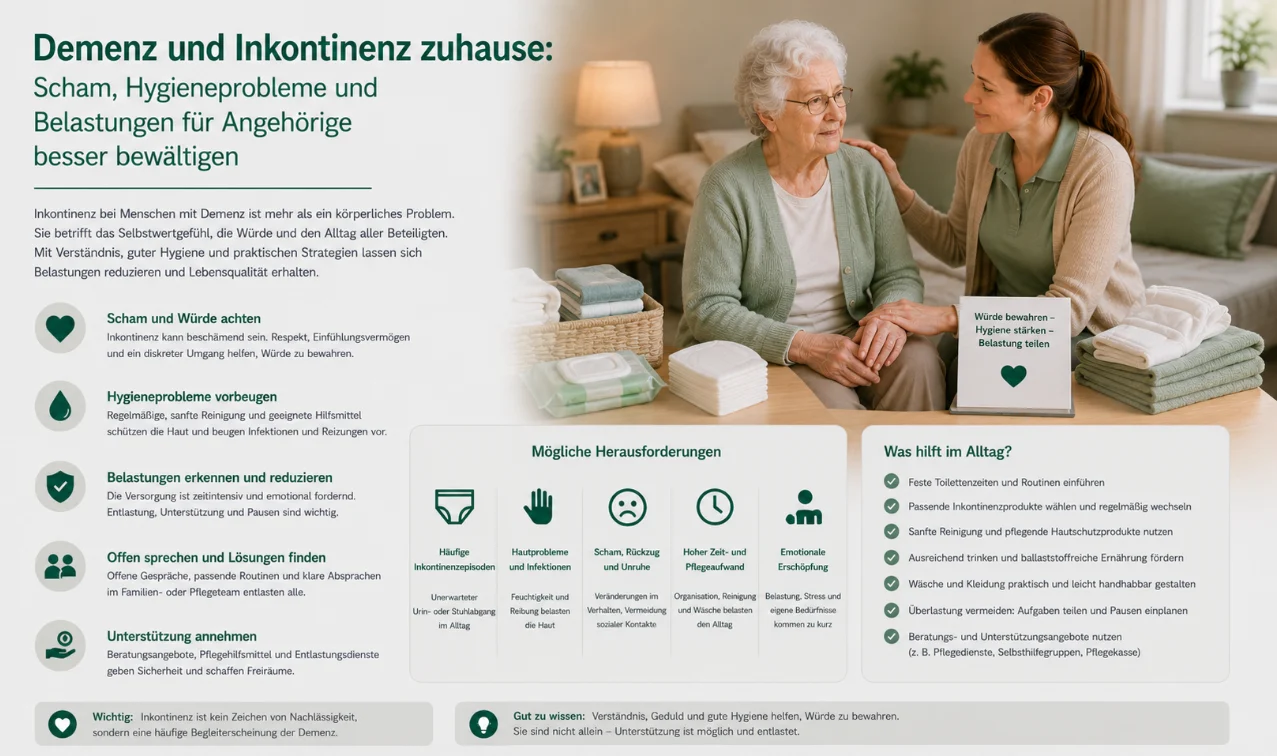
Incontinence affects people in an area closely linked to dignity and self-control. Many of those affected are acutely aware that something embarrassing has happened, even if they can no longer fully explain the situation. Some become aggressive, others deny that it has happened, whilst others withdraw. These reactions are not malicious. They are often attempts to protect themselves from shame.
Relatives are under considerable pressure in such situations. Wet clothes, odours, mattresses, time pressure and feelings of revulsion cannot be romanticised away. Nevertheless, the reaction of those around them determines whether the situation escalates or can be defused. Comments such as ‘Not again?’ or ‘Why don’t you say anything?’ often hurt those affected deeply, even if they are meant in a matter-of-fact way. People experience not just care, but judgement.
A dignified approach does not mean sugar-coating everything. It means describing the situation calmly and concisely, without assigning blame. ‘We’ll sort you out’ is often more helpful than long explanations. ‘These things happen’ takes the pressure off. Discretion is not a luxury, but a basic requirement. Nobody wants to be made into a family issue just because their trousers are wet.
Toilet routine: Fixed times rather than constantly asking
One of the most effective measures is establishing a predictable toilet routine. Many carers repeatedly ask: ‘Do you need to go to the toilet?’ However, in cases of dementia, this question does not always get you anywhere. Those affected often reply ‘no’ because they cannot recognise the urge to urinate, do not understand the question, or do not want to admit that they need help. It is often better to offer this calmly: ‘Let’s go to the toilet now, and then we’ll have a coffee.’
Fixed times make life easier for both parties. It makes sense to go to the toilet after getting up, before breakfast, after meals, before going for a walk, before an afternoon nap and before going to bed. The intervals must be tailored to the individual. The aim is not control, but prevention. If you anticipate situations, you’ll have fewer emergencies to deal with.
It is important not to make routines sound like orders. People with dementia are often sensitive to pressure. If going to the toilet is incorporated as a normal part of the daily routine, there is less resistance. The choice of words also helps: instead of ‘You must go now’, ‘Come on, let’s freshen up quickly’ often comes across as gentler.
Making night-time trips to the toilet safe
The risk of falls increases at night. People with dementia are often disoriented after waking up, start walking in the semi-darkness and overestimate how safe they are. A clearly visible route to the toilet, night lights and unobstructed walkways are therefore key safety measures.
If a person experiences a strong urge to urinate at night, relatives should have this checked to see whether physical causes, medication or drinking habits might be a factor. Drinking less is not automatically the solution. Dehydration can exacerbate confusion and circulatory problems. People who seek to simplify daily care by simply cutting things out across the board would probably also remove smoke alarms because they beep too loudly.
Living environment: Small changes, big impact
The layout of the home often plays a key role in whether trips to the toilet are successful. In cases of dementia, simply having a toilet is not enough. It must be found, recognised and reached safely. A door that looks almost identical to other doors can become a problem. Dark corridors, carpet edges, narrow passageways or light switches that are difficult to reach also increase the risk.
Clear visual cues are helpful. A clearly visible toilet sign, high-contrast colours or a bathroom door left slightly ajar can help with orientation. A commode chair in the bedroom can also be useful if walking distances become too long or too dangerous at night. This is not a step backwards, but an adaptation to changing abilities.
Many families put off making such changes because they don’t want their home to look like a ‘care facility’. That’s understandable, but risky. A safe home is no less a home. It’s a home that looks out for you. And if pieces of furniture took offence at having to make way for a commode, we’d really have far bigger social problems.
- Clearly mark the toilet door
- Using night lights in the hallway
- Removing trip hazards
- Keep clothes and insoles within easy reach
- Provide a laundry bin with a lid
- Use mattress protectors and washable covers
- Have a commode chair or urinal professionally inspected
Clothing: Why buttons and belts suddenly become the enemy
Clothing is often underestimated when it comes to incontinence. Things that used to be no problem at all can become a hurdle when living with dementia: tight trousers, belts, small buttons, complicated zips or multiple layers. If the urge to urinate is recognised too late, every second counts. Clothing that takes a long time to put on increases the risk of accidents.
Practical options include comfortable trousers with an elasticated waistband, fastenings that are easy to open, and clothing that those affected can manage themselves for as long as possible. This is not just a matter of hygiene, but of independence. People who can undress themselves experience less of a sense of loss of control.
Relatives should not choose clothing solely on the basis of ease of care. Appearance, personal habits and dignity are also important. If someone used to be neatly dressed, a sudden switch to purely functional clothing can be humiliating. Good care involves finding a balance: practical enough for everyday life, yet respectful enough of the person.
Assistive products: Insoles, incontinence pants, bed protectors and whatever really suits you
Assistive devices can make everyday life considerably easier if they are chosen appropriately. Insoles, incontinence briefs, pads, bed pads, mattress protectors, skin care products and specialised underwear all serve different purposes. However, products chosen incorrectly can lead to leaks, skin irritation, odours or resistance to using them.
Many relatives start by buying something off the shelf at a chemist’s. Whilst this may provide short-term relief, it is no substitute for professional advice. Medical supply shops, care professionals and continence advice centres can explain which absorbency level, fit and method of use are most suitable. Getting the right size is particularly important. Products that are too large do not fit properly, whilst those that are too small may dig in or leak.
A common mistake is to change assistive devices too late or to use them for too long in an effort to save money. This increases the risk of skin problems and odour. At the same time, products should not be changed too frequently if this causes unnecessary stress. The key is to find a practical routine that takes into account skin protection, dignity and workload.
Introducing assistive devices without causing embarrassment
Some people with dementia refuse to use incontinence pads because they perceive them as nappies. Relatives should therefore choose their words carefully. Terms such as ‘protective underwear’, ‘safety pads’ or ‘fresh underwear’ may be less stigmatising.
It is also important not to explain products for the first time in a stressful situation. It is better to choose a calm moment when the use of the product is being prepared as a matter of course. The more naturally relatives deal with it, the easier it is for the person concerned to follow.
Skin care: preventing soreness, odour and infections
Skin care is a medically important issue in cases of incontinence. Moisture, friction and urine can irritate the skin. The groin, buttocks, genital area and skin folds are particularly at risk. If redness, a burning sensation or open sores develop, any attempt at skin care becomes painful. This, in turn, increases resistance. A vicious circle that should be broken at an early stage.
It is important to cleanse gently, dry thoroughly and use suitable protective products. Washing too frequently with harsh soaps can damage the skin. Mild products and gentle care without rubbing are preferable. Nursing staff can help if skin problems recur or if products are not tolerated.
Odours often arise not only from incontinence itself, but also from changing laundry too late, unsuitable storage or poorly fitting aids. A closed laundry bin, washable covers and clear routines significantly reduce the problem. Relatives should tackle odour problems in a practical way, without blaming the person affected.
Supporting toilet visits without a power struggle
Conflicts often arise when relatives believe a visit to the toilet is necessary, but the person concerned refuses. This leads to arguments, pressure or simply waiting until it is too late. A better approach is a combination of routine, a calm manner of speaking and distraction. Rather than trying to prove the necessity, the next step can be initiated as a matter of course.
Many people with dementia respond positively to familiar routines. A phrase such as ‘Let’s get ready quickly’ can be more effective than asking directly whether they need to go to the toilet. Starting movements together also helps: standing up, walking towards the bathroom, switching on the light. The body sometimes follows more readily than conversation.
If the person is reluctant, relatives should check whether the situation is uncomfortable. Is the bathroom too cold? Is the person tired? Are they worried about pain? Is someone standing in the doorway, putting pressure on them? Small changes often have a greater effect than lengthy attempts to persuade.
If resistance persists
It is not always possible to insist on a trip to the toilet. In such cases, it is often better to take a short break and try again later. Constant arguments make the next situation more difficult.
However, relatives should also prioritise safety. Where there is heavy soiling, risks to the skin or a risk of infection, clear assistance is required. Where possible, two things should go hand in hand: decisive action and respectful language. One without the other leads either to chaos or to humiliation.
Bowel movements, constipation and dementia: the taboo subject
When people think of incontinence, many think of urine first. However, faecal incontinence or constipation often place an even greater strain on families. Constipation can exacerbate pain, restlessness, loss of appetite and confusion. At the same time, medication, a lack of exercise, insufficient fluid intake and changes to diet can exacerbate the problem.
People with dementia are often unable to clearly describe stomach ache or a feeling of pressure. Instead, they become restless, aggressive or refuse to eat. Relatives should therefore not ignore bowel movements out of a false sense of shame. A simple overview of frequency, consistency and any discomfort can be very helpful from a medical point of view.
If you suffer from recurrent constipation or faecal incontinence, it is important to seek medical advice. Taking laxatives without consulting a doctor can be problematic. Care in this area requires an objective approach. The human body is, in any case, already a poorly documented, ageing system with a surprising number of ‘pipes’; in the case of dementia, the instruction manual doesn’t get any clearer.
Don’t simply cut down on drinking
Many relatives try to manage incontinence by reducing fluid intake. In the short term, this seems logical, but in the long term it can be harmful. Not drinking enough fluids increases the risk of urinary tract infections, constipation, circulatory problems and increased confusion. Dehydration can quickly become dangerous, particularly in older people.
It makes more sense to spread your fluid intake sensibly. Drink plenty in the morning and afternoon; in the evening, avoid excessive amounts, but do not impose a strict ban either. Coffee, alcohol or habits that cause significant fluid loss should be assessed on a case-by-case basis. One-size-fits-all rules are rarely helpful.
Drinks should be visible and easily accessible. People with dementia often forget to drink or do not recognise when they are thirsty. Relatives can incorporate small routines: a glass of water after getting up, with every meal, after a walk, and before taking medication. Repetition takes the place of memory.
Incontinence and care levels: Why documentation is important
Incontinence is relevant to the care level because it affects self-care, mobility, daily routines and the burden on carers. Nevertheless, it is sometimes underestimated in care needs assessments when families, out of embarrassment, provide only vague accounts. Statements such as ‘it usually works out’ are of little help when, in reality, laundry needs to be changed daily, assistance is required at night and personal hygiene needs to be attended to.
Relatives should document the actual level of care required. How often is assistance needed when using the toilet? Are there any night-time visits? Does the person need to change their clothes? Is skin care, washing or changing bed linen required? Do falls or conflicts occur? Such information shows just how much care is actually required.
Honesty is key, without sensationalising the situation. A care needs assessment is not a drama, even if some forms might suggest otherwise. Describing everyday life realistically helps safeguard one’s own care arrangements. Downplaying the situation, on the other hand, often leads to receiving insufficient support.
- Record the frequency of urinary and faecal incontinence
- Documenting night-time care
- Keep track of laundry changes and skin care
- Describing conflicts or defensive situations
- Mention the risk of falls when going to the toilet
- Assessing assistive technology needs
- Realistically addressing the strain on family carers
Make use of respite care services before carers reach breaking point
Incontinence significantly increases the burden of care. Washing, changing clothes, cleaning, laundry, odour management and night-time interruptions all add up. Many relatives only realise at a late stage that the strain is not only physically but also emotionally gruelling. Disgust, shame, feelings of guilt and lack of sleep often occur simultaneously.
Relief should therefore not be organised only when no one is able to help any longer. Home care services can provide support with personal hygiene, intimate care or the provision of assistive devices. Day care can give relatives regular breaks. Respite care and short-term care can help when providing care at home is temporarily no longer manageable.
Many families wait too long because they believe that accepting help is a sign of failure. The opposite is true. Organising support helps to stabilise home care. Nobody wins a prize for going under on their own. If they did, it would probably be a very poorly funded prize that required filling in a form.
When incontinence changes a relationship
For spouses, children or siblings, incontinence has a particularly profound effect on relationships. Intimate care can foster closeness, but it can also lead to feelings of shame, being overwhelmed and emotional distance. Relatives are entitled to feel this ambivalence. It is possible to love someone and yet find certain care situations almost unbearable.
It is important to take personal limits seriously. Anyone who regularly reacts with anger, apathy or despair needs relief. Not later, but now. The person affected needs protection from humiliation. The carer needs protection from being constantly overwhelmed.
Open discussions within the family help to distribute tasks more fairly. Often, personal care ends up falling to one person because others withdraw from the situation. This leads to silent resentment. Caring becomes more sustainable when responsibilities are allocated more clearly, even if not everyone can take on the same tasks.
Professional help: When to involve care professionals
Care professionals should be involved at the latest when skin problems, strong odours, frequent faecal incontinence, night-time strain or recurring conflicts arise. Specialist support can help adapt products, demonstrate care techniques and relieve the burden on relatives. Sometimes, just a few simple tips are enough to make a significant difference to everyday life.
An outside perspective is particularly valuable. Relatives are often so deeply immersed in the daily routine that they no longer recognise patterns. Care professionals can sometimes quickly spot whether clothing is unsuitable, aids are fitted incorrectly or the journey to the toilet is too risky.
A medical assessment remains important too. Sudden incontinence, pain, blood in the urine, fever, confusion or a strong odour should not be ignored. Dementia explains a lot, but not everything. Making this distinction can prevent suffering.
Common mistakes when dealing with incontinence
A common mistake is waiting too long. Many relatives hope that the situation will settle down again. Sometimes it does, for example after an infection. Often, however, the need for care becomes a permanent one. Those who react too late will then find themselves with exhausted relatives, irritable patients and a home that has been improvised rather than adapted.
A second mistake is making moral judgements. Incontinence is then interpreted as carelessness, defiance or a lack of cooperation. In the case of dementia, this leads down the wrong path. Those who look for someone to blame rarely find solutions. Those who look for triggers are far more likely to find practical approaches.
A third mistake is trying to sort everything out on your own. Personal care, in particular, is often kept secret within the family. As a result, people miss out on advice, aids and support. Discretion is important, but secrecy can be harmful.
- Don’t just buy insoles – look into the underlying causes
- Do not exacerbate feelings of shame by making accusations
- Do not reduce fluid intake across the board
- Don’t neglect skin care
- Don’t underestimate the risk of falls at night
- Documenting care needs relevant to care levels
- Seek professional help before it’s too late
Practical example: When going to the toilet every evening becomes a struggle
A daughter helps her mother to the bathroom every evening. The mother refuses, raises her voice and accuses her daughter of trying to control her. Afterwards, she often wets herself just before going to bed. The daughter becomes more irritable, the mother more suspicious. Both find the evening a struggle.
In a situation like this, it’s worth taking a closer look. Perhaps Mum is tired in the evening, the bathroom is too cold or the process is too direct. Perhaps the word ‘toilet’ triggers feelings of embarrassment. Perhaps an earlier time, warmer lighting, clothes laid out in advance and a different phrase might help: ‘Let’s get ready for bed now.’
This example illustrates how closely language, timing and context are interlinked. Going to the toilet remains the same, but the context changes. Care does not become perfect. It simply becomes less confrontational. In many families, that in itself is already a significant step forward.
Checklist for everyday life at home
The following checklist helps families to tackle incontinence associated with dementia in a more structured way. It is not a substitute for professional advice, but can help prepare for discussions with a care adviser, a care service or a doctor.
It is important not to change everything at once. It is better to take two or three specific steps and test them over several days. Everyday care is not a laboratory with perfect conditions. It is more like a wobbly kitchen stool on which several people are trying to fit a smoke alarm at the same time.
- Set toilet times and offer them calmly
- Clearly mark the bathroom
- Ensuring night lights and clear pathways
- Choose comfortable clothing with simple fastenings
- Get expert advice on suitable insoles or orthotic insoles
- Check your skin daily
- Spread your fluid intake sensibly rather than cutting it down drastically
- Practical ways to organise laundry and odour management
- Documenting care requirements
- Check whether respite care or day care is available
Mornings, lunchtimes, evenings: planning for incontinence as part of your daily routine
Day-to-day life with dementia becomes easier if incontinence is addressed not just in emergencies. Many families only react when clothes are wet or it is already too late to make it to the toilet. It is better to have a daily routine that takes into account toilet breaks, drinks, rest periods, meals and routes right from the start. This takes the pressure off individual situations and prevents every mishap from feeling like a personal failure.
In the morning, rushing is often a problem. People with dementia need time to find their bearings after waking up. Urging them straight to the bathroom will meet with resistance. A calm routine makes more sense: switch on the light, speak to them briefly, help them sit up, put on their slippers, then walk to the bathroom together. If relatives are already irritated in the morning before the day has even begun, a trip to the toilet can quickly become the first point of conflict.
At lunchtime and in the afternoon, fixed reminders are helpful. After a meal, before a walk or before an afternoon nap, a trip to the toilet can naturally form part of the routine. In the evening, the routine should be particularly calm, as tiredness and overstimulation can increase resistance. Care planning here is not a rigid schedule, but rather a handrail. You hold on to it when the day feels a bit shaky.
Communication: Which phrases help and which ones do more harm than good
When it comes to incontinence, the choice of language often determines whether those affected feel protected or exposed. Long explanations about hygiene, illness or necessity can be overwhelming for many people with dementia. Short, friendly and action-oriented sentences work better. Relatives should ask less often whether help is needed and instead offer a simple next step more frequently.
Phrases such as ‘Let’s pop into the bathroom for a moment’, ‘I’ll help you freshen up’, ‘You’ll feel more comfortable afterwards’ or ‘We’ll take our time with this’ are helpful. Phrases that emphasise blame, repetition or annoyance are best avoided: ‘Not again’, ‘Why didn’t you say anything?’ or ‘That can’t be right’. Such phrases arise from exhaustion, but they do not improve the situation. They merely turn a care issue into a relationship problem as well.
Body language matters too. Anyone who appears flustered, sighs loudly or looks visibly disgusted is sending messages that have a stronger impact than words. Relatives don’t have to be perfect. However, they should be aware that people with dementia often perceive moods very clearly, even if they no longer fully understand the content of what is being said.
When humour helps – and when it causes offence
Humour can help ease the tension, provided it remains warm and engaging. A light-hearted remark can help reduce feelings of embarrassment. Sarcasm directed at the person concerned, on the other hand, is dangerous. Anyone who feels they are being laughed at is more likely to refuse help next time.
The rule of thumb is simple: is the person concerned laughing along, or are they being laughed at? If in doubt, silence is better than a joke. The world of care has enough bad jokes as it is, mostly in application forms.
Relatives torn between revulsion, love and a sense of duty
Incontinence gives rise to feelings that many relatives find difficult to talk about. Disgust, shame, feeling overwhelmed, sadness, anger and pity can all arise at the same time. That doesn’t make people heartless. It makes them human. Personal hygiene is an intimate, repetitive and often unpredictable task. Anyone who never feels overwhelmed by it is either very well supported or not being entirely honest.
The shift in roles can be particularly difficult. A daughter helps her father get dressed. A husband washes his wife following an accident. A son organises insoles and laundry. Situations like these alter the nature of the relationship. Some relatives subsequently feel guilty because they feel distanced. It is important to remember: feelings are not care mistakes. What matters is how you deal with them.
Anyone who realises that they are regularly becoming rude, reacting loudly or finding it almost unbearable to cope with care tasks should organise some relief. Not as a last-resort lifeline, but as a necessary means of stabilising the situation. Home care requires stamina. Stamina does not come from giving up on oneself, but from distributing the burden realistically.
Organising hygiene without turning your home into a care facility
Many families fear that incontinence will make their home feel less private. Pads, laundry, gloves and protective underlays are scattered everywhere. At the same time, hygiene must not be left to chance. The trick is to set up practical stations that are discreet and easily accessible.
It is a good idea to have a designated area in the bathroom or bedroom stocked with pads, washcloths, skin protection, bin bags, gloves and a change of clothes. A second small supply may be helpful at night. Laundry should be placed in a closed container that is easy to clean. This reduces odours, and relatives do not have to search for items in every situation.
It is important not to embarrass the person concerned by leaving care products on display. Discreet storage preserves dignity. At the same time, relatives should not torment themselves simply to ensure that nothing looks like it’s part of care. A well-organised home is not a sign of defeat. It is a sign that someone has stopped trying to use decoration to mask reality.
Dementia, incontinence and the risk of falls: an underestimated link
Incontinence indirectly increases the risk of falls. People get up hastily in the night, walk unsteadily to the toilet or try to change wet clothes on their own. In cases of dementia, disorientation is also a factor. A dark corridor, the edge of a carpet or a toilet that is too low are then enough to cause serious accidents.
That is why every incontinence situation should also be considered from a safety perspective. Is the route clear? Are there handrails? Is the toilet easily accessible? Are the slippers non-slip? Can the person ring a bell or call out at night? Will relatives be woken in good time? These questions are by no means an exaggeration. In case of doubt, they can mean the difference between a hospital stay and staying at home.
Particularly problematic are situations in which those affected, out of a sense of shame, try to manage everything secretly on their own. This leads to wet clothes being hidden away, changing clothes in the dark, or attempting the journey to the bathroom without assistance. Support that respects their dignity therefore not only reduces feelings of shame but also lowers the risk of accidents.
How families can share responsibilities more fairly
In many families, one person ends up doing almost everything. This imbalance becomes particularly apparent in cases of incontinence, as the work is a daily task involving personal care. Other family members may help with shopping or making phone calls, but tend to avoid personal hygiene tasks. Whilst this is understandable, it can easily lead to unfairness.
Not everyone has to take on the same task. But everyone involved should play a genuine part. Those who are unable to assist with personal hygiene can take charge of laundry, order medical aids, organise doctor’s appointments, accompany the person receiving care to care advice sessions, or ensure they have regular time to themselves. It is important that responsibility is not just felt, but actually shared in practical terms.
Family discussions should be specific. ‘We need to help more’ achieves nothing. Clear agreements are better: Who is coming and when? Who pays for what? Who organises the care service? Who takes care of the paperwork? Care needs less moralising and more organisational discipline. Unfortunately, this is precisely the point at which many families suddenly become surprisingly creative in finding ways to avoid the issue.
Honestly assessing the limits of home care
Not every case of incontinence can be managed at home in the long term. When severe faecal incontinence, night-time restlessness, falls, skin damage and aggressive behaviour all occur together, the strain can become extreme. Relatives should not wait until they themselves fall ill before recognising this limit.
An honest assessment does not automatically mean moving into a care home. Perhaps home care services, day care, additional aids or structural adaptations will suffice. Sometimes, however, it becomes clear that care at home is only possible at great risk. This realisation is painful, but it can be the responsible thing to do.
It is important not to make decisions out of a sense of guilt. The guiding principles should be: Is the person concerned safe? Can the carer cope in the long term? Is there enough support? If the answers to all these questions are consistently negative, a change is needed. Love is no substitute for night shifts, skin care, fall prevention or having a second person in the bathroom.
Advice, costs and procurement of incontinence products
Incontinence products incur ongoing costs and require organisational effort. Many relatives initially buy these themselves because they need them quickly. In the long term, however, they should check what support is available via a doctor’s prescription, health insurance or long-term care insurance. Depending on the situation, absorbent aids, care aids or supplementary products may be relevant. The exact responsibility should be clarified with the doctor’s surgery, a medical supply shop or a care advice service.
It is important not to simply look for the cheapest product. An ill-fitting aid results in more laundry, more skin problems and more frustration. Cheap ends up being expensive – only with more odour and a bad mood to boot. Good care takes into account absorbency, body shape, mobility, skin condition and the user’s acceptance of the product.
Relatives should test samples before ordering larger quantities. Many medical supply shops offer advice and sample products. It is worth describing specific situations: Do any leaks occur at night? Does the person tear off the products? Is there any skin redness? Are clothes changed independently? The more detailed the description, the more appropriate the recommendation will be.
Storage is also part of the organisation. Large boxes in the hallway constantly draw attention to the need for care and can cause embarrassment to those affected. It is better to have fixed, discreet storage spaces and a small daily supply in the bathroom. This keeps things practical without the home being completely taken over by care products. The products should serve everyday life, not dominate the space visually.
FAQ: Frequently asked questions about dementia and incontinence
Is incontinence common in people with dementia?
Incontinence is common in cases of progressive dementia, but it is not simply ‘normal’ in the sense of being unavoidable and untreatable. The causes should be investigated, particularly in the event of sudden changes. Routines, aids and home adaptations can make everyday life significantly easier.
Should relatives offer fewer drinks?
No, not across the board. Insufficient fluid intake can exacerbate infections, constipation and confusion. It makes more sense to spread fluid intake evenly throughout the day and seek professional advice if the urge to urinate at night is causing significant distress.
What should you do if your application for a stairlift is rejected?
Rejection is often linked to feelings of shame or a lack of understanding. Using different terminology, familiar procedures and a discreet introduction can sometimes help. It is important not to explain the products for the first time in what is already a tense situation.
When is it a good idea to use a care service?
A care service is a good idea if personal hygiene, intimate care, skin protection or night-time demands are becoming too much for relatives to cope with. An external carer can also provide relief in the event of conflicts, as they are less emotionally involved in the relationship.
Is incontinence a factor in determining the care level?
Yes. Incontinence can significantly increase the need for assistance with personal care, mobility, night-time support and coping with everyday life. Relatives should keep a detailed record of the actual amount of help required.
How can odours be reduced?
Suitable aids, regular changes, skin care, closed laundry bins, washable covers and good ventilation all help. Blame is unhelpful. This may sound obvious, but it is alarmingly often forgotten when people are under stress.
Conclusion: Preserving dignity and realistically reducing the burden
Incontinence associated with dementia is one of those issues that place a heavy burden on families, yet are often kept hidden. It is precisely this silence that exacerbates the problems. Talking early on about causes, aids, routines and ways to ease the burden can often prevent unnecessary escalation.
It is crucial to consider both sides: the person concerned needs protection from embarrassment, skin problems, falls and a loss of control. Relatives need protection from constant stress, lack of sleep, being overwhelmed by feelings of revulsion and organisational overload. Good care takes both aspects into account.
Not every situation will have a solution. But many situations become easier when toilet routines, clothing, aids, the home environment and communication are all in harmony. Small adjustments are not a trivial matter. In day-to-day care, they often make the difference between a daily struggle and a routine that at least becomes manageable again.