Which service is right for you?
Long-term care insurance does not pay a single flat-rate sum to cover everything, but rather provides various benefits for different situations. The decisive factor is whether care is organised at home, on a semi-residential basis or on a fully residential basis.
The level of care determines
Many entitlements only apply from care level 2 onwards. Care level 1 primarily provides access to advice, respite care allowances, care aids and certain grants, but does not provide a regular care allowance.
It pays to combine them
Care allowance, benefits in kind, respite care allowance, day care, assistive devices and home adaptations can all help to stabilise everyday life.
Brief overview: What care services are available?
The term ‘care benefits’ sounds as though it refers to a single, straightforward category. In reality, however, it encompasses a whole system comprising cash benefits, benefits in kind, earmarked grants, entitlements to advice and respite care services. For those in need of care and their relatives, it is therefore important first and foremost not to view these benefits in isolation. Care allowance is particularly helpful when relatives, friends or other private carers take on the responsibility of providing care. Non-cash care benefits apply when an approved outpatient care service is used. The respite allowance is not intended for direct payment but to fund recognised support services. Short-term care and respite care step in when home care is temporarily unable to function as usual. Day care can provide structure to the day and relieve the burden on relatives without having to give up home care entirely.
In addition, there are services that many families only become aware of too late: consumable care aids, technical care aids, grants for measures to improve the home environment, care advice, care training courses and social security for carers. In residential care homes, long-term care insurance pays flat-rate contributions towards care-related expenses. In addition, there are graduated top-ups to the personal contribution towards care-related costs, which increase with the length of stay. Anyone wishing to keep track of the situation should therefore not just ask: “How much money will I receive?” A better question is: “What care arrangements need to be financed, organised and stabilised?”
| Service | What is it for? | Typical requirements |
|---|---|---|
| Care allowance | Private home care | Care levels 2 to 5 |
| Care benefits in kind | Home care service | Care levels 2 to 5 |
| Combined benefit | A combination of care provided by relatives and professional care services | Care levels 2 to 5 |
| Tax relief amount | Recognised support in everyday life | Care levels 1 to 5 |
| Respite care and short-term care | Respite care or temporary residential care | Primarily care levels 2 to 5 |
| Care aids | Consumables and technical aids | Depending on your needs and circumstances |
| Home adaptations | Accessibility modifications in the home | Up to 4,180 euros per measure |
How the care benefits system works
Care services follow their own logic. Care insurance is not comprehensive cover, even if that might seem like a charming fantasy to relatives after being put on hold three times by the insurance provider. It covers defined services up to certain maximum amounts. Anything beyond that must be covered privately, through social security, by other funding bodies or by the individual themselves. The distinction between cash benefits and benefits in kind is particularly important. Care allowance is paid to the person in need of care if they organise the care themselves. Benefits in kind are not paid out directly, but are settled via approved service providers. Earmarked grants, on the other hand, may only be used for specific measures.
This distinction is more than just bureaucracy. It determines which invoices are eligible for reimbursement, which providers must be approved, and whether a benefit is paid out directly or merely offset. The respite allowance is a classic example: although it is available on a monthly basis, it does not simply end up in the account as a freely spendable bonus. It is used for approved services, such as care services, domestic support or respite care under state law. The purpose is also decisive when it comes to care aids. Consumables such as disposable gloves or disinfectants are treated differently from technical aids such as care beds or emergency call systems.
In practice, this means that anyone wishing to make the best use of care services does not need a perfect legal treatise, but rather a clear breakdown. Firstly: Where does the care take place? Secondly: Who provides it? Thirdly: Is it ongoing care, short-term respite, assistive devices, advice or home modifications? Fourthly: Does a provider need to be authorised or accredited? Fifthly: Is money paid out or offset against invoices? These five questions prevent many incorrect applications, and incorrect applications are about as popular in the care sector as forms without a return envelope.
The care level as the key to almost all benefits
Without a care level, many services remain out of reach. The care level does not simply describe a diagnosis, but rather the degree to which a person’s independence or abilities are impaired. It assesses how well a person can still manage their daily life independently. This covers mobility, cognitive and communicative abilities, behaviour, self-care, coping with illness-related demands and organising daily life. This is precisely why two people with the same diagnosis may have different care levels. What matters is not the label of the condition, but the specific need for support.
Care level 1 indicates minor impairments. At this level, there is as yet no regular care allowance and no standard care benefits in kind of the sort provided for care levels 2 to 5. Nevertheless, care level 1 is by no means worthless. It provides access to advice, respite care allowances, care aids, home adaptations and certain inpatient or outpatient support services. From care level 2 onwards, the financial benefits become significantly more comprehensive. At this stage, care allowance, care benefits in kind, combined benefits, day care, respite care and short-term care, as well as other entitlements, may be considered.
Anyone who has not yet been assigned a care level should not wait too long if they require regular support. The application to the long-term care insurance fund can be made informally. The date of application is important, as benefits are generally granted from the date of application at the earliest. For details on amounts according to care level, the internal overview of the 2026 care allowance table is a useful starting point. This article takes a broader approach and categorises not only care allowances but all key types of benefits.
Care allowance: direct support for home care
Care allowance is the best-known benefit provided by long-term care insurance. It is paid when the person in need of care is looked after at home and the care is organised by the person themselves, usually by relatives, partners, neighbours or other private carers. The money is paid directly to the person in need of care. They can use it to organise private care or to provide financial recognition to family carers. Legally, it is not a wage payment, but in practice it is often an important form of compensation for the time, effort and responsibility involved.
In 2026, the monthly care allowance will be €347 for care level 2, €599 for care level 3, €800 for care level 4 and €990 for care level 5. Those in care level 1 do not receive a regular care allowance. These figures make it clear that the care allowance alone rarely covers the actual costs and burdens. It is one component, not a complete care budget. Anyone who needs daily help with washing, getting dressed, eating, taking medication, getting about and organising their daily life will quickly realise that private care depends not only on money, but above all on time, energy and reliability.
The mandatory advisory visits are important when care allowance is being received. For care levels 2 and 3, an advisory visit is scheduled every six months; for care levels 4 and 5, every quarter. These visits are intended to ensure the quality of home care and to support relatives. They are not a vote of no confidence, even if it sometimes feels that way in day-to-day life. Anyone who misses these visits risks having their care allowance reduced or suspended. Appointments should therefore be arranged and documented well in advance.
| Care level | Care allowance 2026 (monthly) | Classification |
|---|---|---|
| Care level 1 | No regular care allowance | Other forms of support available |
| Care level 2 | €347 | Introduction to cash benefits |
| Care level 3 | €599 | Where there is a significantly greater need for support |
| Care level 4 | €800 | In cases of severe disability |
| Care level 5 | €990 | For those with the most severe impairments and special requirements |
Care benefits in kind: when an outpatient care service provides support
Care benefits in kind are services providing professional assistance from an approved home care service. The term is misleading, as nobody actually receives a ‘benefit in kind’ box delivered to their home. What is meant are care services provided by the service, which are settled directly with the long-term care insurance fund. These may include physical care, personal care and assistance with household tasks, provided they are included in the catalogue of services and fall within the agreed scope.
In 2026, the maximum monthly amounts for care benefits in kind will be €796 for care level 2, 1,497 euros for care level 3, 1,859 euros for care level 4 and 2,299 euros for care level 5. Care level 1 does not have a standard entitlement to these standard non-cash benefit amounts, but can use the relief allowance for certain forms of support. The benefit in kind is not automatically used up in full. The decisive factor is which services are actually agreed and provided. If part of the allowance remains unused, a proportionate amount of care allowance may remain available via the combined benefit.
In practice, care benefits in kind are particularly important when relatives are unable or unwilling to take on certain tasks. Nobody should be persuaded to believe that care is only loving if it is provided entirely by family members. Professional support can safeguard dignity, reduce conflicts and take the strain off relatives. A care service can provide stability, particularly when it comes to personal hygiene, wound care, mobility assistance or complex daily routines. At the same time, families need to plan realistically, as the funds available do not cover an unlimited number of visits, depending on the region, tariff and scope of services.
| Care level | Care benefits in kind 2026 (monthly) | Typical benefits |
|---|---|---|
| Care level 1 | No standard benefit payment | Check the tax relief amount and seek advice |
| Care level 2 | €796 | Basic care with a care service component |
| Care level 3 | 1,497 euros | Regular home-based support |
| Care level 4 | 1,859 euros | More intensive care at home |
| Care level 5 | 2,299 euros | Significant need for professional support |
Combined benefit: using the care allowance and care services together
The combined benefit is the most realistic solution for many households. It combines private care with professional assistance. If the amount allocated for care benefits in kind is only partially used up, a proportionate amount of care allowance remains. Example: If a person in need of care uses 60 per cent of their in-kind benefits budget, 40 per cent of the care allowance can be paid out. This logic may sound technical, but it is very useful in everyday life. It allows a care service to help with personal hygiene in the morning, whilst relatives take care of meals, companionship, household chores and the evening routine.
The combined care service is particularly useful when relatives cannot manage everything on their own but still wish to play a key role. It also helps to prevent them from becoming overwhelmed. Many families wait too long to seek professional support, until home care has become an urgent priority. They then rush to find help, which in the care sector is about as likely to succeed as trying to book a last-minute visit from a tradesperson on a Friday afternoon. It is better to introduce small elements of professional support early on and scale them up as and when needed.
It is important to ensure clear coordination with the care service and the long-term care insurance fund. The care service should explain transparently which services are billed and how. Relatives should check whether the remaining care allowance is sufficient to cover the actual costs of organising care. In addition, the respite allowance can be used to supplement this, for example for recognised support with everyday tasks. Combined benefits do not mean that everything has to be made as complicated as possible. It simply means that care is paid for where it actually takes place.
Relief amount: €131 per month for recognised support
The respite care allowance is one of the most frequently overlooked benefits. People in need of care with care levels 1 to 5 will be entitled to up to €131 per month in 2026. The money is earmarked for specific purposes. Unlike care allowance, it is not paid out freely, but can be used for recognised services providing support in everyday life, care services, respite for family carers or certain outpatient services. Different eligibility rules apply to providers depending on the federal state. This is precisely where many people run into difficulties: a friendly domestic helper from the neighbourhood is not automatically eligible for reimbursement simply because they are friendly.
Nevertheless, this amount can make a big difference in everyday life. It can help to fund care, enable support, organise domestic help or give relatives regular breaks. Particularly for care level 1, it is often the main ongoing source of funding from long-term care insurance. For higher care levels, it supplements care allowance or benefits in kind. If the relief allowance is not used immediately, entitlements can, under certain conditions, be carried over to the following year. However, families should not save it up for years whilst day-to-day life has long since required support. Relief is not a collector’s item.
In practical terms, a simple approach is recommended: first, ask your long-term care insurance provider which approved services are available in your area. Then clarify whether the provider settles the costs directly or whether you need to submit invoices. After that, use the service regularly and keep your receipts. If you are unsure, you should obtain written confirmation before the service begins that the costs are eligible for reimbursement. This way, you can avoid a situation where, although the help has been provided, the insurance fund explains – with all the charm of a government office – that, unfortunately, the wrong form, the wrong provider or the wrong section of the regulations has been used.
Respite care and short-term care: ensuring cover and a smooth transition
Respite care and short-term care provide support in situations where home care is temporarily unavailable. Respite care helps when the private carer is unable to provide care, for example due to illness, holidays, appointments or exhaustion. Short-term care is temporary residential care, for example following a hospital stay, during crises at home, or when home care cannot be guaranteed at short notice. Since 2025, the combined annual allowance for these two types of benefit has been gradually standardised; in 2026, a combined annual allowance of up to 3,539 euros is available for care levels 2 to 5.
The great advantage of a joint budget lies in its flexibility. Families no longer need to think in such strict terms of two separate budgets, but can plan more effectively according to actual needs. For once, this is a simplification of the bureaucratic process, so please do pause for a moment – something like this doesn’t happen every day. Nevertheless, the eligibility criteria and accounting rules remain important. Special restrictions apply to respite care provided by close relatives or members of the household. Where care is provided by other individuals or services, there may be greater flexibility. Short-term care, on the other hand, requires a suitable residential care place, which is not readily available in many regions.
In care planning, neither of these services should be treated merely as a stopgap. Caregivers need breaks. People discharged from hospital sometimes need a transition period. Those planning home adaptations may need alternative care arrangements for a time. This is where these services complement one another. If a move becomes necessary for care reasons, or if the current home is no longer suitable, it is also worth consulting the long-term care insurance fund’s internal guide to relocation costs. Respite care, short-term care and home-based support measures can together provide a viable solution during such transitional phases.
Day and night care: semi-residential support without having to move in permanently
Day care and night care form part of semi-residential care. People in need of care continue to live at home, but spend certain periods of time in a care facility. Day care is particularly common. It can provide structure, supervision, meals, activities and nursing support. This provides relatives with predictable relief. This is particularly important when work, one’s own health, childcare or simply human limits come into play. The idea that a relative can manage everything on their own in the long term is romantic, but everyday care is no sentimental film.
In 2026, maximum monthly amounts will be available for semi-residential day and night care: €721 for care level 2, 1,357 euros for care level 3, 1,685 euros for care level 4 and 2,085 euros for care level 5. Those in need of care may also make use of the respite allowance under certain conditions. This benefit is not counted towards care allowance or care benefits in kind, provided the statutory requirements are met. This makes day care a valuable addition to home care.
Whether day care is suitable depends not only on the level of care required. Key factors include accessibility, transport, daily routine, personal comfort and health status. People with dementia can benefit from regular routines, but may also be sensitive to changes of location. People with physical limitations require suitable transfers and support. Relatives should visit facilities, enquire about daily routines, make use of trial days and clarify what costs are incurred in addition to the amount covered by the care insurance. Accommodation, meals, capital costs or transport services may be arranged in different ways.
Care aids, technical aids and digital care applications
Care aids are practical tools that make everyday care safer, more hygienic or easier. Care aids intended for single use include, for example, disposable gloves, disinfectants, bed pads or protective aprons. From 2026, up to €42 per month may be reimbursed for these. Technical care aids are larger or more durable aids, such as care beds, positioning aids, home emergency call systems or other devices that make care easier or promote independence. Care insurance generally covers the costs of technical care aids, although a co-payment may be required under certain conditions.
The benefits of assistive devices are often underestimated. A care bed can make transfers easier and prevent back injuries amongst carers. A home emergency call system can provide peace of mind when someone is left alone for short periods. Positioning aids can prevent pressure sores. Consumables protect not only those in need of care, but also their carers. Anyone who regards assistive devices merely as accessories overlooks their preventive value. Good assistive devices prevent further injury, reduce stress and make care more predictable.
In addition, there are digital care applications – DiPA for short – and supplementary support services. Up to €40 per month will be available for digital care applications in 2026, whilst supplementary support services can amount to up to €30 per month. Digital services can, for example, support exercises, documentation, communication or the structuring of daily life. They are no substitute for human care – which will presumably reassure anyone who wouldn’t want to be washed by an app. They are useful if they specifically meet a need and can actually be used by those requiring care or their relatives.
Home adaptations, accessibility and moving costs
Care often takes place in homes that were never designed for that purpose. Narrow doors, bathtubs, steps, slippery floors and poorly laid-out bedrooms can suddenly become real challenges when it comes to providing care. Long-term care insurance can provide funding of up to 4,180 euros per measure to improve the home environment. If several eligible persons live together, the amount can, under certain conditions, be increased up to four times that figure. Typical measures include bathroom conversions, widening doors, installing ramps and stairlifts, making adjustments to the entrance area, or carrying out alterations that make home care possible in the first place.
It is important that the application is submitted before work begins. Anyone who carries out the alterations first and only then asks whether the care insurance will cover the costs is making life unnecessarily difficult for themselves. The care insurance provider generally wants to understand why the work is necessary, what costs are involved and how it facilitates care or improves independence. Cost estimates, photographs, medical notes, care assessments and a clear explanation are helpful. The more clearly the link between care needs and the modification is demonstrated, the better.
Home modifications are not always sufficient. Sometimes moving house is the more sensible solution, for example if a flat remains permanently unsuitable, there is no lift, or the carer needs to live closer by. In such cases, moving costs may become a relevant factor in care arrangements. You can find details on this in the guide to care insurance and moving costs. Mobility outside the home can also be a factor. In cases of disability, care needs and social participation, the question may also arise as to whether support is available regarding cars, vehicle modifications or transport. The guide to car grants for care and disability provides a more in-depth introduction to this topic.
Full-time residential care: services provided in care homes
If home care is no longer sufficient, full-time residential care may become necessary. In such cases, long-term care insurance contributes towards care-related expenses by means of fixed monthly benefit payments. In 2026, the amount will be €805 for care level 2, 1,319 euros for care level 3, 1,855 euros for care level 4 and 2,096 euros for care level 5. Care level 1 receives a monthly allowance of €131. These amounts do not cover the full cost of care home accommodation. Accommodation, meals, capital costs and the standard co-payment set by the care home remain significant cost components.
In addition, there are service surcharges on top of the personal contribution towards care-related expenses. These increase with the length of the stay in a care home: 15 per cent from the first month, 30 per cent after 12 months, 50 per cent after 24 months and 75 per cent after 36 months. This does not reduce all costs, but relates specifically to the care-related personal contribution. Anyone checking care home costs should therefore ask for a detailed breakdown of the invoice. A low contribution from the long-term care insurance fund does not automatically mean poor care, and a high total price does not automatically mean luxury. Care home invoices are a small parallel universe of their own, only with fewer stars and more abbreviations.
Before moving into a care home, relatives should clarify several questions: What services are included in the care fee? What additional costs will be incurred? How is medical treatment organised? What support services are available? What is the staffing situation like? What opportunities are there for visits and involvement? How transparent is the care home’s communication? Residential care is not merely a financial decision, but a profound change to a person’s life story, daily routine and family life. This is precisely why it requires thorough preparation.
Services for family carers and private carers
Family carers are the backbone of home care. That may sound like a warm tribute, but it is also a sober description of a system that would very quickly grind to a halt without them. That is why there are provisions that help not only the person in need of care, but also carers, either directly or indirectly. These include care training courses, care advice, social security, pension insurance contributions under certain conditions, contributions to unemployment insurance and care support allowance in the event of short-term inability to work.
Care courses are free of charge and can help you learn safe handling techniques, positioning, mobilisation, how to use aids and strategies to reduce strain. Care advice can also involve relatives if requested. Anyone who provides regular care and has scaled back their working life as a result should check whether their pension insurance contributions are being paid by the long-term care insurance fund. This depends, amongst other things, on the care level, the extent of the care required, the receipt of certain benefits and one’s own employment status. It is worth seeking individual advice on this matter, as the details may be relevant to future pension entitlements.
Care support allowance can help employees when urgent care arrangements need to be organised at short notice. It is available for up to ten working days per calendar year and replaces part of the lost net pay. In addition, there are options under employment law, such as care leave or family care leave, though these have their own eligibility criteria and implications. Relatives should not wait until they are facing a combination of burnout, workplace conflicts and unresolved care arrangements before looking into these issues. Care requires planning, not just improvisation using a calendar app and a guilty conscience.
Applying for care services: How to take a strategic approach
The most important rule is: apply for benefits early and in writing. Many entitlements only come into effect from the date of application at the earliest. If you wait, you risk wasting money and time. The initial application for a care level can be submitted informally to the long-term care insurance fund. This is followed by an assessment. Once the decision has been made, specific benefits can be claimed or further applications submitted. Some benefits, such as care allowance or benefits in kind, are determined by the care level and the chosen form of care. Others, such as home adaptations or assistive devices, should be specifically justified and applied for in advance.
Assessing needs
Make a note of where help is needed on a daily, weekly and in emergency situations. Think about personal care, mobility, household tasks, medication, appointments, finding your way around, nutrition and night-time support.
Determine the level of care required
Without the correct care level, many benefits will not be provided. If your condition worsens, do check whether you are eligible for a higher care level.
Determine the type of care
Decide whether your priority is private care, a care service, a combination of services, day care or residential care.
Combine services
Check care allowance, benefits in kind, the relief allowance, assistive devices, home adaptations and respite care together rather than individually.
Keep your receipts
Keep notices, invoices, quotes, supplier confirmations and correspondence in an organised manner.
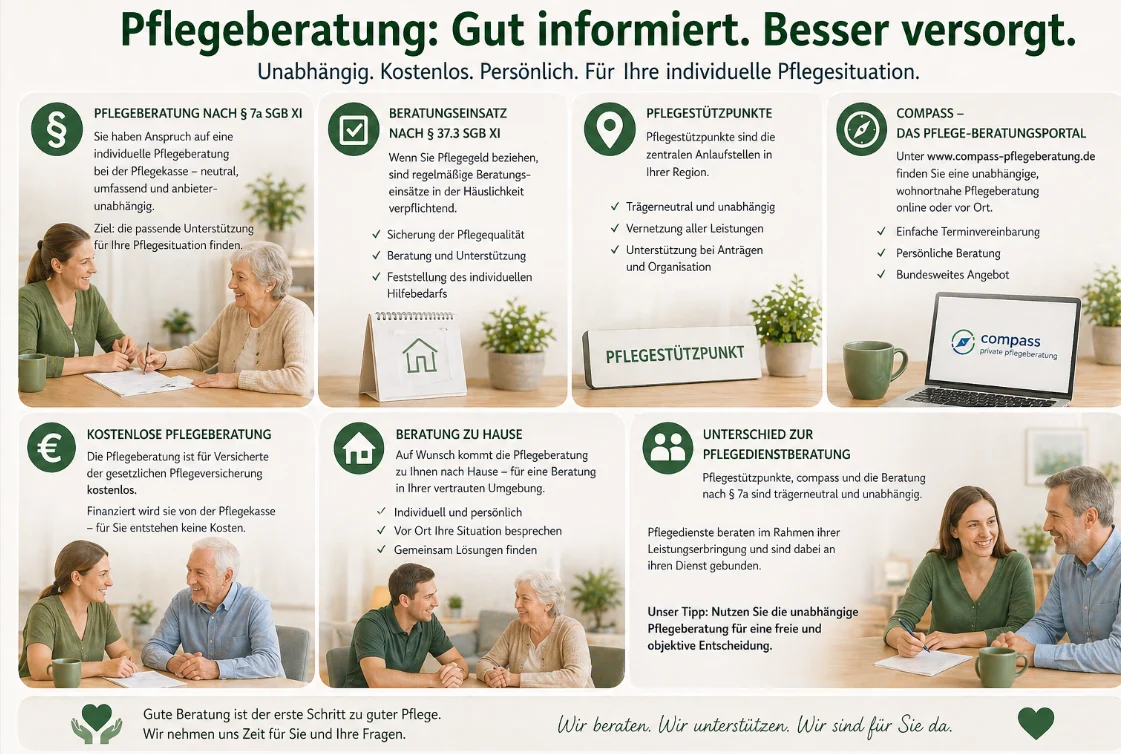
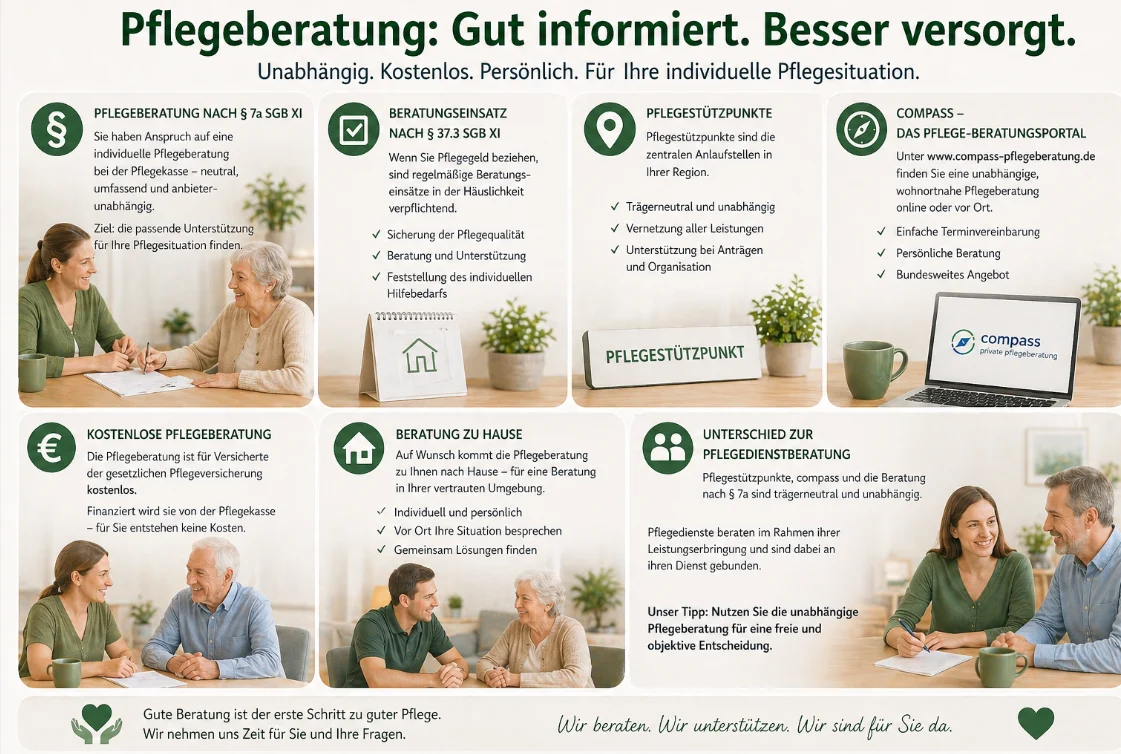
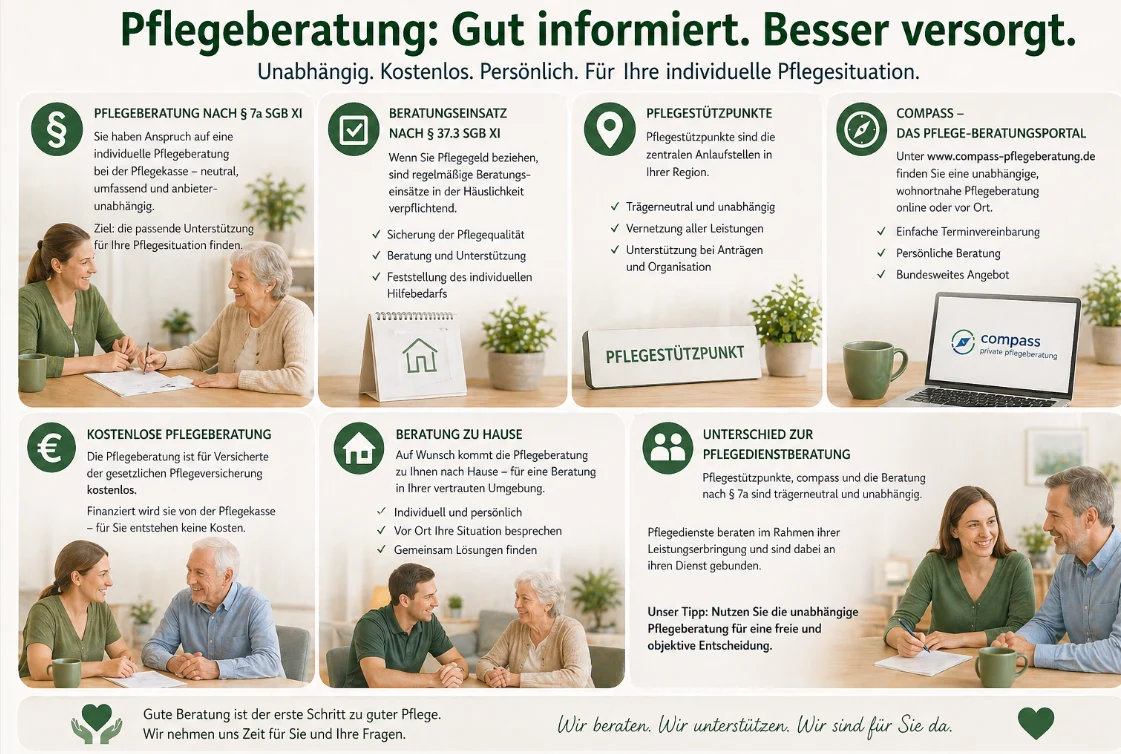
It makes strategic sense to seek advice before making major decisions. Long-term care insurance funds are obliged to provide advice, care support centres can offer assistance, and outpatient services or care homes also frequently explain care options. Nevertheless, families should remain critical: naturally, a provider will often explain the service they themselves offer. This is not malicious, just human and commercial. Impartial advice helps to identify alternatives and combine services in a sensible way.
Common mistakes when using care services
The first mistake is to sort benefits solely by the highest amount. A high amount is of little use if the benefit does not suit the situation. Day care is valuable if the person in need of care accepts it and transport arrangements are in place. Care benefits in kind are helpful if a service is available. Home adaptations are beneficial if they are planned in good time. The second mistake is to submit applications too late. Time can be of the essence, particularly when it comes to home modifications, assistive devices and short-term care.
The third mistake is a lack of documentation. The need for care is evident in everyday life, not just in a doctor’s report. Anyone wishing to demonstrate a need for support should describe specific situations: How often does someone need to help with getting up? What happens at night? Who administers medication? How is the risk of falling prevented? Which tasks are impossible to carry out without help? The fourth mistake is misplaced modesty. Many people downplay their situation during assessments or consultations. This is understandable, but counterproductive. Benefits should reflect actual needs, not the most optimistic version of a good day.
The fifth mistake is to treat relatives as an unlimited resource. Caring for someone can be fulfilling, but it can also be exhausting, physically demanding and emotionally draining. Not making use of the care allowance, respite care, day care, advice and care training courses does not automatically save money. It often merely shifts the costs towards health issues, conflicts and the breakdown of care within the home. Good care therefore protects not only the person in need of care, but also those who help them on a daily basis.
Practical examples: How care services work together effectively
An overview remains dry unless it is translated into everyday terms. Example one: A person living alone with care level 2 receives support from their daughter in the mornings and evenings. A home care service visits twice a week to help with showering and to check on their care needs. In this case, the combined benefit may be appropriate. Part of the benefits-in-kind budget is used for the care service, whilst the remainder is received proportionally as a care allowance. In addition, the relief allowance can be used for recognised domestic help or care support. Consumable care aids ensure good hygiene, and a home emergency call system can enhance a sense of security.
Example two: A person with care level 3 lives with their spouse, who is themselves in poor health. Care is generally manageable, but the days are long and the nights restless. In this situation, day care, the respite allowance and respite care can work together. Day care provides fixed care times, the respite allowance funds additional support with everyday tasks, and respite care allows the spouse to have days off or to rest. If more care is temporarily required following a hospital stay, short-term care can help stabilise the transition. It is precisely such combinations that prevent home care from being shouldered solely by one person making constant sacrifices.
Example three: A person with care level 4 can barely use their current flat. The bathroom is too cramped, getting into the bath is dangerous, and several steps make every appointment difficult. In this situation, care allowance alone is not enough. A structural solution is needed. The long-term care insurance fund may subsidise home adaptations; technical aids can make transfers easier; and, until these changes are implemented, short-term care or additional home care visits may be necessary. If a conversion is uneconomical or impossible, a care-related move may be considered. This shows that good care planning does not begin with a single service, but with the problem that needs to be solved.
Example four: As dementia progresses, physical assistance alone is often not enough. Relatives need support, structure, advice and respite. The respite allowance can be used for recognised care services; day care can provide social contact and a daily routine; care courses help with managing challenging behaviour; and professional advice can clarify when an upgrade is appropriate. The focus should not be solely on the number of minutes spent on physical care. Disorientation, supervision, night-time restlessness, a tendency to wander off, anxiety, aggression or listlessness can have a massive impact on everyday life. Anyone who fails to describe these issues in their applications often receives a decision that fails to reflect their actual circumstances.
The most important care services, categorised by life situation
When looking for the right care service, sorting by life situation is often more helpful than a simple list organised by legislation. Anyone receiving care at home from relatives should first look into care allowance, advisory visits, respite care allowance, care aids, respite care and, where applicable, home adaptations. Anyone who also needs professional help should plan for care benefits in kind and combined benefits. Anyone who needs support or care during the day without moving permanently into a care home should look into day care or night care. Anyone who cannot return home immediately after a hospital stay should plan for short-term care. Anyone who can no longer be cared for at home on a permanent basis must compare residential care services and personal contributions.
Another useful way of categorising these services is based on their purpose. Care allowance supports independent living. Care benefits in kind are used to purchase professional care. The respite allowance provides assistance with everyday tasks. Respite care replaces a carer who is temporarily unavailable. Short-term care bridges crises and transitional periods. Day care stabilises the weekly routine. Care aids reduce risks and strain. Home adaptations change the living environment. Care advice provides guidance. Benefits for carers protect those who make care possible in the first place. This logic makes the system easier to understand than any haphazard list, even though long-term care insurance still seems to take visible pleasure in turning simple things into bureaucratic jargon.
It is also important for those searching for information to note that not every benefit needs to be re-applied for every year. Many entitlements continue as long as the care level, eligibility criteria and type of care remain in place. Other benefits are tied to calendar years, monthly budgets or specific measures. That is why it is worth carrying out an annual review. Have care needs changed? Is the care allowance still being used appropriately? Are respite care allowances going unused? Is the scope of care services sufficient? Is there an entitlement to assistive devices, home modifications or day care? Does an appeal or a request for a higher care level need to be reviewed? Such a review is less dramatic than a crisis, but considerably more pleasant.
FAQ: Frequently asked questions about care services
Which care services will be a particular focus in 2026?
Particularly important topics include care allowance, care benefits in kind, combined benefits, respite allowance, day and night care, respite care, short-term care, care aids, home adaptations, care advice and residential care services. Which service is suitable depends on the care level and the individual’s care situation.
Do people with care level 1 receive a care allowance?
No, the standard care allowance is only available from care level 2 onwards. However, care level 1 may give access to other benefits, such as the respite allowance, care advice, care aids, grants for home adaptations and certain forms of support with everyday tasks.
What is the difference between care allowance and care benefits in kind?
Care allowance is paid out when care is organised privately. Care benefits in kind are used to cover services provided by an approved outpatient care service and are settled directly with the long-term care insurance fund. Both benefits can be combined via the combined benefit scheme.
Can the relief amount be paid out freely?
Generally speaking, no. The subsidy is earmarked for a specific purpose and is used for approved services. Invoices usually need to be submitted or settled directly by the provider.
How much is the grant for home adaptations?
Grants of up to 4,180 euros per measure may be awarded for improvements to the home environment. If several eligible persons live together, the amount may be higher under certain conditions.
Which is better: a care allowance or a care service?
It depends on your day-to-day circumstances. A care allowance is suitable if private care is reliably arranged. A care service is advisable if professional support is required. Often, the combined benefit is the best solution, as it combines both options.
What role does care advice play?
Care advice helps people to understand the services available, prepare applications and plan their care. If you are receiving care allowance, regular advisory visits are compulsory. Regardless of this, advice is useful if your condition changes or a new form of care becomes necessary.
Conclusion: Care services are a modular system, not a single application
To understand the full range of care services at a glance, it is essential to view the system as a modular structure. Care allowance supports private care. Care benefits in kind fund professional outpatient assistance. The combined benefit brings both together. The respite allowance provides additional support in everyday life. Respite care and short-term care cover periods when the carer is unavailable and facilitate transitions. Day care provides regular respite, assistive devices make care safer, home adaptations help maintain independence, and residential care steps in when care at home is no longer viable.
The most important practical advice is: don’t wait until the situation gets out of hand. The need for care often develops gradually, but applications, providers, home modifications and support arrangements all require lead time. Those who assess early on which services are suitable can organise care in a way that is more stable, dignified and bearable for relatives. The system remains complicated because, apparently, someone has decided that people in need of care should also become administrative experts on the side. But with a clear structure, it is possible to turn the many individual entitlements into a workable care plan.
Tagline
Don’t just ask about the highest amount. Ask which service solves the specific problem: ongoing care, professional help, respite care, substitute care, home modifications, assistive devices, advice or residential care.