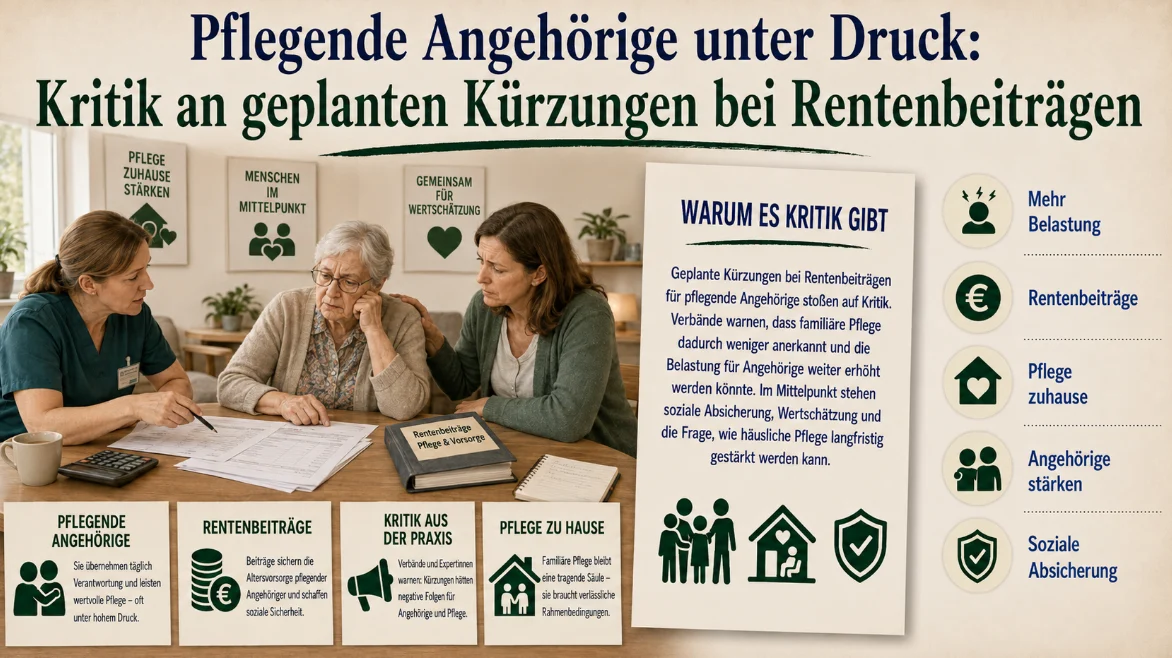
Family carers are the backbone of care provision in Germany. A large proportion of care does not take place in care homes or through professional services, but in flats, family homes and multi-generational households. Daughters, sons, spouses, partners, siblings and neighbours provide help with washing, getting dressed, eating, taking medication, attending doctor’s appointments, night-time care, organisation, housework and general support. Many reduce their working hours, change jobs, put their careers on hold or give up their jobs entirely for a time.
This is precisely why pension insurance contributions for family carers are a key component of social security. They are intended to compensate, at least in part, for the fact that carers earn less from their own employment due to providing care at home and therefore accrue lower pension entitlements. If these contributions are reduced, part of the financial burden is shifted into the future: care is provided today, but the consequences may only become apparent years later in the pension statement.
The crux of the criticism: The draft bill on care reform proposes that, in future, care insurance funds will pay lower pension insurance contributions on behalf of family carers. According to public reports, the contributions will no longer be covered in full, but only on a reduced basis. This would mean that family carers would accrue fewer pension entitlements.
Why pension contributions are so important for family carers
Those who care for relatives often take on tasks that would otherwise have to be carried out by home care services, day care centres, short-term care places or residential care homes. This work is physically, mentally and organisationally demanding. It often begins gradually with help with everyday tasks and, as the need for care increases, develops into a long-term responsibility. Care levels, care allowances, care benefits in kind, respite care allowances, respite care and advisory visits then become terms that shape everyday life.
Pension contributions are not merely an insignificant additional benefit. They recognise that carers invest time which they cannot use, or can only use to a limited extent, for paid work. The statutory pension scheme explicitly describes caring for relatives as a commitment that may be relevant to one’s pension if certain conditions are met. These include, amongst other things, providing care from care level 2 onwards, a minimum level of care required, and a restriction on one’s own gainful employment.
In practice, therefore, it is not about abstract pension points, but about real-life circumstances. A woman who cares for her mother, who has care level 3, and reduces her working hours does not merely lose her current income. She also accumulates less in her own pension provision. A son who looks after his father alongside his job and regularly reaches his limits cannot simply extend his working life at will. Anyone who cares for relatives over many years cannot simply make up for gaps in their own pension later on.
Care reform as an austerity package: where the pressure is coming from
Long-term care insurance is under considerable financial pressure. The number of people requiring care has risen sharply in recent years, expenditure is increasing, the personal contributions required in care homes remain high, and outpatient care is also becoming more expensive. The draft bill for the Care Reform Act is therefore intended to increase revenue, limit expenditure and change benefit structures.
The measures under public discussion include a higher surcharge for childless people, stricter rules on non-contributory co-insurance, adjustments to care levels, a postponement or cap on relief for care homes, and lower pension contributions for family carers. Supporters argue that long-term care insurance must be stabilised in the short term. Critics, on the other hand, see this as an austerity programme that places an additional burden on those in need of care, their relatives and local authorities.
Pflege-Portal had already noted that the planned reform could lead to higher costs for those in need of care. In residential care in particular, the focus is on personal contributions and relief surcharges. Read more in the article Care Reform 2026 will bring higher co-payments for those in need of care, announces Warken.
Home care must not become a hidden source of savings
The dispute over pension contributions highlights a fundamental problem in care policy: home care is regularly praised in political circles, but is often only provided with limited financial backing. Relatives take a considerable strain off care insurance funds, social welfare agencies, hospitals and care homes. Without their work, it would be impossible to organise care for many people. At the same time, many relatives themselves are affected by burnout, loss of income, loneliness and health problems.
If savings are made on their pension provision of all things, this creates a contradiction. On the one hand, people are supposed to be cared for at home for as long as possible. On the other hand, those who make this care possible would be worse off when it comes to their pensions. This can undermine the willingness to provide care at home or force families into difficult decisions: to continue providing care and accept long-term financial disadvantages, or to seek professional care services to a greater extent, even though these are scarcely available in many places.
This uncertainty can also have consequences for those in need of care. If relatives can no longer afford to provide care because their income and pension savings are being eroded too severely, the pressure on home care services, day care, short-term care and residential care homes increases. However, these sectors are already under strain in many places. A reform that saves on pension contributions in the short term could therefore generate new care costs in the medium and long term.
Caregivers are affected
This change is relevant for people who regularly assist relatives with home care and thereby accrue pension entitlements through the care insurance scheme. This is a particularly sensitive issue in cases of long-term care and reduced working hours.
Families are affected
When home care becomes a greater financial burden, families need to reassess care allowances, care benefits in kind, respite care budgets, working hours and their own pension provision. This can make organising home care considerably more difficult.
Criticism from the Bundestag, associations and the care sector
The planned cuts to pension contributions have now reached the Bundestag. During a special debate, the question of whether caring for relatives should lead to poverty was discussed. The very wording of the political debate shows just how great the concern is: this is not merely about a single calculation factor in the Social Security Code, but about respect, social security and the distribution of the burden within long-term care insurance.
Social welfare organisations, advocacy groups representing family carers and sections of the opposition criticise the reform for tackling the wrong issue. They argue that those who care for relatives perform work that is indispensable to society. These people should not be burdened further. The German Nursing Council and other stakeholders in the care sector also warn that the reform is too heavily focused on short-term financial stabilisation and pays too little attention to care provision, staffing, prevention and fair funding.
From the perspective of many of those affected, the debate comes at a difficult time. Care allowances, care benefits in kind, the respite allowance, respite care and short-term care are already difficult to understand. At the same time, the costs of everyday support, domestic help and care services are rising. If, on top of this, the old-age pension for family carers is now to be reduced, there is a growing sense that families are being asked to help plug the financial gap in the care insurance system.
What a cut might mean in practical terms
The exact impact depends on the level of care required, the scope of care, employment status and the specific legal provisions. As a general rule: if the long-term care insurance fund pays lower pension insurance contributions, fewer pension entitlements are accrued. This may seem manageable for individual months. However, over several years of care, the difference can add up significantly.
Those particularly affected would be people who provide a great deal of care over a long period and therefore scale back their working lives. This often affects women, but not exclusively. Men are also increasingly taking on care responsibilities, particularly when partners, parents or parents-in-law require care. The cut would therefore take effect during stages of life in which families are already under considerable organisational and financial strain.
For care advice, this means that relatives will need even clearer information in future. They need to know what pension entitlements arise as a result of providing care, what the eligibility criteria are, how changes brought about by the care reform will affect them, and what alternatives are available. This includes advice from care insurance funds, care support centres and, where applicable, the pension insurance scheme. Anyone taking on the responsibility of providing care should not have to wait until just before retirement to find out what long-term consequences their decision has had.
Care allowance, respite care budget and pension contributions go hand in hand
The issue of pensions must not be viewed in isolation. The same reform package also involves a review of existing care benefits. According to the draft, care allowances and benefits in kind are to be integrated more fully into new budgetary structures. For relatives, this means they must not only understand potential pension cuts, but also the new rules governing the respite care budget, the benefits-in-kind budget and the use of outpatient support.
It is precisely this simultaneous nature that makes the reform so contentious. If care allowance is transferred to a respite care budget, if care benefits in kind are reorganised and if pension contributions for carers are reduced, the foundations of home care will change in several areas at once. Families will then need not just individual explanations, but a comprehensive overview: What remains? What is being replaced? What is being cut? What evidence needs to be provided? And which benefits can still be used freely?
Pflege-Portal has already published its own analysis of the planned new budget structures: Care Reform 2026: Relief and in-kind benefit budgets are set to reorganise care services.
Why the debate is directly relevant to those in need of care
At first glance, the issue of pensions seems to concern the carer, not the person in need of care. In fact, the two are closely linked. Home care only works if relatives are able to provide it on a long-term basis. To do so, they need time, energy, financial stability, advice and a sense of what their own future holds. If this outlook deteriorates, the care of the person in need of care also comes under pressure.
Many people in need of care wish to remain in their own homes for as long as possible. Support from relatives is often crucial to this. Professional services can achieve a great deal, but they cannot cover every night-time watch, every instance of emotional support, every organisational task or every spontaneous request for help. When relatives are unable to help, gaps in care arise that cannot be filled at short notice.
That is why the planned reduction in pension contributions is more than just a minor detail in the reform. It affects the stability of home care as a whole. A long-term care insurance scheme that aims to strengthen home care must provide security for the people who support it. This includes care allowances, respite care services, advice, short-term care, respite care for carers, flexible working arrangements and a reliable old-age pension.
Funding remains the key unresolved issue
The debate also highlights that long-term care insurance has a structural funding problem. If rising costs are to be offset primarily through cuts, deferrals and stricter eligibility criteria, this ultimately often affects those in need of care and their relatives. Associations have therefore been calling for years for a broader funding base, more tax subsidies for services not covered by insurance and a fairer distribution of care costs.
The issue of pension contributions is a good example of this. If pension contributions for family carers are regarded as a non-insurance-related benefit, this raises the political question of why these costs are financed solely from contributions to the long-term care insurance scheme. A cut does not fundamentally solve this problem. It reduces expenditure, but it shifts the burden onto individual carers.
It had already become clear that long-term care insurance was facing a significant funding shortfall. Pflege-Portal had already provided context for the plans for cuts and higher contributions in its report Long-term care insurance faces a billion-euro shortfall: Minister Warken plans cuts and contribution increases.
What family carers should bear in mind now
This is still a draft bill, not final legislation. Family carers should therefore not be too quick to give up benefits or change existing care arrangements. However, it is important to follow developments closely and to keep a detailed record of your own situation. Anyone caring for a relative should carefully keep records of notifications from the long-term care insurance fund, the care level, the scope of care, care assessment visits and information from the pension insurance scheme.
It is also advisable to check your own pension entitlements regularly. The German Pension Insurance scheme can provide information on whether periods spent providing care are taken into account and what conditions must be met. Care support centres and care advice services can also help you understand the benefits available under the long-term care insurance scheme. In the case of long-term care, advice on balancing care responsibilities with work can be important, so that financial risks become apparent at an early stage.
For families, the following applies: the decision to take on caregiving should not be driven solely by moral pressure. Caregiving involves work, responsibility and a heavy burden. Anyone providing long-term care needs support. This includes respite care, clear arrangements within the family, professional help, time off and an honest assessment of the impact that care will have on income, work and pensions.
Conclusion: The reform touches on a sensitive issue in home care
The planned cuts to pension contributions for family carers are one of the most politically sensitive aspects of the care reform. They affect people who often provide an enormous amount of care behind the scenes. Anyone who cuts back on their old-age provision risks not only criticism from associations and the opposition, but also a loss of trust amongst families organising care at home.
A sustainable reform of the care system must stabilise its funding. However, it must not, of all things, undermine those who take the strain off the care system on a daily basis. Family carers need more certainty, not less. The Federal Government will therefore have to explain how home care is to be strengthened when, at the same time, the pension entitlements of family carers could be reduced.
Conclusion
The criticism of the planned cuts to pension contributions is justified because it strikes at the heart of home care. Family carers ensure that care is provided, save the system money and bear considerable personal risks. If their old-age provision is reduced, home care will become financially more precarious for many families. Any reform aimed at easing the burden on those in need of care and their relatives must preserve this social security and expand it in a way that is easy to understand.