
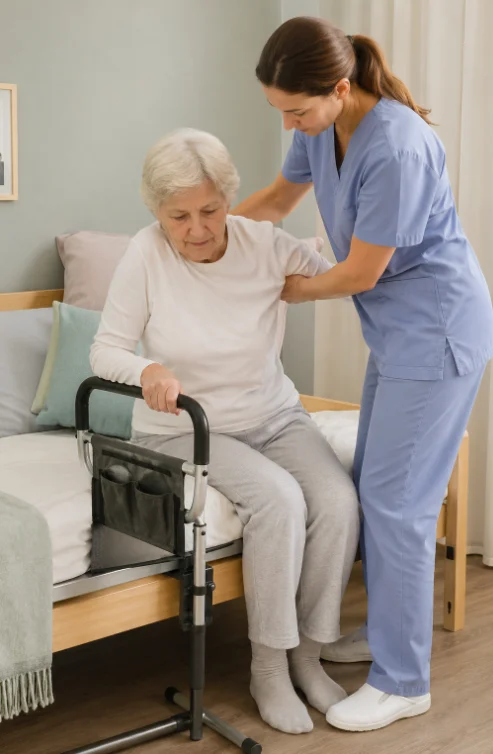
What transfer aids are and why they are so important
Transfer aids are devices that make it easier to move from one position or place to another. This refers to movements such as standing up, sitting down, moving from one place to another, lying down, sitting up, turning, sliding or repositioning. These movements occur constantly in day-to-day care. At first glance, they may seem unremarkable, but they are often precisely the moments when falls occur, pain arises or family carers become physically overburdened.
A transfer aid can be very simple. A handrail next to the bed, a transfer board, a stand-up aid attached to an armchair or a swivel plate in front of a wheelchair can already make a big difference. However, there are also more complex solutions such as patient hoists, ceiling hoists, mobile lever hoists, transfer aids with straps, electric stand-up chairs or special bath lifts. The range is vast, which is precisely why clear categorisation is important.
The purpose of a transfer aid is not to passively transport people from A to B, although some systems do allow for this. Good transfer aids make use of existing abilities. Those who can still use their legs may need a standing aid. Those who cannot stand securely may require a sliding board or a hoist. Those in severe pain need a solution that minimises movement whilst still ensuring safety. Those with cognitive impairments need clear, calm and predictable procedures.
It is particularly important to take the strain off the carer. Many relatives spend years lifting with their backs, pulling on arms, supporting people in awkward positions or nearly catching them as they fall. This is understandable from a human perspective, but physically devastating. Transfer aids can help make care safer, more dignified and, in the long term, sustainable at all. Caring is hard enough as it is; it shouldn’t also feel like a poorly organised weight-training session without a trainer.
Making it easier to change position
Transfer aids assist with moving between the bed, a chair, a wheelchair, the toilet, the shower or the bath.
Making the most of your remaining strength
Many aids support existing mobility rather than completely replacing every movement.
Preventing falls
A safe transfer reduces risks for both the person using the stairlift and their carers.
The living environment matters
The best solution takes into account door widths, bathroom size, bed position, flooring and actual care routines.
Typical situations in which transfer aids are needed
The most common reason for needing transfer aids is getting up from bed, a chair or an armchair. Many people can sit down, but are no longer able to stand up safely. Reasons for this include muscle weakness, pain, dizziness, balance problems, Parkinson’s disease, the after-effects of a stroke, osteoarthritis, rheumatism or a general age-related loss of strength. In such cases, standing aids, bed rails, raised seats, grab rails or special stand-up armchairs can help.
A second typical situation is transferring from bed to a wheelchair or care chair. This transfer is challenging because it involves several steps: sitting up, sitting on the edge of the bed, positioning the feet, shifting weight, standing up or sliding out, turning and sitting down safely. If just one part of this process goes wrong, the whole procedure becomes risky. Sliding boards, swivel discs, transfer belts or hoists can help here.
Transfers in the bathroom are particularly difficult. Toilets, showers and baths are often cramped, slippery and difficult to access. Added to this are wet surfaces, exposed skin, a lack of confidence and, at times, embarrassment. Toilet grab rails, shower seats, bath boards, bath lifts, handrails and anti-slip solutions are essential here. Unfortunately, the bathroom is often the room where German flat layouts reveal that accessibility was long regarded as an exotic hobby.
Repositioning in bed is also considered a form of transfer. People need to be turned, raised, positioned higher or moved to the edge of the bed. Sliding mats, sliding sheets, lifting aids, care beds, bed hoists or side handrails can assist with this. A solution that is gentle on the back and the skin is particularly important for those who are bedridden, at risk of pressure sores or in pain.
Another area is getting in and out of the car. Swivel seats, transfer aids, grab handles, sliding boards or special swivel seats can help here. These solutions are particularly relevant when doctor’s appointments, therapy sessions, day care or family visits take place regularly. Mobility does not end at the front door, even if some systems seem to stop right there in people’s minds.
| Situation | A common problem | Possible transfer aid |
|---|---|---|
| From bed to wheelchair | Standing up, turning round and sitting down can be tricky | Sliding board, transfer belt, swivel platform, hoist |
| From armchair to standing position | not enough strength in the legs and arms | Standing aids, stand-up chairs, grab rails |
| Toilet | Confined space, low seat height, risk of falling | Toilet seat raiser, grab rails, transfer aid |
| Shower or bath | Dampness, risk of slipping, high step | Shower chair, bath board, bath lift |
| Turning a person over in bed | Pain, skin irritation, considerable physical exertion | Sliding mat, sliding sheet, care bed, standing aid |
What types of transfer aids are available?
Transfer aids can be categorised according to their function. There are aids for standing up, aids for sliding and repositioning, aids for turning, aids for lifting, aids for the bed and bathroom, as well as structural or furniture-based solutions. This distinction is important because not every problem needs to be solved with a large piece of technical equipment. Sometimes a well-placed handrail is enough. Sometimes, however, a simple handrail is dangerously inadequate, as a hoist would actually be necessary.
Standing aids help people who wish to stand up from a seated position. These include grab rails, mobile standing aids, bed rails, chair attachments, armchairs with a standing function, or frames that you can pull yourself up against. They are suitable if the person concerned is still able to use their legs and arms. Anyone who is completely unable to stand will not be safely supported by a stand-up aid alone.
Sliding and transfer aids assist with sideways transfers, such as from a bed to a wheelchair. Sliding boards, transfer boards, sliding mats and sliding sheets reduce friction and enable a controlled transfer without having to lift the person completely. These aids are particularly useful when the person can sit but cannot stand safely. The correct technique is important, as a sliding board used incorrectly is not a help but a slippery mistake with the potential to cause an accident.
Turning aids such as turntables or swivel discs make it easier to turn in a controlled manner whilst standing or sitting. They are often used when it is difficult to move one’s feet or when turning causes pain. It is usually necessary for the person to be able to stand briefly or sit with some weight-bearing capacity. Turntables can make it easier to transfer from a bed to a chair or from a wheelchair to the toilet, but require calm guidance.
Lifting aids and hoists are used when the person concerned is unable to cooperate sufficiently or when transfers using muscle strength are too dangerous. Mobile patient hoists, floor-mounted hoists, ceiling-mounted hoists or bath hoists take on a larger share of the load. They are particularly important in cases of high body weight, severe weakness, paralysis, advanced illness or when relatives are physically unable to lift the person. A hoist may initially seem large and technical, but in everyday life it can be a much more dignified solution than uncertain pulling and lifting.
Standing aids: when getting up from a seated position becomes difficult
Standing aids are among the most common transfer aids. They are designed for people who can still stand or walk, but are no longer able to take that first step safely from a seated position. The problem is often caused by weak thigh muscles, pain in the knees or hips, dizziness, a lack of arm strength or seating that is too low. An armchair that is too low can become a bit of a trap in old age – albeit one with upholstery and sentimental family history.
Simple standing aids are sturdy handles or frames that are placed next to the bed, a chair or an armchair. They provide support when pushing oneself up and offer security when sitting down. It is important that the aid is stable or securely fixed in place. Wobbly solutions are dangerous. Anyone who pulls themselves up using an unstable piece of furniture risks falling and knocking the furniture over.
Electric stand-up chairs slowly raise the seat and tilt it slightly forwards. This means the user needs to exert less effort. Such chairs can be very helpful if your favourite armchair has become too low or if getting up several times a day is causing problems. However, they are not a substitute for every type of mobility aid. Anyone who is unable to stand or walk safely after getting up needs additional support.
Toilet seat raisers are also effectively a form of standing aid, as they raise the seat height and shorten the distance one has to move. When combined with side support handles, they can make using the toilet significantly safer. This is a particularly sensitive issue for many people. A good solution provides safety and maintains independence without turning every visit to the toilet into a team effort.
When choosing a standing aid, factors such as height, weight, grip height, arm strength, seat height and the surrounding environment should be taken into account. An aid that is too high can be just as problematic as one that is too low. If the person has to lean forward too far or their feet are poorly positioned, the risk increases. A brief demonstration by a nurse, physiotherapist or occupational therapist can make a world of difference.
Sliding boards, sliding mats and transfer boards
Transfer aids are particularly useful when a person can sit but cannot stand securely. Instead of lifting the person, the transfer is carried out in a controlled, gliding motion. This can be done from the bed to a wheelchair, from a wheelchair to a shower seat, or from a wheelchair to a car seat. The main advantage: less physical effort, less strain on the arms and shoulders, and, in most cases, greater control.
A transfer board is a sturdy board that is placed between two seats. The person slides across the board from one side to the other. To do this, the seats must be as close to the same height as possible, the wheelchair brakes must be applied, and the board must be positioned securely. Small differences in height are acceptable, but large differences make the transfer difficult or dangerous.
Sliding mats and sliding sheets are frequently used in bed. They reduce friction and make it easier to turn, reposition or lift a person. This is particularly important for people who are in pain, are unable to assist much, or are at increased risk of skin damage. Less friction means less strain on the skin and the carer. A piece of fabric can sometimes be that revolutionary, which once again shows just how low the bar for human ingenuity in everyday life can sometimes be.
Transfer boards come in various shapes, lengths and materials. Some are straight, others curved. Curved boards may be more suitable for certain transfers, for example when the wheelchair is not positioned exactly parallel. The surface should allow for smooth gliding, but not be uncontrollably slippery. Edges must be neatly finished so that clothing and skin do not get caught.
Practising how to use a sliding aid is essential. The correct foot position, leaning the upper body forward, hand position and pace are crucial. Relatives should not simply pull, but should guide the movement. If the person is anxious, they often tense up, which makes the transfer more difficult. Patience here is not a pedagogical luxury, but a safety factor.
Patient hoists, floor-mounted hoists and ceiling-mounted hoists
Stairlifts are used when transfers can no longer be carried out safely with simple aids. They support a large proportion of the user’s body weight and enable transfers without the need for heavy lifting. This may be necessary when moving from a bed to a wheelchair, from a wheelchair to the toilet, or from the floor back into a safe position. Particularly in cases of advanced care needs, stairlifts are often not an over-the-top solution, but rather the sensible choice.
Mobile patient lifts are mounted on a wheeled frame. A lifting arm is positioned over the person, a suitable harness is fitted, and the person is lifted electrically or hydraulically. They can then be moved to another location. Mobile patient lifts require sufficient space, particularly under the bed and around the wheelchair or toilet. This can be difficult in small flats.
Standing lifts assist people who are still able to stand to some extent. They help the person move from a seated position into an upright position and support them during the transfer. This is useful when the person still has some strength left and standing is required for therapeutic or practical reasons. Standlifts can make toilet transfers easier, as they allow better access to clothing and personal hygiene than a full-body sling.
Ceiling hoists run along a rail attached to the ceiling. They save floor space and are particularly convenient for regular transfers. However, installation is more complex and must be suited to the layout of the room. Ceiling lifts can be permanently fitted in a single room or designed as a rail system connecting several areas. This is a particularly effective solution for those requiring a high level of care.
Choosing the right lifting harness is crucial. There are various harnesses available to suit different body shapes, medical conditions and transfer situations. A harness that does not fit properly can cause pain, pressure sores or a feeling of insecurity. That is why the selection process should not be treated as an afterthought. Guidance and instruction are essential, not just a formality.
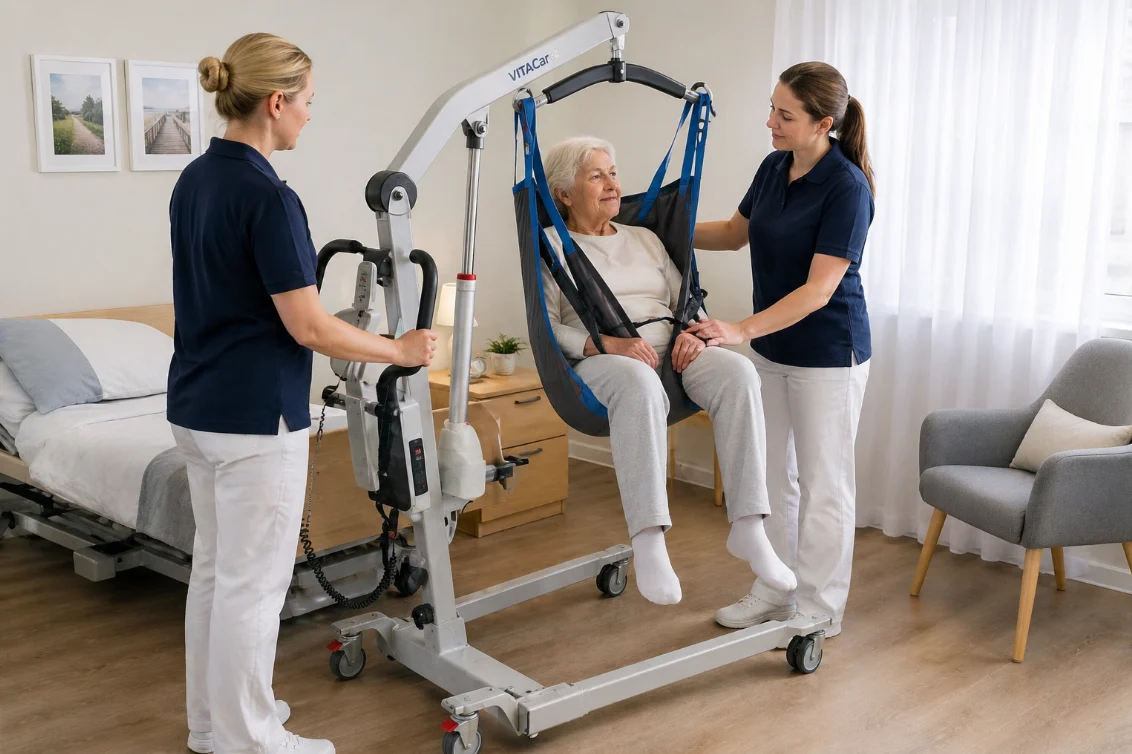 Patient lifts: suitable when standing up or standing is no longer possible safely.
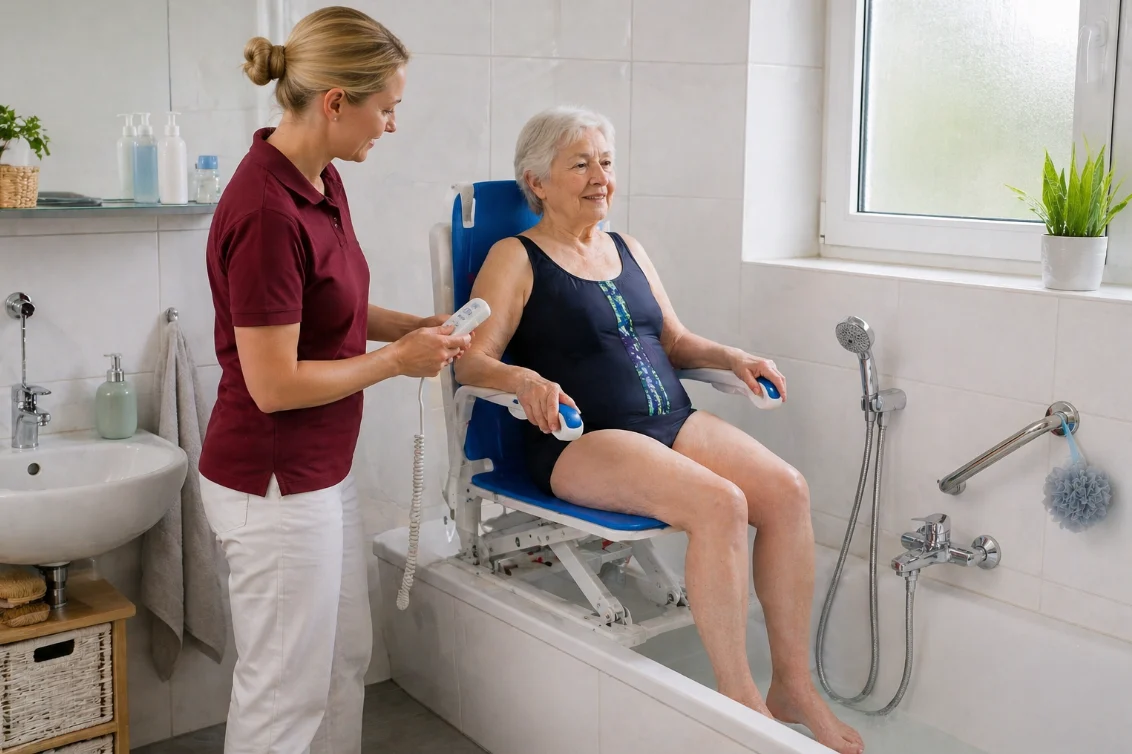 Bath lifts: assist with safe transfers in and out of the bath.
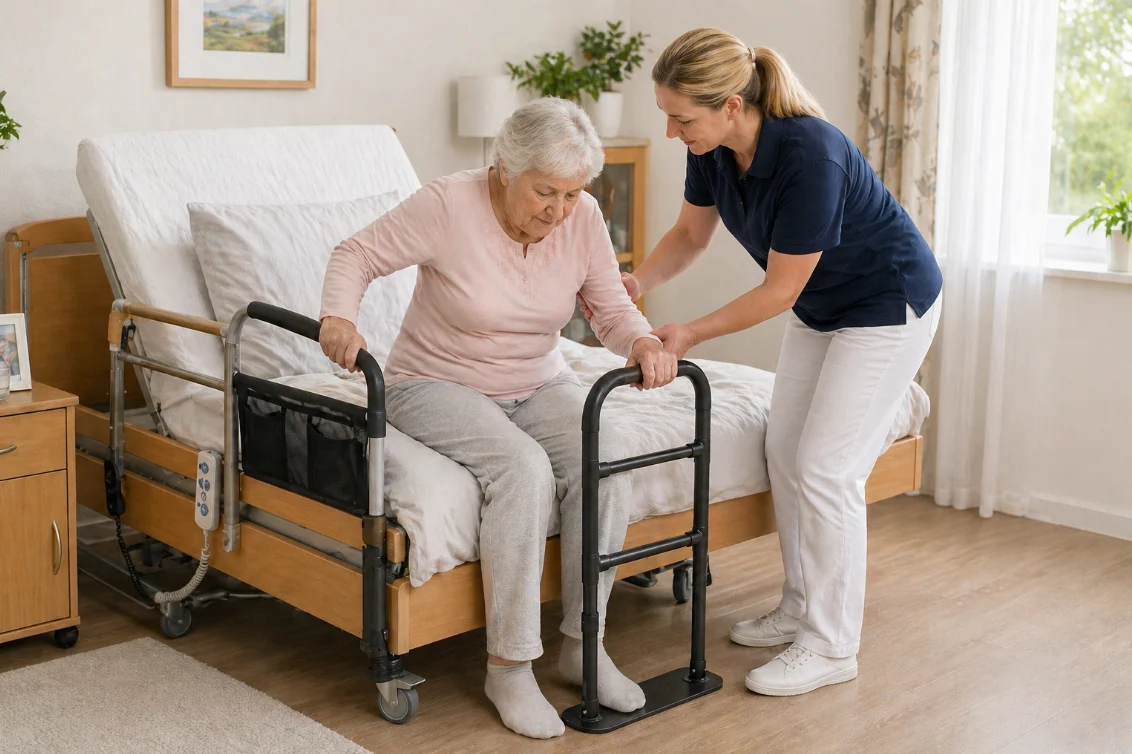 Bed handle: makes it easier to sit up, turn over and get out of bed.
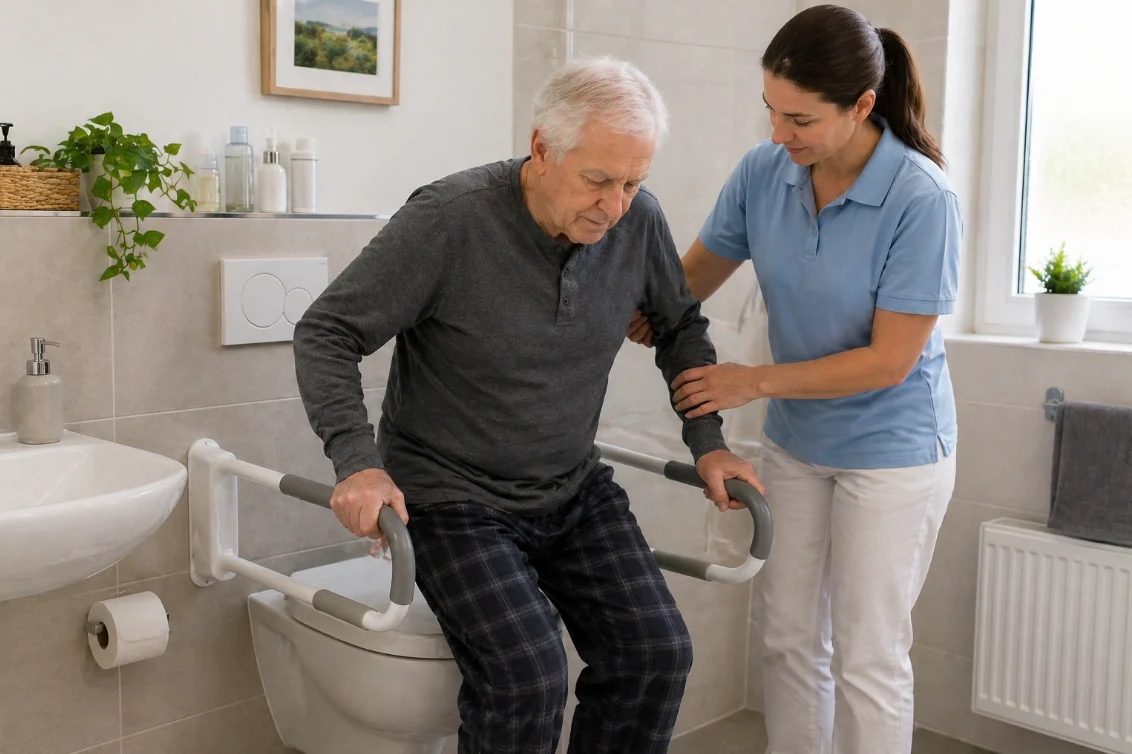 Toilet grab rails: provide support when sitting down, standing up and moving around in the bathroom.
Transfer aids in the bathroom: toilet, shower and bath
The bathroom is one of the most important places for transfer aids. It is a space where confined areas, hard surfaces, wet conditions, feelings of embarrassment and the risk of falls all come together. Anyone who feels unsteady there can quickly lose their independence. Good transfer aids in the bathroom can enable personal hygiene and using the toilet to continue safely and with dignity for longer.
For the toilet, options include raised toilet seats, folding support handles, grab rails, toilet wheelchairs or transfer aids. A raised seating position reduces the effort required when sitting down and standing up. Side handles provide stability. It is important that the handles are fitted correctly and can reliably support the user’s body weight. A single screw in crumbling plaster in an old building is not a safe solution, even if the product description on the DIY shop shelf sounds surprisingly optimistic.
In the shower, shower stools, shower chairs, shower wheelchairs, wall-mounted folding seats, grab rails and non-slip flooring solutions can be helpful. For transfers from a wheelchair into the shower, a shower chair with armrests or a shower wheelchair may be useful. Level-access showers make things much easier, but are not always available. If alterations are possible, they should be planned in conjunction with transfer aids.
For the bath, there are bath benches, bath seats and bath lifts. A bath bench allows you to sit over the edge of the bath without having to get fully in. A bath lift lowers the person into the bath and lifts them out again. This can be an alternative to carrying out alterations if you already have a bath. However, it is important to check whether getting in, the sitting position and the operation are truly safe.
Bathroom aids should always be tailored to the actual layout of the bathroom. The direction the door opens, the washbasin, the radiator, the position of the toilet, the shower enclosure and the space available for movement all play a part. Many bathrooms are not small; they are simply poorly laid out. Transfer aids can improve this, but they cannot defy the laws of physics.
Transfer aids for use around beds and care beds
The bed is a central feature of everyday care. Many transfers begin or end there. If getting up, lying down, turning over or sitting up is difficult, even a normal bed can become a daily hurdle. Transfer aids for use around the bed range from simple handrails to electrically adjustable care beds.
A bed handle or sit-up aid can help you move from a lying position into a sitting position. A bed hoist enables you to pull yourself up using your arms. Side handrails provide support when turning or getting up. It is important that these aids are stable and fitted correctly. They must not get caught or obstruct your exit from the bed.
A care bed can make transfers considerably easier. Height adjustment, an adjustable backrest and leg supports help to position the body in a better starting position. If the bed can be raised to working height, this reduces the strain on carers. When transferring to a wheelchair, the bed height can be adjusted to match the seat height. This may sound trivial, but it saves an enormous amount of effort in everyday life.
Sliding mats, sliding sheets and repositioning aids help with repositioning. They are particularly important if the person spends a lot of time in bed. Regular repositioning can prevent pressure sores and reduce pain. When doing so, care should be taken to protect the skin and not to drag the sheet across it. Friction in a care bed is not a test of character, but a risk.
Particular attention must be paid to safety when getting up to use the toilet at night or if the person is restless. Good lighting, easily accessible aids, a stable footing next to the bed and clear pathways reduce the risk of falls. If the person becomes confused at night or gets out of bed too quickly, simple aids may not be sufficient. In such cases, care professionals or doctors must be consulted.
How to choose the right transfer aid
The selection process does not begin with the product, but with the mobility issue. Which movements are difficult? Where does the person feel unsteady? Is there a lack of strength, balance, mobility, spatial awareness or space? Is the person in pain? Can they assist with the process? How much support can the carer provide? Only once these questions have been answered does the search for an aid make sense.
An important factor is the person’s remaining mobility. Can they stand when supported? Can they briefly bear their weight on their legs? Can they use their arms? Can they understand instructions? Can they sit? Can they bend forwards? Depending on the situation, completely different types of assistance may be required. A person who can sit safely but cannot stand needs different solutions to someone who can stand briefly but is unsteady when turning.
The home environment must be carefully assessed. Door widths, bed position, wheelchair width, floor covering, carpet edges, bathroom size, toilet height, shower access and storage options all determine whether a transfer aid will work in practice. A mobile stairlift requires space for its support legs. A sliding board requires suitable seat heights. A ceiling-mounted lift requires a load-bearing installation. Unfortunately, the home has no regard for product promises.
The carer matters too. An aid must work for both parties. If relatives cannot operate the aid safely, it will not be used. If installation is too complicated, the aid will end up in the storeroom. If operating it causes anxiety, people will go back to walking. That is why instruction, practice and simple procedures are crucial.
Advice is particularly important when it comes to transfer aids. Medical supply shops, specialist care services, occupational therapy, physiotherapy, home adaptation advice or care advice services can help you find the right solution. For complex transfers, a practical trial should be carried out. Ideally, the transfer should be tested in the actual home. An aid that only works well in a showroom is about as useful as an umbrella in an advert without any rain.
Costs, prescription, health insurance and long-term care insurance
The costs of transfer aids vary considerably. Simple aids such as grab rails, transfer boards or swivel discs can be relatively inexpensive. Electric stand-up chairs, patient lifts or ceiling lift systems cost significantly more. On top of this, there may be costs for installation, maintenance, customisation, accessories and training. It is therefore important to clarify at an early stage whether the costs can be covered.
Many transfer aids can be prescribed as medical aids through the statutory health insurance scheme if they are medically necessary and serve to compensate for a disability, treat an illness or ensure the success of treatment. A doctor’s prescription is usually required for this. The medical supplies shop can often check whether the specific product is listed in the assistive devices register or advise on how to submit the application.
The long-term care insurance fund may be relevant when it comes to care aids or measures to improve the home environment. If a care level has been assigned, certain measures to improve the home environment may be subsidised if they enable or facilitate home care. Depending on the situation, these may include structural alterations to the bathroom, widening doorways, ramps or permanently installed aids. Each case is always assessed on an individual basis.
The order of events is important. Applications for assistive devices and home modifications should, where possible, be submitted before making a purchase or before work begins. Anyone who buys first and then submits the invoice risks being left to foot the bill themselves. Bureaucracy isn’t pleasant in this context, but it’s a reality, so it’s best to take it seriously from the outset.
If your application is rejected, it is worth looking into the matter in detail. Sometimes documents are missing; sometimes the justification is too brief; and sometimes the reasons why the aid is necessary for everyday life have not been adequately explained. Medical reports, care records, photographs of the home environment or statements from therapists can help. It is crucial to describe the need in concrete terms: which transfers cannot be carried out safely without assistance, and what are the consequences of this?
| Assistive devices | typical price range | Possible funding sources |
|---|---|---|
| Sliding board, turntable | low to medium | Health insurance cover where medically necessary |
| Grab rails, toilet supports | low to medium; installation charged separately | Health insurance or long-term care insurance, depending on the purpose |
| Bath lifts | medium | May be covered by health insurance if prescribed |
| Patient hoists | high | Health insurance cover where medically indicated |
| Home adaptations | very varied | Long-term long-term care insurance fund for care levels and approved measures |
Integrating transfer aids correctly into everyday care routines
A transfer aid is only useful if it is used regularly and correctly. Many aids fail not because of the technology, but because of everyday life. They are too far away, not within easy reach, seem complicated or have never been properly explained. So relatives fall back on the old method: giving a quick support, hoisting the person up somehow, and hoping nothing goes wrong. It is precisely this method that is popular because it seems convenient in the short term, yet dangerous because, in the long run, it takes its toll on the body and the nerves.
The transfer should be planned as a fixed procedure. Before starting, brakes must be applied, routes cleared, aids ready, clothing organised and the person informed. Rushing is one of the biggest mistakes. Anyone who is still looking for the transfer board or dragging the wheelchair along in the middle of the transfer has already lost control of the process. Preparation may seem tedious, but it is half the battle when it comes to safety.
Communication is key. The person concerned should know what is going to happen next. Short, clear instructions help: place your feet on the steps, lean forwards, hold onto the handrail, press down as you count, and sit down slowly. For people with dementia or confusion, calmness and repetition are particularly important. Too many words can be overwhelming; too few can cause anxiety.
Carers should work in a way that protects their backs. This means: supporting the person close to your body, avoiding twisting, keeping your knees slightly bent, using assistive devices, not pulling with your back and avoiding risky lifting manoeuvres. If a transfer can only be carried out regularly by using a great deal of force, the provision of assistive devices is inadequate. Care work may be strenuous, but it should not be a daily risk of suffering a slipped disc.
Following the initial fitting, it is important to check whether the transfer aid is actually being used. Are there any concerns? Is it too heavy? Does it not fit in with the surroundings? Does the person not understand how to use it? Has their state of health changed? The need for assistive devices is constantly evolving. What works today may no longer be sufficient in six months’ time. Regular adjustments are therefore not a luxury, but sensible care planning.
Common mistakes with transfer aids and how to avoid them
A common mistake is to leave it too late to consider transfer aids. Many families wait until a fall has already occurred or until a family member is physically at their limit. It makes more sense to start monitoring mobility needs early on. If it takes longer to get up, if someone is reaching for furniture for support, or if family members regularly have to pull or lift them, it is time to seek advice.
A second mistake is misjudging a person’s abilities. Some people are overestimated because, on good days, they are still capable of achieving a surprising amount. Others are underestimated, which makes them unnecessarily passive. Mobility aids should neither overwhelm nor render people incapable of making their own decisions. They should provide exactly as much support as is necessary, whilst allowing as much independent activity as possible.
Assistive devices are often chosen based on price or appearance. This is understandable, but risky. A cheap sliding board that doesn’t fit the seat height isn’t cheap – it’s useless. A stylish stand-up chair from which the person cannot walk away safely after standing up only solves half the problem. A stairlift that doesn’t fit through the door is a monument to poor planning.
Another mistake is a lack of instruction. Especially with stairlifts, safety harnesses, sliding aids and bath transfers, users need to practise how to use them. Anyone who is given a brief explanation of how to use the equipment and then carries on on their own risks making mistakes. A good induction should demonstrate how the aid is prepared, used, cleaned, checked and safely stored.
The surroundings are also often underestimated. Loose rugs, furniture placed too close together, poor lighting, slippery floors and a lack of handrails make transfers more dangerous. Transfer aids work best when the surroundings are taken into account. Sometimes removing a carpet is just as important as the new aid itself. Tragic for the carpet, but good news for the hips.
Relief for relatives and carers
Family carers perform an enormous amount of physical work. Transfers are among the most physically demanding tasks, as they occur frequently, spontaneously and often require awkward body positions. Getting out of bed in the morning, going to the toilet during the day, getting back into bed in the evening, plus showers, doctor’s appointments, repositioning and emergency situations. Anyone who does this without aids often underestimates how much small strains can add up.
Transfer aids protect not only the person requiring care, but also the carer. They reduce the strain on the back, shoulders, wrists and knees. At the same time, they alleviate the fear of letting someone fall. This psychological relief is often overlooked. A safe procedure gives both parties greater peace of mind.
Many relatives are reluctant to use assistive devices. They perceive them as impersonal or fear that the person receiving care might feel neglected. In practice, the opposite is often the case. A calm, safe transfer using assistive technology is more dignified than frantic tugging, staggering and clinging on. Technology can be very humane when it reduces pain and anxiety. What a blow to all those who romanticise improvisation.
It is important to involve the person concerned. Transfer aids should be explained and tried out together. Anyone who suddenly finds themselves strapped into a stairlift harness without knowing what is happening will, understandably, become wary. Trust is built through a gradual introduction, clear procedures and positive experiences.
Relatives should also not be afraid to seek professional help. Care advice services, care providers, occupational therapists or medical supply shops can demonstrate and improve transfer techniques. You don’t have to figure everything out on your own. After all, humankind has developed wheels, levers and specialist professions; it’s perfectly fine to make use of them from time to time.
Transfer aids for people with dementia, unsteadiness or anxiety
In cases of dementia or cognitive impairment, transfers become even more challenging. The person may not understand why they are being asked to stand up, where they are being seated, or what the aid does. This can lead to anxiety, resistance, restlessness or sudden movements. In such cases, it is not just the aid itself that is crucial, but the entire process.
Clear routines help. Transfers should follow the same procedure as far as possible: the same sequence, the same words, the same position, and a calm environment. Too many people, loud instructions or hectic movements can be overwhelming. Assistive devices should be visible and familiar. When using a stairlift, it can help to show the harness beforehand and announce the movement slowly.
When someone is anxious, safety is more important than speed. Some people need time to adjust to a change of position. Pressure often makes the situation worse. Carers should explain, reassure and avoid arguing as if they were at a board meeting. Short sentences, eye contact and a gentle touch can be more effective than technical explanations.
Not every transfer aid is suitable for people with dementia. Complex devices can cause anxiety if they are not introduced gently. At the same time, stairlifts or stable transfer aids can be particularly useful when sudden movements increase the risk of falling. Professional advice should be sought in such cases.
It is also important to bear in mind that pain can be a cause of resistance. Anyone who experiences pain during a transfer will resist or tense up. In such cases, it may be necessary to adapt not only the procedure, but also, where appropriate, pain management, positioning or the choice of aids. Behaviour is often a form of communication, even if it is difficult for relatives to interpret.
Practical examples: Which type of assistance suits which need?
Example one: A person can still manage a few steps but finds it difficult to get up from a deep armchair. In this case, a combination of a higher seat, a sturdy grab rail and, possibly, an electric lift chair may be a sensible solution. A stairlift would probably be overkill as long as the person can stand and take steps safely.
Example two: A person can sit but can no longer stand safely. Transferring from the bed to the wheelchair is difficult every time. A transfer board, transfer belt or sliding mat can help here. This requires that the seating surfaces can be positioned correctly and that the person understands the movement. If this is not sufficient, a stairlift should be considered.
Example three: A person is paralysed on one side following a stroke and is unable to shift their weight safely. Transfers carry a high risk of falls. Depending on the person’s remaining abilities, standing lifts, patient lifts or specially adapted transfer techniques may be necessary. Occupational therapy and physiotherapy should be involved to help maintain abilities and reduce risks.
Example four: Getting to the toilet is the main problem. The person can make their way to the bathroom, but sitting down and standing up are difficult. A toilet seat raiser, folding support rails, better lighting and a non-slip floor can help here. If standing and turning are difficult, a commode chair or a transfer aid may be worth considering.
Example five: A person is no longer able to assist actively and needs to be moved regularly from their bed to a care chair. In this case, a patient lift or ceiling lift is often the safest solution. Relatives should not be expected to lift the person on a permanent basis. This is not a test of love, but a health risk for both parties.
Checklist before purchasing a transfer aid
Before making a purchase, the specific needs should be set out in writing. Which transfers are problematic? How often do they occur each day? Who helps with these? Have there been any falls or near-falls? What pain is experienced? What assistive devices are already in use? A clear description facilitates advice, a doctor’s prescription and the application process.
Next, the home environment should be assessed. This includes measurements of doors, the bathroom, the bed, the wheelchair, storage areas and space for movement. Photographs can be helpful during the consultation and when submitting an application. Measurements and structural requirements are particularly crucial for stairlifts or fixed handrails.
Where possible, the person concerned should be given the opportunity to try out the aid to see how it feels. Acceptance is important. An aid that causes anxiety or pain will not be used. For complex aids, training should be provided and, ideally, documented.
Cleaning and maintenance should also be taken into account. Straps, steps, mats and handrails must be kept hygienically clean. This is particularly important in the bathroom or in cases of incontinence. Materials should be robust, easy to wipe clean and suitable for their intended use.
Finally, issues such as who covers the costs, delivery times, fitting, maintenance and who to contact should be clarified. Who pays? Who installs it? Who explains how it works? Who carries out repairs? Who replaces it if circumstances change? These questions may be less exciting than product images, but they determine whether the solution will work in everyday life.
Needs and context
- Make a note of any problematic transfers
- Describing frequency and risks
- Measuring door widths and clearance areas
- Check the position in the bathroom, in bed and in the wheelchair
- Take photos for the consultation and application
Safety and instruction
- Trying out assistive devices in practice
- Receive training
- Check the brakes and stability
- Training care staff in technical matters
- Check procedures regularly
Frequently asked questions about transfer aids
Mobility aids raise many practical questions because they directly affect intimate everyday situations. The most important question is usually: Which aid is the right one? There is no one-size-fits-all answer. The key factors are mobility, strength, medical condition, living environment and the support that relatives or care services can provide.
Many people also ask whether transfer aids are covered by health insurance. If there is a medical need, a prescription may be issued. Whether the specific aid is covered depends on the individual case. If a care level has been assigned, supplementary benefits from the long-term care insurance fund may also apply, particularly if the home environment needs to be adapted.
Another common question concerns dignity. Some people are worried that using assistive devices will make them appear even more dependent. In fact, transfer aids can have exactly the opposite effect: they enable greater independence, reduce anxiety and make it easier to plan for assistance. A safe transfer is more dignified than a risky struggle to pull oneself up whilst in pain.
When relatives are using the equipment, it is important to consider whether training is necessary. For simple handles or boards, brief instructions are sometimes sufficient. For stairlifts, harnesses, bath transfers or complex situations, professional training is essential. Operating errors can be dangerous.
If a person’s state of health changes, their mobility aid must also be reviewed. Increased weakness, new pain, cognitive changes or a move house may mean that a solution which was previously suitable is no longer appropriate. The provision of assistive devices is not a one-off event, but part of ongoing care planning.
Conclusion: Mobility aids promote safety, dignity and independence
Transfer aids are among the most important assistive devices in everyday care. Whilst they may seem less spectacular than large mobility aids, they play a crucial role in ensuring safety, independence and reducing strain on a daily basis. For many people, moving safely from bed to a wheelchair, from an armchair to a standing position, or from a wheelchair to the toilet is essential to being able to live at home at all.
The right solution always depends on specific needs. Sometimes a handrail is enough, sometimes a sliding board is required, sometimes a hoist, or a comprehensive bathroom adaptation. It is important not to improvise based on gut feeling, but to analyse movement patterns carefully and seek expert advice.
For relatives, transfer aids provide protection against physical strain. Nobody should have to lift, pull or carry out risky transfers on a permanent basis simply out of habit. Good aids do not make care less personal; rather, they make it safer and more reliable. They reduce anxiety, pain and the risk of falls.
Planning mobility aids early on can often make it possible to provide care at home for longer. In doing so, cost coverage, prescriptions, care levels, home adaptations and practical training should all be considered together. An aid is only effective if it is not just approved and delivered, but actually used in everyday life.
Transfer aids are therefore not a minor matter, but a key element of good home care. They help to make movements more controllable, maintain existing abilities and take the strain off carers. This is precisely why they should not only be considered once the first fall has occurred.