
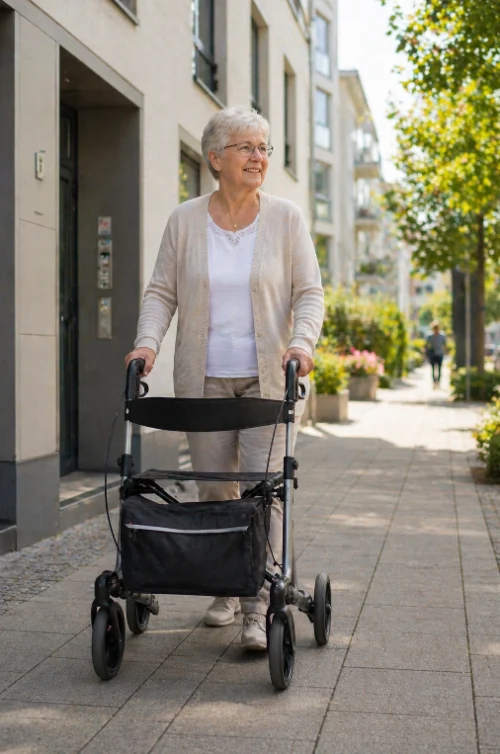
What a rollator is designed to do in everyday life
A rollator should not only enable mobility, but also make it safer, more predictable and less tiring. That may sound obvious, but it is the most important factor to consider when choosing one. A good model is suited to the routes you actually walk, rather than an idealised image from a brochure, a consultation or an online comparison. Someone who mainly covers short distances indoors needs different features to someone who is regularly out and about, has to negotiate kerbs or frequently stows their rollator in the car.
Essentially, a rollator fulfils several functions at once. It provides support whilst walking, allows for short breaks thanks to its seat, carries small items and offers safety in situations where a walking stick is no longer sufficient. This combination can be particularly valuable in cases of declining strength, balance problems, dizziness, unsteady gait, pain or shortness of breath. A rollator does not replace one’s own mobility, but supports it precisely where it has become unstable.
Many people hesitate for a long time before using a rollator. This is rarely due to a lack of need, but rather to feelings of embarrassment, insecurity or the worry that it will make them appear older or in need of care. In reality, the rollator often has the opposite effect: it can prevent people from giving up going places altogether. Those who can once again make their way safely to the letterbox, the chemist’s, the garden or the doctor’s not only regain their freedom of movement, but also their social participation.
It is important to have the right expectations. A rollator does not automatically make unsteady movements safe. It must be correctly adjusted, operated safely and checked regularly. Brakes, handle height, posture and manoeuvrability determine whether it provides relief or creates new risks. A poorly adjusted rollator can lead to a stooped posture, incorrect weight distribution or a risk of tripping. A well-adjusted rollator, on the other hand, provides upright, stable and predictable support.
Inside
In confined spaces, manoeuvrability, a slim design, small turning circles and simple braking controls are particularly important.
Exterior
For outdoor use, larger wheels, good directional stability, sturdiness and reliable brakes are more important than sheer compactness.
On the move
Anyone who needs to use a bus, a car or navigate stair landings should check the weight, folded dimensions and carrying handles very carefully.
The different types of rollators available and how they differ
Not every rollator is designed for the same purpose. Standard rollators, lightweight rollators, indoor rollators, outdoor rollators and specialised models differ significantly. The differences relate not only to price, but above all to handling, stability, weight, seating comfort, foldability and suitability for specific surfaces. Anyone who chooses based solely on appearance or weight can easily overlook features that are more important in everyday life.
The classic standard rollator is robust, has a relatively simple design and is often the basic option offered as part of an assistive device provision. It fulfils the basic function, but is often heavier and less comfortable than higher-quality models. This may be sufficient for short distances. However, for people who frequently have to lift or carry the rollator, or walk longer distances, the extra weight can quickly become a burden.
Lightweight rollators are often made of aluminium or other lighter materials. They are easier to push, lift and store. This can be a major advantage, particularly for people with limited strength. At the same time, you should check whether the model is stable enough despite its lower weight. Lightweight is not automatically better if the person needs a lot of support or has unsteady footing.
Indoor rollators are narrower, more manoeuvrable and designed for smooth floors and short distances. They can be useful in narrow hallways, small kitchens or near bathrooms. They are generally less suitable for outdoor use, as the wheels and frame are not designed for uneven surfaces. Outdoor rollators, on the other hand, have larger wheels, often better tyres and greater stability on pavements, gravel, cobblestones or park paths.
Specialised models may be appropriate for specific requirements, such as very tall or very short users, those of heavier build, those with neurological impairments, unilateral weakness or a particular need for assistance when braking. Such cases should not be decided on the basis of a standard list, but rather following a doctor’s prescription, advice from a medical supply shop and, where necessary, a therapeutic assessment.
| Rollator-style | Suitable for | Strengths | What should you look out for? |
|---|---|---|---|
| Standard rollator | Basic care, short distances, simple everyday situations | robust, widespread, functional | often heavier, less comfortable; check the folded dimensions |
| Lightweight rollator | frequent use, transport, low power | easier to push and lift | Check stability, load capacity and braking performance |
| Indoor rollator | Confined spaces, short distances indoors, everyday life at home | Compact, manoeuvrable, often suitable for use with a tray | Generally not suitable for outdoor use |
| Outdoor rollator | Pavements, park paths, uneven surfaces | Larger wheels, greater comfort outdoors | Please note the space requirements, weight and folded dimensions |
| Specialised rollator | specific body measurements or limitations | More personalised care is possible | Advice and precise fitting are particularly important |
How to find the right rollator
Choosing a rollator doesn’t start with the model, but with everyday situations. Where will the rollator be used? How steady is the person on their feet? How much strength do they have? Do they need to negotiate kerbs, door thresholds or lifts? Will the rollator often be folded up or stowed in a car? Are there narrow passageways in the home? Only once these questions have been answered does choosing a product make sense.
A key consideration is the height of the handrails. The handrails should be adjusted so that the user can walk as upright as possible. If the handrails are too low, this results in a stooped posture. If they are too high, control is lost and unnecessary strain is placed on the shoulders. As a rough guide, the handrails are usually around the level of the wrists when the arms hang loosely by the sides. However, the decisive factor remains a practical trial whilst standing securely and walking naturally.
The brakes also deserve more attention than they often receive. They must be easily accessible, straightforward to understand and safe to operate with the user’s existing hand strength. Anyone with limited hand strength, osteoarthritis, paralysis or neurological impairments may need particularly smooth-operating brakes or a customised solution. The parking brake must hold reliably, especially when the seat is in use.
The seat height and seat surface are important if the rollator is regularly used as a place to rest. A seat that is too low makes it difficult to stand up, whilst a seat that is too narrow or unstable is unlikely to be used. It is important to remember that the seat is intended for short breaks, not as a permanent replacement for a chair. Both parking brakes must be applied before sitting down. This simple rule sounds obvious, but is surprisingly often ignored in everyday life, presumably because people tend to treat technical instructions in the same way as they do a toaster’s user manual.
Weight is also a key factor. A lightweight rollator is easier to push and carry. At the same time, it should not appear so unstable that it fails to inspire confidence when leaning on it for support. Relatives, in particular, often check whether the rollator fits in the car. For the user, however, it is just as important that it feels safe to use in everyday life. Both factors must be in harmony.
Checking everyday life
Take an honest look at indoor spaces, outdoor routes, transport, door widths, thresholds and typical routes.
Clarifying physical requirements
Strength, balance, hand function, height, load-bearing capacity and eyesight all have a significant influence on the choice.
Testing several models
A rollator should not just be looked at, but tried out on real-life routes, as far as possible.
Have it fitted correctly
Handrail height, brakes, accessories and the folding mechanism should be explained and practised.
Check again in a few days’ time
It is only in everyday life that it becomes clear whether the model is really suitable or whether adjustments are needed.
Rollators on prescription: costs covered by health insurance
Walking frames are among the aids that may be covered by statutory health insurance if medically necessary. This is usually based on a doctor’s prescription. Health insurance funds usually provide these to insured persons through contracted partners, such as medical supply shops. This is a benefit in kind: the insurance fund does not simply pay for any walker of the insured person’s choice, but organises the provision within the framework of its contracts.
For those with health insurance, this means: anyone who needs a rollator should first speak to their treating doctor. The prescription should state as clearly as possible why the rollator is required. In cases involving specific requirements, a general description is sometimes insufficient. In such cases, the prescription should explain why a particular model – such as a lightweight rollator, a particularly stable rollator or one with special features – is medically necessary.
For many medical aids, the statutory co-payment amounts to ten per cent of the cost, with a minimum of five euros and a maximum of ten euros. Children and young people are exempt from co-payments. Additional costs may arise if insured persons choose a more expensive model of their choice that goes beyond what is sufficient and appropriate. This is precisely where a frequent point of contention lies: the health insurance fund must provide medically necessary care, but is not obliged to pay for every comfort feature.
It is important to distinguish between what is medically necessary and what is simply more comfortable. A lighter model may be medically necessary if the person is unable to use a standard rollator safely due to a lack of strength, pain or transport requirements. However, it may simply be more comfortable. This distinction determines whether the health insurance fund must cover the cost or whether any additional costs must be borne privately.
Anyone with private health insurance must check the terms and conditions of their own policy. Private health insurers and subsidy agencies may have different rules, reimbursement limits or requirements for providing evidence. For those with statutory health insurance, however, the standard procedure is to obtain the service via their health insurance fund, the medical aids list, contracted providers and a doctor’s prescription.
Step by step: How the process of obtaining a rollator works
The process of getting a rollator is usually less complicated than many people fear. Nevertheless, it is worth ensuring the process runs smoothly, as mistakes can lead to delays or unnecessary additional costs later on. The first step is a medical assessment. If there is unsteadiness when walking, a risk of falling, reduced stamina or a medical condition that makes walking difficult, this should be documented by a doctor.
Once the prescription has been issued, the next step is usually to visit a medical supplies shop or another partner of the health insurance provider. There, they will assess which model is appropriate within the scope of the provision. Good advice means not just handing over a model, but explaining its use, the height of the handrails, the brakes, the folding mechanism and how to handle it safely. Anyone who takes the rollator home after a three-minute consultation, only to find that it doesn’t fit through the bathroom door, may have an aid, but not yet a solution.
In the event of special requests or specific medical requirements, a cost estimate may be necessary. The health insurance provider will then decide whether to approve the provision of the equipment. Some assistive devices require prior authorisation, whilst for others health insurance funds have waived the authorisation requirement or use simplified procedures. It is therefore advisable to clarify at an early stage what your own health insurance fund requires.
Once the rollator has been delivered or handed over, it should be put through its paces straight away. Are the handle height and brakes correct? Does the rollator feel stable? Does it fit through key doorways? Can it be folded away? Can the user operate the parking brake themselves? Is the bag within easy reach? Can kerbs or thresholds be negotiated realistically? The sooner any problems are spotted, the easier they are to rectify.
If your health changes, you may need a new aid. A rollator is not a lifelong commitment to a metal frame. If the model becomes too heavy, too unstable, too narrow, too low or unsuitable due to new limitations, you should reassess whether an adjustment, repair, replacement or a different aid is required.
Obtain a doctor’s prescription
Clarify medical needs and ask them to specify any special requirements as precisely as possible.
Check the health insurance route
Enquire in advance about the contract partner, authorisation and any potential co-payments or additional costs.
Have the model customised
Have the grip height, brakes, seat, storage pocket and folding mechanism explained and adjusted.
Take the everyday test
Don’t just assess your flat, the pavement, thresholds, the lift, your car and typical routes in theory.
Walking safely with a rollator: adjustment, posture and brakes
Safety does not come simply from owning a rollator. It comes from correct adjustment, regular use, practice and a realistic understanding of one’s limitations. A rollator is not a handrail on wheels. Leaning forwards with your full body weight, walking too far away from the rollator or failing to control the brakes on a slope creates new risks.
The correct body position is key. The rollator should be kept close enough to the body to provide support, but not so close that the feet bump against the rear wheels. An upright posture is important, as leaning forward too far shifts the centre of gravity and can increase the risk of falls. Many people push the rollator too far in front of them. As a result, it loses its supportive function and becomes more of a means of escape when balance is poor.
Brakes should be checked regularly. The hand brakes must engage evenly, and the parking brake must secure the rollator firmly. Before sitting down on the seat, both parking brakes must be applied. The same applies when standing up: first stand firmly, then release the brakes. On sloping paths, users should walk slowly and apply the brakes gently. If you feel unsure, it is best to avoid such paths or practise walking on them with a companion.
Door thresholds, carpets, loose cables, wet floors and tight bends are typical places where people trip or get stuck. It’s particularly worth making small adjustments to the home environment. Secure carpet edges, clear pathways, avoid arranging furniture like a slalom course and ensure there is sufficient lighting. Even the best rollator is of little use if the hallway looks like an obstacle course that nobody asked for.
Sitting down on the rollator should also be practised. The seat is intended for short breaks. The rollator should be standing on level ground, both brakes must be engaged, and the person should sit down slowly and in a controlled manner. On sloping surfaces, on buses and trains, or in very crowded conditions, the seating function is not automatically safe.
Using it safely
- Adjusting the handrails correctly
- Keep the rollator close to your body
- Check the brakes before each use
- Engage the parking brake before sitting down
- Do not hang heavy bags on the handrails
Avoiding risks
- Do not sit on sloping surfaces
- Do not rush across wet floors
- Remove loose rugs and cables
- Do not overload a rollator as a trolley
- If in doubt, practise walking routes with a companion
Using a rollator indoors: tight spaces, thresholds and everyday life at home
It is often easier to tell whether a rollator is really suitable indoors than outdoors. Narrow corridors, narrow doorways, carpets, door thresholds, small bathrooms and the edges of furniture can make it difficult to use. A model that works well on the pavement may be far too bulky for the living room. That is why it sometimes makes sense to distinguish between a rollator for outdoor use and a narrower indoor rollator.
A home rollator can be particularly helpful when short distances around the house become unsafe. It provides support when walking to the kitchen, the bathroom, the bedroom or the sitting area. Many models have a tray or a small shelf, so that drinks, plates or other items can be carried more safely. This is invaluable in everyday life, as it is important to have your hands free whilst walking.
Not every home is immediately suitable for a rollator. Sometimes, small changes are all it takes: removing or securing carpets, running cables along the wall, removing doorstops, moving furniture slightly, installing night lights or storing frequently used items where they are easier to reach. Such adjustments may seem unremarkable, but they often prevent precisely those situations in which people fall or avoid certain routes due to a lack of confidence.
The bathroom is a particularly critical area. Damp, confined spaces and the need to turn make it difficult to use. A rollator is not always the best solution there. Depending on the situation, grab rails, shower stools, toilet seat raisers or other bathroom aids may be more appropriate. Mobility aids should not be viewed in isolation, but as part of a safe home environment.
Anyone with several narrow passages in their flat should take measurements before buying. Door widths, corridor widths, turning spaces and storage options determine whether the rollator will be used daily or end up in a corner after a short time. An aid that is constantly in the way will eventually be avoided. Then, although it is there, it is practically useless.
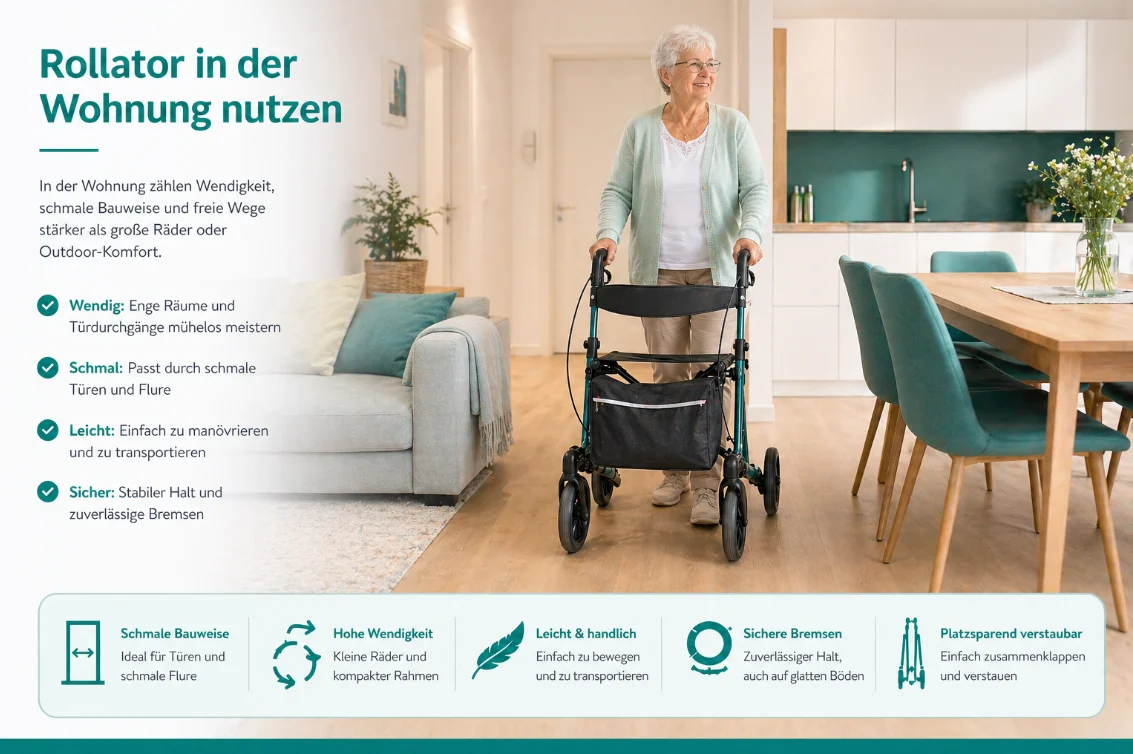 In the home, manoeuvrability, a slim design and unobstructed pathways are more important than large wheels or outdoor comfort.
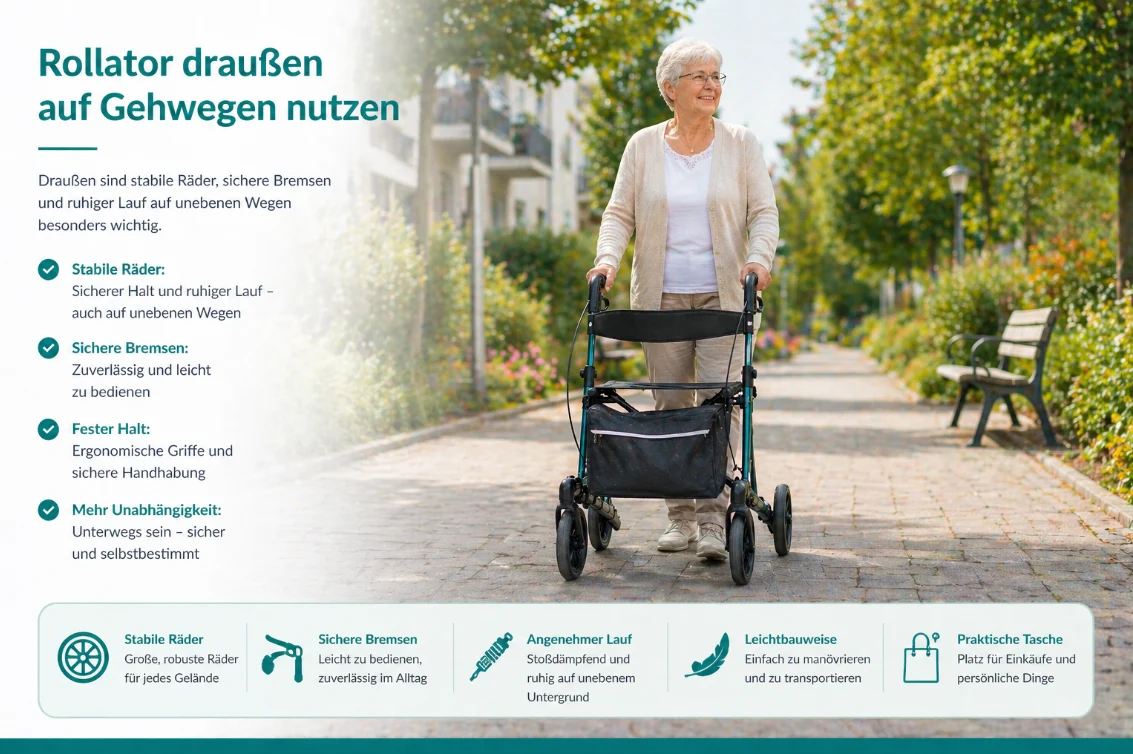 Outdoors, sturdy wheels, reliable brakes and a smooth ride on uneven surfaces are particularly important.
Using a rollator outdoors: pavements, kerbs, buses and longer distances
Outdoors, the challenges are quite different. Pavements are rarely perfect. Kerbs, paving stones, lowered edges, wet leaves, gravel, slopes and blind crossings demand greater stability than smooth floors inside the home. An outdoor rollator should therefore run smoothly, have larger wheels and be easy to manoeuvre safely even on slightly uneven ground.
Kerbs are a classic problem. Many rollators have a tilt assist feature that makes it easier to lift the front wheels. This function should be explained and practised. Anyone who yanks the rollator upwards with force risks losing their balance. A controlled movement with the correct posture is better. In the case of high kerbs or if you feel particularly unsteady, a lowered ramp is always the better choice.
When using public transport, key factors include whether the rollator folds, its weight, its brakes and its stability. When boarding a bus or train, the rollator should not pose a tripping hazard. Where possible, users should not be transported whilst seated in the rollator, but should instead use a safe seat and park the rollator securely. Rules may vary depending on the transport operator and the situation, but safety takes precedence over convenience.
For longer journeys, the seat is invaluable. It allows you to take a break when you’re out of breath, running out of energy or losing your balance. Nevertheless, you should choose where to rest carefully: level ground, plenty of space, no slopes, no narrow passages. Anyone who sits down in the middle of a sloping footpath turns their break into an experiment in applied gravity – and gravity usually wins.
The bag is handy for shopping, but it has its limitations. The maximum load capacity should be observed. Heavy bags attached to the handles shift the centre of gravity and can make the rollator more prone to tipping over. It is better to use the rollator’s own bag. Anyone who regularly carries large shopping bags should consider whether a different shopping arrangement, a delivery service or assistance might be a better option.
Useful accessories for rollators
Accessories can make a rollator much more suitable for everyday use, but they should not be added indiscriminately. Every additional part alters the weight, handling or space requirements. Accessories make sense when they solve a specific problem: visibility, transport, weather protection, safety, orientation or comfort. It becomes pointless if the rollator ends up with more attachments than a camper van.
A rollator bag is included as standard with many models. It should be securely attached, easily accessible and not overloaded. Reflectors or lights can be important at dusk and in poor visibility. People who are out and about early in the morning or in the evening benefit particularly from being more visible. A walking stick holder can also be useful if a walking stick is used as well.
For outdoor use, umbrella holders, weather protection or larger wheels can be helpful. However, it is important to check whether the person can use the accessories safely. An umbrella holder sounds practical, but can be problematic in windy conditions. Bells or small warning signals can also be useful in certain situations, but are no substitute for careful use.
Trays or shelves are useful in the home because they make it easier to carry small items. Drinks, in particular, should not be carried in the hand if both hands are needed to use a rollator. A tray can provide safety here, provided it is securely fixed and does not encourage the user to carry too much at once.
It is important to ensure that accessories are compatible with the specific model. Not everything fits every rollator. Bags, hooks or brackets that are fitted incorrectly can compromise stability. For this reason, accessories should, where possible, be selected through a medical supply shop, the manufacturer or a specialist adviser.
Often useful
- Rollator bag
- Reflectors or lights
- Stockhalter
- Tray for indoor rollators
- Doorbell or signal device
Check carefully beforehand
- Umbrella stand
- Additional considerations
- large shopping bags
- Retrofit seat cushions
- unapproved third-party accessories
Common mistakes when buying and using a stairlift
The most common mistake is buying a rollator that isn’t suitable for the user’s needs. Many people buy a model because it is cheap, lightweight or visually appealing. It later becomes apparent that it is too wobbly when used outdoors, too wide for the home or difficult to fold away. However, a rollator is not a decorative item for the hallway, but a safety aid. The choice should therefore be made with a practical mindset.
Another common mistake is incorrect handrail height. Handrails that are too low cause a hunched posture, whilst those that are too high make it difficult to control the stairlift and apply the brakes. Handrails set at different heights can also cause problems. The height should not be adjusted based on feel alone, but should be checked whilst standing and walking. After a few days’ use, readjustment may be necessary.
Many users either use the brakes too infrequently or incorrectly. When sitting down, they forget to apply the parking brake; when going downhill, they brake too late; or the brakes are poorly maintained. Clear routines are particularly important for older people with reduced reaction times. Check the brakes, apply the parking brake, and only then sit down. This is not excessive caution, but a basic safety measure.
Overloading is also a problem. Walking frames are not shopping trolleys. If heavy bags are hung from the handles, the centre of gravity shifts. The walking frame can become unstable, particularly when turning, braking or lifting. The designated bag should be used and the maximum load capacity observed.
One often overlooked mistake is a lack of practice. Many people are given a rollator and are expected to use it safely straight away. It is better to have a short training session: walking in a straight line, turning, braking, sitting down, standing up, negotiating thresholds, and practising folding and transporting the rollator. Relatives can help with this, but should not constantly correct the user. Anyone who is told what to do at every step will quickly lose the desire to use it.
What relatives should bear in mind
Relatives often play an important role in the provision of a rollator. They organise appointments, speak to doctors, visit the medical supplies shop, assess the home and encourage the person to use it. At the same time, there is a risk that relatives, with the best of intentions, will make decisions without consulting the person concerned. However, a rollator will only be accepted if the user understands it, can operate it and finds it helpful in everyday life.
There is little point in buying a particularly high-quality model if the person concerned refuses it or feels unsafe using it. It is better to choose one together. The person should be allowed to try out the rollator, ask questions and say what feels uncomfortable. Feelings of embarrassment should also be taken seriously. For many people, their first rollator is a visible sign that something has changed. This is an emotional issue that should not be downplayed.
Relatives should check the home, paying particular attention to the routes taken. Where is the rollator kept? Can you get from the bed to the bathroom? Are there any trip hazards? Are essential items within reach? Is there sufficient lighting at night? Night-time trips to the toilet are particularly risky. A rollator is only of help if it is within easy reach and the route is clear.
It is also important not to expect too much too soon. Anyone who is using a rollator again after an illness, a stay in hospital or a prolonged period of uncertainty needs time. Short walks, regular practice and positive experiences are better than putting pressure on them. The rollator is meant to provide security, not to become a daily test.
If relatives notice that the stairlift is not working properly despite adjustments, professional help should be sought. A GP, physiotherapist, occupational therapist, care adviser or medical supplies shop can assess whether training, a different model or additional aids are required. Sometimes the problem is not with the rollator itself, but with pain, dizziness, vision problems or an unsuitable environment.
Rollators, care levels and further support
A rollator is not automatically linked to a care level. As a medical aid, it is usually provided through the health insurance scheme if there is a medical need. A care level may also be relevant, as it indicates a general need for support and opens up access to further benefits. However, the provision of a rollator itself is typically not based on the existence of a care level, but on the specific need for assistance with walking.
For people with a care needs assessment, a rollator can form part of a wider support plan. Other relevant options may include disposable care aids, a home emergency call system, home adaptations, bathroom aids, a care bed or respite care services. Mobility is rarely an isolated issue. When walking becomes difficult, this often leads to changes in how one uses the bathroom, goes shopping, visits the doctor, maintains social contacts and carries out daily household routines.
A rollator can help maintain existing abilities, particularly when the need for care is just beginning. People who walk more confidently often move about more. In turn, more exercise can help to maintain strength, spatial awareness and self-confidence. Of course, a rollator is no substitute for therapy, a medical assessment or a safe environment. But it can be an important part of ensuring that mobility is not given up too soon.
Care advice can help integrate the rollator into everyday life. It is not just a question of whether a particular model is covered by insurance. More importantly: Which routes are essential? Where are the risks of falling? What support is still lacking? How can the burden on relatives be eased? And what measures can prevent minor limitations from turning into major gaps in care?
If a rollator is required following a stay in hospital, the discharge planning team should be involved at an early stage. Ideally, this will allow the necessary equipment to be organised in good time, before the person returns home. Trying to arrange an aid at short notice whilst the person is already feeling unsteady at home is possible, but unnecessarily stressful.
Goes well with
- Care advice
- Fall prevention
- Home adaptations
- Bathroom aids
- Home emergency call system
Check if you have any problems
- Dizziness or unsteadiness when walking
- frequent falls
- unsafe transfers
- night-time journeys
- a growing fear of walking
Care, maintenance and inspection of the rollator
A rollator does not require extensive maintenance, but it does need regular checks. The brakes, wheels, screws, folding mechanism and handles should be checked at regular intervals. Parts may become misaligned or loose, particularly after a fall, transport in a car or prolonged use on uneven ground. Anyone using a rollator as a safety aid should not treat it like an old garden chair that will somehow hold up.
The wheels should turn freely and not get stuck. Hair, dirt, small stones or damaged tyres can impair handling. In wet weather, the rollator should be allowed to dry, particularly if it is left in a hallway or stairwell. Brake cables can become worn over time. If the brakes apply unevenly, are difficult to operate or the parking brake does not hold securely, this must be checked.
Handles should be securely fitted and comfortable to grip. Worn or slippery handles can become unsafe. The seat and storage pocket should also be in good condition. A torn storage pocket is not only unsightly, but items may fall out or get caught. Accessories should be checked regularly to ensure they are securely fitted.
In the case of rollators provided by a health insurance fund, repairs, maintenance or replacement may be covered by the provision if necessary. The service provider or contractual partner is often responsible for this. Therefore, if problems arise, you should not try to sort them out yourself, but should contact the medical supplies shop or your health insurance fund. Cable tie constructions on the safety device may be creative, but creativity is not the desired approach to maintenance in this case.
If you are not using your rollator for a prolonged period, you should still avoid storing it in a damp place or under heavy loads. Before using it again, the brakes and wheels should be checked. Your needs may have changed, particularly following a stay in hospital or a period of rehabilitation. In such cases, it is not only important to check the rollator, but also to consider whether it is still suitable for your current level of mobility.
When a rollator is no longer sufficient
A rollator is helpful as long as the person is able to stand, grasp, brake and control the rollator independently. If these abilities are increasingly lost, a rollator may no longer be sufficient. Frequent falls despite using a rollator, severe confusion, loss of control over the brakes, pronounced weakness or severe pain may be signs that other forms of assistance are required.
Sometimes additional physiotherapy or occupational therapy is needed to practise using the stairlift safely. In other cases, a wheelchair, walking training, home adaptations, a home emergency call system, bathroom modifications or more intensive care support may be advisable. A rollator should not continue to be used out of habit if it no longer provides safety.
Particularly in cases of dementia or cognitive impairments, it is important to monitor closely whether the person is using the rollator correctly. Some people forget to apply the brakes, sit down unsteadily or leave the rollator in unsuitable places. This does not automatically mean that a rollator is not an option. However, it does mean that support, training and adapting the environment become more important.
Fear of walking should also be taken seriously. If someone owns a rollator but avoids going out, there is often more to it than meets the eye: a history of falls, dizziness, pain, poor lighting, an unsuitable model or a lack of confidence. These causes should be investigated. Simply providing a new aid rarely alleviates anxiety.
Moving on to other forms of support is not a sign of failure. Mobility changes over time. A rollator may be ideal for a particular stage and can later be supplemented or replaced by other forms of support. The key is not to cling to a single aid, but to consider how safety, dignity and participation can best be maintained.
Frequently asked questions about rollators
When is a rollator a good idea?A rollator is a good idea if walking becomes unsteady, covering longer distances is difficult, you need to take breaks, or a walking stick no longer provides enough support. What matters is your specific everyday situation, not just a diagnosis.
Does the health insurance fund cover the cost of a rollator?If medically necessary, the statutory health insurance scheme may cover the cost. A doctor’s prescription is usually required. Provision is often arranged through the health insurance scheme’s contracted partners.
How much does a rollator cost with a prescription?For those with statutory health insurance, only the statutory co-payment is usually payable. For many medical aids, this is ten per cent, with a minimum of five euros and a maximum of ten euros. Additional costs may arise if a more expensive model of your choice is selected.
Which is better: a standard rollator or a lightweight rollator?That depends on your needs. A standard rollator may be sufficient for short journeys. A lightweight rollator is often a better choice if you have limited strength, need to carry the rollator frequently, or plan to walk longer distances.
Can you use a rollator indoors?Yes, but not every model is suitable for confined spaces. Narrow, manoeuvrable models are often better suited to flats. Door widths, thresholds, carpets and storage areas should be checked in advance.
How do you adjust a rollator correctly?The handrails should be adjusted so that the person can walk as upright as possible with their arms slightly bent. The exact setting should be tested in practice and adjusted by a professional if necessary.
Is it OK to sit on any walking frame?Only if the model has a seat and is designed for that purpose. Both parking brakes must be applied before sitting down. You should not sit on the rollator on sloping or uneven ground.
What should you do if the rollator isn’t the right fit?You should then contact the medical supplies shop or your health insurance provider. The handle height, brakes or accessories can often be adjusted. If the model is fundamentally unsuitable, a further assessment may be necessary.
Conclusion: The right rollator is not a sign of weakness, but a tool to make everyday life easier.
A rollator can significantly improve safety, independence and freedom of movement if it is suited to the individual, their home and the routes they actually take. The key is not to get any model as quickly as possible, but to ensure the right solution: medically justified, practically tested, correctly adjusted and accepted in everyday life.
Standard rollators, lightweight rollators, indoor rollators and outdoor models each have their place. Understanding the differences helps you avoid making the wrong purchase and unnecessary uncertainty. Particularly important factors include handle height, brakes, weight, manoeuvrability, seat, wheel size and whether the rollator is to be used indoors, outdoors or in both settings.
The health insurance fund may cover the cost if there is a medical need. For specific models, the need should be clearly justified. Relatives can best support the person concerned not only by organising things, but also by testing and practising with them and making the home safer. Then the rollator becomes not a symbol of limitation, but a very practical piece of freedom on wheels.