
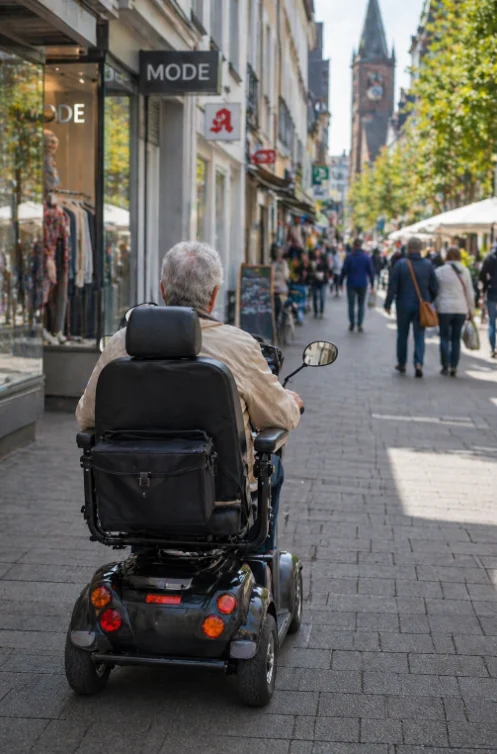
What a mobility scooter is and what it is used for
A mobility scooter is an electrically powered mobility aid with a seat, handlebars, a battery and several wheels. It is often also referred to as a senior mobility scooter, a scooter or a mobility scooter. Unlike an electric wheelchair, a mobility scooter is usually steered using handlebars. The user sits on a swivelling or fixed seat and controls the speed, brakes and direction using controls on the handlebars. As a result, using it is more like driving a small vehicle than using a traditional wheelchair.
Electric mobility scooters are primarily intended for outdoor use. They help with journeys that have become too long, too tiring or too unsafe. This could be the trip to the supermarket, the walk to the chemist’s, an appointment at the doctor’s surgery, a visit to friends or a stroll through the park. Many people use an electric mobility scooter not because they can no longer walk at all, but because the distance they can walk is limited. It is precisely in this gap between still being able to walk and no longer being able to cope that the typical benefit lies.
The models vary considerably. Small electric mobility scooters are compact, often foldable and designed for short journeys. Larger models offer greater comfort, bigger wheels, more powerful batteries, better suspension and a longer range. Some models travel at walking pace only, whilst others reach speeds of 10 or 15 km/h. The higher the power and speed, the more important lighting, insurance, brakes, traffic regulations and safe operation become.
An electric mobility scooter is not automatically the right solution for every mobility issue. Anyone who needs assistance at home may be better off with a rollator, a wheelchair, an electric wheelchair or home adaptations. On the other hand, anyone who wishes to travel longer distances outdoors independently, but is still able to sit securely, react, steer and brake safely, may find that an electric mobility scooter is a very suitable option. The decision therefore depends not only on the desire for greater mobility, but also on everyday life, safety and physical capabilities.
Outdoor area
Electric mobility scooters are particularly useful for outdoor trips, such as shopping, appointments, visits or leisure activities.
Safe operation
Users must be able to sit, steer, react, brake and assess traffic situations.
Checking everyday life
Parking spaces, loading bays, kerbs, doors, paths, gradients and insurance should all be included on the checklist before making a purchase.
Who might benefit from an electric mobility scooter
An electric mobility scooter is a sensible option if a person can still manage short distances but can only cover longer distances with pain, severe fatigue or an increased risk of falling. Typical users include people with declining strength, chronic joint conditions, cardiovascular problems, respiratory conditions, neurological impairments or age-related unsteadiness when walking. An electric mobility scooter can also provide temporary help in regaining mobility following surgery or a prolonged illness.
It is not just the diagnosis that matters. Two people with the same condition may have completely different needs. One person may only need help with their weekly shopping, whilst another may want to travel several kilometres every day. One person may live on the ground floor with a spacious garage, whilst another may live in a block of flats with a narrow hallway. One person may have good reaction times, whilst another may quickly feel overwhelmed when faced with pedestrians, cyclists, kerbs and traffic all at once. Providing assistive technology is simply not a matter of picking and choosing, even if some product pages make it seem as though all you have to do is click on a nice colour.
A mobility scooter is particularly suitable if it enables specific everyday journeys. These include shopping, visits to the doctor, trips to the chemist’s, journeys to day care or therapy, visits to relatives, trips to the cemetery, outings or short journeys in the local area. If the device is only theoretically helpful but cannot be parked, charged or driven safely, it remains an expensive problem with a battery.
A mobility scooter is not suitable if the person cannot steer it safely, has severe problems with spatial orientation, does not reliably follow traffic rules, is very unsteady when seated, or does not react appropriately in dangerous situations. In such cases, other solutions may be more suitable, such as a wheelchair with an accompanying person, an electric wheelchair with adapted controls, transport services, home adaptations or a combination of several forms of assistance.
Limited walking distance
For those who find walking distances too short, but are still able to sit, steer and react independently.
Uncertain operation
If a person has problems with orientation, a significant delay in reaction time or is unable to move about safely, the use of a stairlift should be carefully assessed.
What types of electric mobility scooters are available?
Electric mobility scooters can be broadly divided into three groups: small, compact models; classic everyday models; and large electric mobility scooters for longer distances. In addition, there are specialised solutions, such as particularly lightweight travel scooters, models with a higher weight capacity for heavier users, or variants with weather protection. This classification is important because each type has different strengths and limitations.
Compact electric mobility scooters are usually lighter, shorter and more manoeuvrable. Many can be dismantled or folded so that they can be transported in a car. They are suitable for short distances, smooth surfaces, courtyards, doctors’ surgeries, shopping centres or travel. The downside is often a smaller battery, less suspension, reduced stability on uneven surfaces and less comfort during prolonged use. Anyone who travels longer distances every day will often find that a very small model does not meet their needs.
Medium-sized electric mobility scooters are the typical everyday solution. They offer a longer range, a more robust build, greater seating comfort, larger wheels and more features. Many of these models are suitable for journeys around the neighbourhood, shopping, appointments and leisure activities. However, they are heavier and require a suitable place to park and charge. Their turning circle can be a problem in narrow corridors or small lifts.
Large electric mobility scooters are designed for comfort, range and stability. They may feature more powerful motors, larger batteries, suspension, lighting, mirrors, indicators, a basket, a seatbelt and comfortable seats. Such models are suitable for longer journeys, uneven terrain and regular outdoor use. However, they are large, heavy, less portable and require more space. Anyone living in a narrow stairwell is likely to face more problems than they gain in terms of mobility.
Travel scooters or foldable electric mobility scooters form a special category. They are chosen when transport by car, train travel or holidays are important considerations. They are practical, but not necessarily comfortable. Load capacity, battery capacity, stability and seating comfort should be examined particularly carefully. A foldable model is only useful if the person concerned or their relatives can actually lift, dismantle and reassemble it.
| Type | Suitable for | Strengths | What should you look out for? |
|---|---|---|---|
| Compact electric mobility scooter | short distances, travel, smooth surfaces | compact, lightweight, often collapsible | Limited reach, suspension, stability and seating comfort |
| Everyday model | Shopping, appointments, home environment | A good balance of comfort, range and size | Check the parking space, turning circle and loading area |
| Large electric mobility scooter | longer distances, regular outdoor use | Greater reach, comfort and stability | Heavy, takes up a lot of space, transport is rarely possible at short notice |
| Travel scooters | Travel by car, holidays, occasional use | foldable or dismantlable | Only advisable if the weight and installation are practically feasible |
Technical specifications: range, battery, motor and speed
The technology determines whether an electric mobility scooter is reliable for everyday use. The most important features are range, battery type, motor power, speed, climbing ability, turning circle, total weight and maximum load capacity. Manufacturers’ specifications should be assessed realistically. The stated range is often measured under ideal conditions. In practice, body weight, gradients, cold weather, headwinds, uneven surfaces, frequent starts and ageing batteries reduce the actual distance travelled.
The range of small models is often in the region of 10 to 20 kilometres. Mid-range models frequently manage more, whilst large electric mobility scooters can offer significantly greater ranges. It is not the highest figure that matters, but having the right amount of reserve. Anyone who wants to travel five kilometres regularly should not choose a model that, under ideal conditions, can barely manage ten kilometres. A battery isn’t an ‘Optimist’, even if sales brochures like to claim otherwise.
Depending on the model, lead-gel, AGM or lithium batteries are used. Lead batteries are common but heavier. Lithium batteries can be lighter and offer better transport characteristics, but are often more expensive and are subject to specific regulations when travelling. Key considerations include charging time, replacement costs, service life and whether the battery is removable. If the battery can only be charged whilst attached to the device, the mobility scooter requires a parking space with access to a power supply.
Speed has implications for both legal and practical matters. Slow electric mobility scooters travelling at 6 km/h are easier to categorise and, in many cases, do not require their own third-party liability insurance via an insurance registration plate. Faster models, for example up to 10 or 15 km/h, may be subject to compulsory insurance and impose higher requirements in terms of brakes, lighting and safe use. Before purchasing, it is therefore important to be clear about what speed is actually required and what obligations this entails.
The stair-climbing capability is particularly important if the living environment includes ramps, courtyard entrances, garage driveways or hilly paths. Kerbs, lowered crossings and cobblestones are also everyday challenges that quickly put technical specifications into perspective. Large wheels and good suspension can improve comfort. A small travel scooter may work wonderfully in a shopping centre, but on old cobblestones it can rattle and ride like a bad decision on wheels.
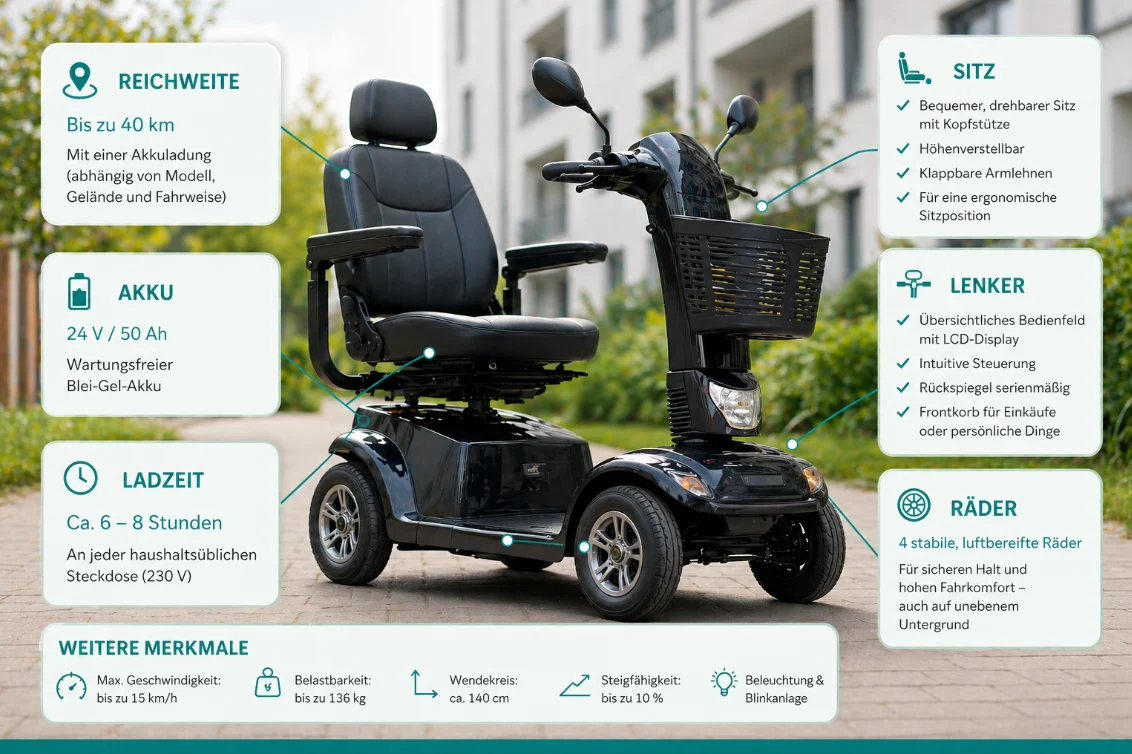 Range, battery, wheels, seat and handlebars should be suited to the home environment.
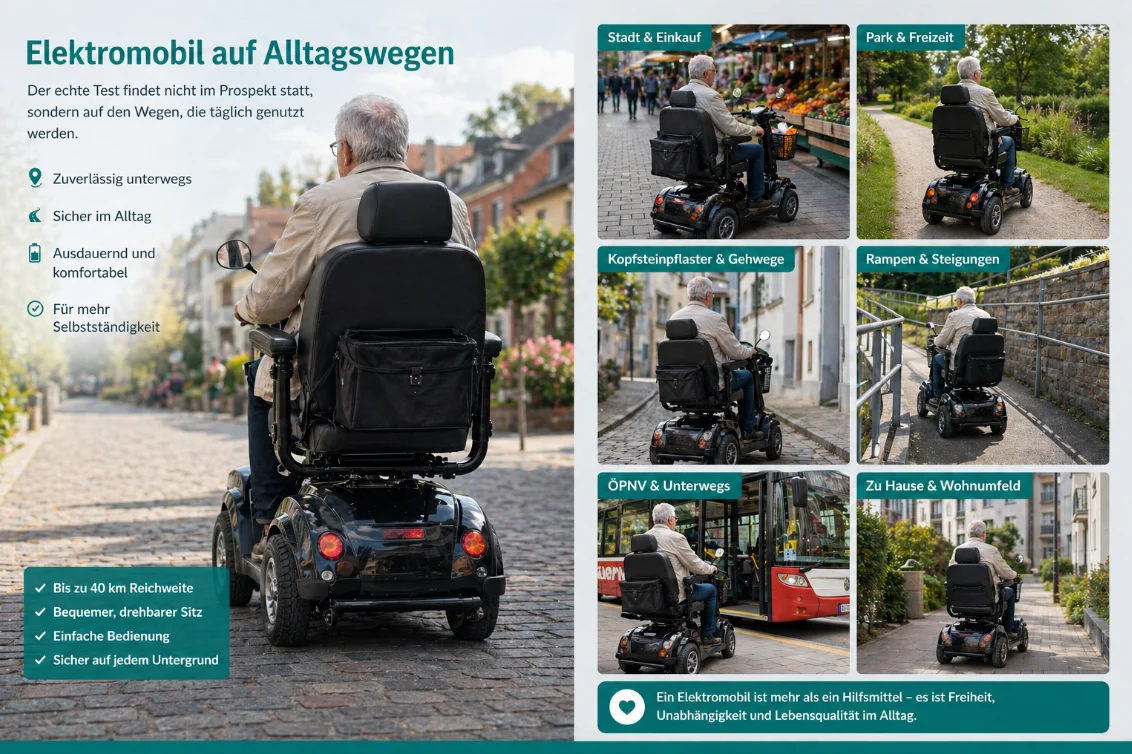 The real test doesn’t take place in the brochure, but on the routes used every day.
Costs: How much electric mobility scooters cost and what ongoing costs are involved
The cost of mobility scooters varies considerably. Simple, compact models often start in the lower four-figure range. Robust, everyday models are usually significantly more expensive. Large, comfortable models with a long range, suspension, a powerful battery, lighting and accessories can cost several thousand euros. However, the purchase price is only part of the bill. Accessories, maintenance, battery replacement, insurance, repairs and possible transport solutions can incur additional costs.
An affordable electric mobility scooter can be a sensible choice if your needs are modest and the distances you travel are short. However, it can end up being expensive if the model is too underpowered, too uncomfortable or too unstable and needs to be replaced later on. Conversely, not everyone needs a large, premium model. Anyone who only travels short distances on flat surfaces may end up paying for range and power they’ll never use if they opt for an oversized model. The best solution isn’t the most expensive one, but the most suitable one. A truly revolutionary insight, which, unfortunately, not every online shop shares.
Ongoing costs are mainly incurred by the battery. Batteries are wear-and-tear parts. Depending on usage, maintenance and quality, they will need to be replaced after a few years. Tyres, brakes, lights, the charger, seat cushions, control elements and the seat itself can also incur costs. If the stairlift is used frequently, you should therefore ask before purchasing which spare parts are available, who carries out repairs and how long the service will be available.
If a faster electric mobility scooter is subject to compulsory insurance, annual premiums for third-party liability insurance will apply. A suitable parking space may also incur costs, for example if a shelter, a power socket, a ramp or a secure charging point needs to be provided. In rented flats, it should also be clarified where the mobility scooter may be parked and whether escape routes remain unobstructed.
Second-hand mobility scooters are often attractively priced. However, the condition of the battery, mileage, maintenance history, brakes, tyres, charger, availability of spare parts and warranty should all be checked very carefully. A second-hand mobility scooter with a weak battery may seem like a bargain at first, but can turn out to be quite expensive shortly afterwards. Battery chemistry clearly has no time for the allure of a bargain.
| Price range | Typical range | Note |
|---|---|---|
| Compact models | often approx. 1,000 to 2,500 euros | For short distances, travel or occasional use |
| Everyday models | often around 2,500 to 5,000 euros | Greater comfort, range and stability |
| Large, comfortable models | often from around 5,000 euros | For longer distances, powerful batteries and regular use |
| Battery replacement | Depending on the model | Be sure to enquire about replacement costs before purchasing |
| Maintenance and repairs | depending on usage | Check the brakes, tyres, electronics and charger |
Health insurance, prescription and cost coverage
When it comes to cost coverage, a very clear distinction must be made. Statutory health insurance funds cover medical aids if, in individual cases, they are medically necessary to compensate for a disability, prevent a disability or ensure the success of a treatment. The GKV-Spitzenverband’s list of medical aids serves as an important guide in this regard, but is not simply a shopping list in every detail. The specific need in each individual case remains the decisive factor.
Electric mobility scooters may be relevant as medical wheelchairs or mobility aids. However, costs are not automatically covered. Health insurance providers often scrutinise very closely whether a simpler aid would suffice. This may include a rollator, a manual wheelchair, an electric wheelchair or other care solutions. If an electric mobility scooter merely offers comfort, convenience or a greater range for leisure activities, it becomes more difficult to justify. If, on the other hand, it is necessary to enable basic mobility within the local area, the case for it may be stronger.
A doctor’s prescription is usually required to apply. This should not only include the term ‘electric mobility scooter’, but also clearly describe the medical reason for the application. It is important to provide details regarding walking distance, risk of falling, strength, stamina, medical conditions, assistive devices currently in use, and the everyday routes that cannot be accessed without such devices. The more specifically the need is described, the less scope there is for the all-too-common bureaucratic practice of ‘we’ll just ask three more times’.
The health insurance fund may request a cost estimate from a contracted provider and involve the Medical Service. An assessment is carried out to determine whether the aid is necessary, suitable and cost-effective. Safety of use may also be a relevant factor. A mobility scooter that the person cannot operate safely or that cannot be used in their home environment is unlikely to be justifiable.
If the health insurance fund approves a medical aid, those with statutory health insurance are usually required to pay the statutory co-payment. For many medical aids, this amounts to ten per cent of the retail price, with a minimum of five euros and a maximum of ten euros. Additional costs may arise if a model is chosen that goes beyond what is medically necessary. In such cases, insured persons must bear the additional costs and any resulting costs themselves. For those with private health insurance, reimbursement depends on the policy.
Consult a doctor to determine your needs
Walking distance, medical conditions, risk of falls and mobility goals should be documented in detail.
Arrange for a prescription to be issued
The regulation should describe the medical necessity and practical application as clearly as possible.
Involve your health insurance provider
Before making a purchase, you should clarify which contracting party is responsible and what documents are required.
Check assessment and provision
The model must actually work in the home environment, along typical routes and when being operated.
Long-term care insurance, care level and other funding options
The long-term care insurance fund does not automatically cover electric mobility scooters as standard care aids. Nevertheless, the need for care may be a factor, as mobility, independence and the home environment are closely linked. Anyone with a care level should check whether other benefits might also be of assistance. These include home adaptations, respite care, care advice and, where appropriate, technical aids that make it easier to receive care at home.
An electric mobility scooter itself is often more a matter for health insurance than for long-term care insurance. However, if structural alterations are required to enable mobility within the home at all, the long-term care insurance fund may, under certain conditions and provided a recognised care level has been established, provide grants for home adaptations. This tends to apply to ramps, door widening, safe access routes or other adaptations, rather than automatically to the vehicle itself.
In individual cases, social security agencies, integration support services, accident insurance, pension insurance or the Jobcentre may also be responsible if mobility is linked to social participation, work, training or the consequences of an accident. Anyone who is unsure should not simply scatter applications haphazardly like confetti across an official’s desk. It makes more sense to seek advice, for example from a care advice service, health insurance provider, social services, a social inclusion advice service or a consumer advice service.
For those on a low income, it may be worth checking whether financial support is available through social security benefits. The eligibility criteria depend heavily on the individual case. It is important to submit applications before making a purchase, if possible. Those who buy first and then seek reimbursement later often find themselves in a worse position. This is particularly true for expensive assistive devices, where funding bodies wish to assess in advance whether the provision is necessary and cost-effective.
Buying guide: What to look out for before you buy
Before making a purchase, the focus should not be on choosing the most attractive model, but on the usage profile. How long are the typical journeys? Are there any inclines? How wide are the doors and pathways? Where will it be charged? Does the mobility scooter need to fit into a lift? Will it be transported in a car? How much weight can it carry? How long will the person be sitting on it? Will it be used daily or only occasionally? These questions are less glamorous than product photos, but far more useful.
The seating position is a key consideration. The seat should be stable, comfortable and suited to the user’s height. Armrests, backrest, seat width, seat depth and entry height all affect comfort and safety. A swivelling seat can make getting on and off easier. For people with pain, balance problems or limited strength, this can be a crucial factor. A seat position that is too high or too low makes transfers more difficult and can cause a feeling of insecurity.
The controls must be easily accessible and simple to use. The throttle, brake, lights, horn and display should be laid out in an intuitive manner. People with limited hand strength, osteoarthritis or neurological conditions should pay particular attention to ease of use. A test drive is essential here. What seems straightforward in the shop can become more difficult under pressure, in cold weather or on uneven ground.
The turning circle determines whether the mobility scooter can be used in confined spaces. Anyone who needs to manoeuvre through narrow building entrances, courtyards, lifts or small storage rooms should check not only the vehicle’s length but also the practical manoeuvring space. It is of little use if the mobility scooter theoretically fits into the cellar but can only be manoeuvred back out again with a twelve-step manoeuvre and a family crisis meeting.
When making a purchase, service and spare parts should be just as important as the price. A supplier should be able to explain how maintenance works, who carries out repairs, how quickly spare parts are available and what the warranty covers. Particular caution is advised when buying online. Advice, test runs and fitting are often unavailable or only possible to a limited extent. For a device intended to provide safety in everyday life, this is a serious drawback.
Take measurements before making your choice
- Check door widths and the lift
- Measuring the landing area
- Check for a socket at the loading point
- View typical routes and gradients
- Realistic testing of transport by car
Be sure to give it a go
- Starting and braking
- Bends and turns
- Getting on and off
- Seating comfort after several minutes
- Operation whilst wearing a jacket, carrying a bag or wearing gloves
Safety in everyday life and on the roads
A mobility scooter is somewhere between an aid and a vehicle. That is precisely why safety is so important. Users must adjust their speed to suit their surroundings, the surface they are travelling on and the traffic situation. Caution is required on pavements, in pedestrian zones, at driveways, where kerbs are lowered and in supermarkets. An electric mobility scooter restores mobility, but it is not a free pass for reckless slaloming between shelves.
Lights, reflectors, the horn, mirrors and brakes should be checked regularly. Good visibility is crucial, particularly when cycling at dusk or in winter. Many accidents are not caused by high speed, but by a poor assessment of kerbs, slopes, wet surfaces or tight spaces. Anyone who feels unsure should practise on quiet roads first.
Kerbs and ramps require particular attention. Not every mobility scooter can safely negotiate kerbs. Ramps that are too steep can be dangerous, particularly when travelling downhill. Lateral inclines are also a concern, as they can increase the risk of tipping over. Large wheels and a sturdy design help, but are no substitute for careful driving.
For faster models, it is important to clarify whether insurance is compulsory. Depending on the design and speed, an insurance sticker may be required. The operating licence and permitted use in public spaces should also be checked before purchase. The retailer should be able to provide clear information on this. If not, that in itself is a sign – though, unfortunately, not a good one.
It is important for relatives not simply to leave the user alone with the device if they feel uncertain. Practising together, covering short distances, sticking to familiar routes and gradually increasing the distance help. Anyone who has not been able to get about independently for a long time needs to rebuild their confidence and get back into the swing of things. Mobility is not just about technology, but also about getting used to it.
| Situation | Risk | Recommendation |
|---|---|---|
| Kerbs | Tipping over, losing one’s footing, loss of control | Use lowered kerbs and drive slowly |
| Damp and leaves | Skidding, longer braking distance | Reduce your speed and take bends carefully |
| Supermarket | narrow corridors, pedestrians, shelves | Drive slowly and keep a safe distance |
| Gradient | Battery and motor load, risk of tipping | Check the stairlift’s climbing capability beforehand and avoid using steep ramps |
| Twilight | poor visibility | Use lights, reflectors and light-coloured clothing |
Living environment, storage space and shop
Even the best mobility scooter is of little use if it cannot be parked and charged safely. That is why the home environment must be assessed at an early stage. Is there level access? Is the entrance wide enough? Are there thresholds, steps or heavy doors? Will the mobility scooter fit in the lift? Can it be left in the hallway? Is there a socket near where it is to be stored? These questions should be answered before purchase, not after delivery, when the device stands in the way like a very expensive obstacle.
In blocks of flats, escape routes and fire safety are important. Electric mobility scooters must not simply be left in stairwells or corridors if this blocks passageways. There may also be rules governing the charging of batteries. Landlords, property management companies or owners’ associations should be consulted at an early stage if there is no designated parking space.
A secure storage area should be dry, easily accessible and, where possible, protected against theft. For larger models, a garage, carport, storage room or a dedicated shelter are suitable options. Outdoor storage should be protected from the elements. Prolonged exposure to damp can damage the electronics, seat, contacts and metal parts. An electric mobility scooter is robust, but it is not a submarine.
When charging, the manufacturer’s instructions should be followed. The charger, socket and cable must be used safely. Extension leads running across the hallway are not an elegant solution, but rather a tripping hazard with a live connection. If there is no suitable charging point available, a model with a removable battery may be a sensible option. However, it must then be checked whether the battery is light enough and can be carried safely.
Home adaptations can be useful if minor barriers prevent access. These include ramps, solutions for door thresholds, automatic door openers, wider entrances or secure storage areas. If you have a care level, you can check whether you are eligible for grants to improve your home environment. The same rule applies here: seek advice first, then carry out the alterations.
Electric mobility scooters in everyday life: shopping, doctor’s appointments, leisure activities and social participation
It is in everyday life that you can really tell whether a mobility scooter is the right choice. The benefits are particularly great when it becomes possible once again to make journeys that were previously avoided. These include shopping, visits to the doctor, trips to the chemist, visits to family and friends, visits to the cemetery, leisurely drives, and trips to the bank or post office. Mobility is not just about getting from A to B, but about participation. Being able to decide for yourself when to leave the house restores your dignity and your sense of everyday life.
When shopping, the shopping basket, bag holders, turning space and parking facilities are important. Not every shop is spacious. Narrow aisles, turnstiles, high shelves or crowded checkout areas can be difficult to navigate. Some users combine their mobility scooter with a small shopping basket or have heavy shopping delivered. The mobility scooter doesn’t have to handle every task on its own. It is designed to make everyday life easier, not to turn it into a logistical challenge.
Doctor’s appointments and therapy sessions present different challenges. It is important to check whether the mobility scooter can be parked near the surgery, whether the surgery is accessible, and whether there is enough space in the waiting area. For longer appointments, a comfortable seat can make all the difference. Anyone who experiences pain whilst sitting or has difficulty standing up should take this into account when choosing a model.
When it comes to leisure activities and socialising, range is more important than many people initially realise. A spontaneous trip to see friends, a visit to the park or a stroll around the village all require sufficient battery reserve. The weather also plays a part. Wind, rain, cold and darkness affect comfort and safety. Accessories such as a weather cover, a blanket, good lighting or a secure seat can enhance practical usability.
Many people report that a mobility scooter not only provides physical assistance but also offers psychological relief. The fear of not being able to find their way back whilst out and about diminishes. Relatives have less to organise. Appointments can be attended more independently. At the same time, it can sometimes take a bit of effort to start using such an aid. Taking the visible step towards using a mobility aid is not easy for everyone. A level-headed perspective helps here: it is not the aid that takes away independence, but rather it can help to preserve it.
 When it comes to shopping, manoeuvrability, the shopping basket, a secure place to park the trolley and sufficient reach are key factors.
 Recreational walks require comfort, visibility and sufficient battery power for the return journey.
Buy or hire a second-hand electric mobility scooter
A second-hand mobility scooter can be a sensible option if the budget, needs and condition are right. High-quality models in particular are expensive when new. Buying second-hand can help keep costs down. However, caution is advised, as the battery, electronics, brakes and tyres are crucial for safety and long-term running costs. A very cheap deal can end up costing you dearly in the short term if the battery is weak or spare parts are hard to come by.
When buying second-hand, you should always take the stairlift for a test run. During this, you should check the start-up, braking, cornering, gradients, noise levels, steering, seat adjustment, lighting and charger. Also important are the year of manufacture, maintenance records, battery age, remaining capacity, charging behaviour, accessories, keys, user manual and any warranty. Anyone who ignores these points may well end up buying not a means of mobility, but a mystery on wheels.
Renting or hiring can be a sensible option if the need is temporary. This may apply after an operation, during rehabilitation, for a trip or for a transitional period. Rental schemes also allow you to familiarise yourself with a particular type of stairlift in everyday use before making an expensive purchase decision. In this context, the rental period, costs, liability, insurance, delivery, induction and repair service should be clarified.
Renting is not always cost-effective for long-term use. If monthly costs are incurred over a prolonged period, buying may work out cheaper. On the other hand, renting offers greater flexibility should your health, living situation or needs change. A rental model can be a sensible option, particularly where the future is uncertain. The decision should be based not only on the monthly instalment, but also on the total cost and safety in everyday life.
Second-hand or hired mobility scooters must meet the relevant hygiene and technical standards. The seat, armrests, handles and controls should be clean and in good condition. Brakes, tyres and lights must work reliably. If in doubt, it is advisable to have the scooter checked by a medical supply shop or a specialist workshop.
| Option | Benefits | Disadvantages | Suitable if |
|---|---|---|---|
| New purchase | Full range, warranty, up-to-date battery | higher costs | Long-term use and a clear need |
| Buying second-hand | More affordable, often high-quality models are available | Battery condition and risk of repair | a technical inspection is possible |
| Rent | Flexible, good for testing | often expensive in the long run | temporary need or uncertain situation |
Useful accessories for mobility scooters
Accessories can make a mobility scooter much more suitable for everyday use. However, it is important to distinguish between essential equipment and nice extras. Accessories that improve safety, weather protection, transport or ease of use are particularly useful. These include a basket, a bag, a walking stick holder, a mirror, lighting, reflectors, weather protection, a cover, a safety belt, a USB charging port, mounting brackets or an improved seating system.
A basket or bag is handy for shopping, but must not obstruct the steering and should be securely fastened. Heavy loads should not hang on one side, as this can affect handling and stability. A walking stick holder is useful if a walking stick is to be used at the destination. A mount for a rollator or walking frame can also be useful in some situations, but it must be compatible with the model.
Weather protection is particularly important if the mobility scooter is used regularly. A protective cover provides protection when parked, whilst a rain cape or weather cover can make journeys more comfortable. Full-enclosure solutions look comfortable, but can affect visibility, weight, wind resistance and dimensions. Here, too, it’s better to try it out than to take the brochure at face value.
Mirrors, good lighting and reflectors are important for safety. Some users underestimate how difficult it is to see them at dusk or in bad weather. A horn can help, but should not be misused as a means of scolding pedestrians. Although people often wander about aimlessly, they are usually not deliberately getting in the way.
When it comes to accessories, you should always check whether they are approved by the manufacturer and do not compromise the warranty or safety. Homemade brackets, additional loads or unsuitable battery solutions can be risky. Particularly with electrical appliances, safety should take precedence over the pride of a DIY project.
Common mistakes when buying and using a stairlift
A common mistake is buying without a test drive. Mobility scooters differ significantly in terms of acceleration, braking, steering and seating comfort. A model may look comfortable in product photos but, in practice, feel too big, too sluggish, too hard or too wobbly. Those who base their choice solely on price and range often overlook the crucial factors: seating comfort, turning circle, ease of use, suitability for everyday use and after-sales service.
A second mistake is underestimating the space required for storage and charging. Many buyers focus intently on the battery and speed, but pay little attention to the question of where the device is actually to be kept. It is often too large for a flat, not permitted in the hallway, difficult to access in the cellar and risky to leave outside unprotected. Without a designated parking space, the mobility scooter quickly becomes a constant source of conflict with house rules, the weather and practical realities.
A third mistake is choosing a model that is too small for demanding routes. Mobility scooters are practical, but not designed for everyone’s everyday needs. Anyone who regularly has to negotiate kerbs, cobblestones, longer distances or inclines needs stability, wheels, motor power and suspension. A compact model saves space, but can compromise on comfort and safety.
A fourth mistake is the assumption that the health insurance provider will automatically cover the costs. This is not the case. Medical necessity, a doctor’s prescription, cost-effectiveness and the specific care required must all be assessed. Buying a stairlift without first submitting a claim may make it more difficult to obtain a refund later on. Anyone choosing an expensive model of their choice must also expect additional costs if the features go beyond what is strictly necessary.
A fifth mistake is a lack of practice. People who have been unsteady on their feet for a long time, in particular, need time. Starting off, braking, turning, reversing, negotiating kerbs and navigating tight spaces should all be practised. Relatives should offer support, but not be overbearing. The aim is safe independence, not a family meeting to discuss every metre of the pavement.
Don’t buy one without trying it out in everyday use
A test run should include typical routes, getting on and off, negotiating bends, braking and seat comfort.
Do not buy before applying
If you wish to check whether the costs will be covered, you should contact your health insurance provider or other funding body before making a purchase.
Electric mobility scooter, wheelchair, electric wheelchair or walking frame?
Mobility scooters are often compared with wheelchairs, electric wheelchairs and walking frames. However, these aids serve different purposes. A walking frame provides stability whilst walking and is useful when a person can still walk but needs support and needs to take breaks. A wheelchair provides support when walking is not possible or only possible to a limited extent, and the focus is on sitting, being pushed or self-propulsion. An electric wheelchair is particularly relevant when a person cannot walk sufficiently and is unable to propel a manual wheelchair themselves. The mobility scooter is particularly suitable for longer journeys outdoors where the person retains the ability to sit and control the vehicle.
For those who need assistance at home, an electric mobility scooter is often not the right solution. These devices are usually too large, too heavy and not manoeuvrable enough for confined indoor spaces. In such cases, a rollator, wheelchair, grab rails or home adaptations may be more suitable. On the other hand, anyone who wishes to get about independently outdoors in their local area can benefit greatly from an electric mobility scooter.
The electric wheelchair is more akin to a medical aid for permanent mobility impairment. It can also be used indoors, is more customisable and can be fitted with special controls. The electric mobility scooter, on the other hand, is intended more for people who are able to operate a handlebar and wish to travel longer distances outdoors. This distinction is important for health insurance, prescriptions and everyday life.
Sometimes a combination makes sense. A person might use a rollator indoors, a mobility scooter outdoors and, for very long trips, a wheelchair with an attendant. Assistive devices do not have to be pitted against one another. The key factor is the task at hand. Everyday life is complicated enough as it is, so assistive devices must at least be practical.
| Assistive devices | Main purpose | Typical use | Border |
|---|---|---|---|
| Rollator | Improving balance | Flat, short distances, breaks | Not helpful if the walking distance is very limited |
| Wheelchair | Mobility whilst seated | Indoors and outdoors, with assistance or independently | Manual operation or pushing required |
| Electric wheelchair | Electric mobility for those with more severe mobility limitations | Indoors and outdoors, customisable | more labour-intensive, expensive, involving a lot of paperwork |
| Electric mobility | travelling independently on longer journeys outdoors | Shopping, appointments, leisure, local area | Generally less suitable for confined indoor spaces |
Advice for relatives and carers
Relatives often play an important role in the selection process. They can see which routes are difficult, what risks exist and where support is needed. At the same time, they should not make the decision on their own. A mobility scooter must be suited to the person who will be using it. Comfort, safety, ease of use and acceptance cannot be assessed on someone else’s behalf. The person who will be using the scooter later on must try it out and feel comfortable with it.
Relatives should help to describe the person’s needs. Which routes can they no longer manage? Have there been any falls or near-falls? How far can the person walk? Which appointments are difficult to attend? Are there any symptoms of pain, shortness of breath, exhaustion or a fear of the return journey? Such information is important for the consultation, the doctor’s prescription and the application. General statements such as ‘has difficulty getting about’ are less helpful than specific examples.
Relatives should be patient whilst their loved ones are practising. New aids change routines. Some users drive very cautiously at first, whilst others overestimate their abilities. Both situations require supervision. It is advisable to practise in quiet locations, over short distances and with clear instructions. Braking, reversing, cornering and assessing obstacles should all be practised.
Caregivers should also consider transfers. Can the person get on and off safely? Do they need help with the swivel seat? Are the armrests in the way or helpful? Is the mobility scooter high enough or too low? If in doubt, physiotherapy, occupational therapy or advice from a medical supplies shop can provide valuable guidance.
The emotional aspect is also important. Some people initially perceive a mobility scooter as a visible sign of limitation. Relatives should not press the issue, but neither should they downplay just how much relief such an aid can provide. Mobility aids are not a sign of defeat. They are tools to combat unnecessary dependence. Even dignity may, on occasion, benefit from a set of practical wheels.
A step-by-step guide to making the right choice
A good decision is not based on a single product comparison, but on a structured assessment. First, the actual mobility needs should be described. This is followed by the home environment, medical requirements, financing, a test run, service and the specific choice of model. Following this sequence helps to minimise regrettable purchases and unnecessary conflicts.
The first step is to ask: Which journeys should become possible again? It is not enough simply to wish for greater mobility in general. It is better to set specific goals: going shopping twice a week, travelling to the GP’s surgery, visiting relatives in the neighbouring village, taking a daily stroll in the park or making the journey to the day care centre. These goals determine the range, comfort and speed required.
The second step involves assessing the surroundings. This includes doors, the lift, the garage, the storage room, the loading area, the ground surface, kerbs, ramps and typical routes. This step is often more crucial than technical specifications. A model with a range of 50 kilometres is of little use if it won’t fit through the front door. The laws of physics leave little room for negotiation in this regard.
The third step involves clarifying medical and financial matters. Is there entitlement to cost coverage? Is a doctor’s prescription advisable? Which health insurance fund or funding body is responsible? Are there care levels, home adaptations or other forms of support available? Applications should be submitted before the purchase if reimbursement is sought.
The fourth step involves a consultation and a test run. Ideally, several models should be tested. Attention should be paid not only to speed, but also to ease of entry, seating comfort, operation, braking, manoeuvrability, ride comfort and safety. Only then should a decision be made as to whether buying, hiring, buying second-hand or applying for a grant is the right option.
Setting mobility goals
Which activities would you like to be able to do again? Shopping, visiting the doctor, leisure activities, visiting friends or family, or your daily walk?
Assessing the home environment
Get a realistic view of door widths, lifts, storage space, electricity, ramps, kerbs and typical floor surfaces.
Clarify funding
Before making a purchase, check whether your health insurance, long-term care insurance or another funding body should contribute towards the cost.
Testing models
Take a test run with several different models and don’t just focus on price or range.
Frequently asked questions about electric mobility scooters
What is the difference between a mobility scooter and an electric wheelchair?
An electric mobility scooter is usually steered using handlebars and is primarily designed for longer journeys outdoors. An electric wheelchair is more specifically designed as a medical aid for people with significant mobility impairments; it can also be used indoors and can often be customised to a greater extent.
Does health insurance cover a mobility scooter?
Costs will only be covered if, in each individual case, the mobility scooter is medically necessary, suitable and cost-effective. The health insurance provider will assess whether simpler aids are sufficient. A doctor’s prescription and a clear justification of the need are important.
What is the speed limit for an electric mobility scooter?
Many models travel at 6 km/h, whilst others reach 10 or 15 km/h. Higher speeds may give rise to additional requirements, such as insurance, a licence to operate and better equipment. Before purchasing, you should check carefully which requirements apply to the specific model.
Do you need a driving licence to drive an electric mobility scooter?
For many wheelchairs and mobility scooters, a standard driving licence is not required. The decisive factors are the design, speed and registration status. Nevertheless, the user must be able to operate the device safely and assess traffic situations.
How far can a mobility scooter travel on a single battery charge?
The range depends on the model, battery, weight, surface, temperature, gradients and driving style. Smaller models often have a significantly shorter range than larger, more comfortable models. Manufacturers’ specifications should always be regarded as ideal values and factored in with a margin of safety.
Can a mobility scooter be used indoors?
In many flats, mobility scooters are too large and not manoeuvrable enough. For indoor use, walking frames, wheelchairs or electric wheelchairs are often more suitable. If a mobility scooter is to be used indoors, door widths, turning circle, floor covering and storage space must be checked carefully.
Which is better: buying or hiring an electric mobility scooter?
Hiring makes sense for temporary needs, uncertain circumstances or for trial purposes. Buying is generally more worthwhile for long-term, clear needs. The key factors are total costs, service, battery condition, service life and whether you should look into whether the costs might be covered.
Is it allowed to leave a mobility scooter in the hallway?
This depends on building regulations, tenancy law, fire safety and escape routes. Often, a mobility scooter cannot simply be left in the stairwell or corridor if it blocks the way. Before purchasing one, you should ensure that a safe and permitted parking space is available.
Conclusion: A mobility scooter is worth it if it really suits your everyday life
An electric mobility scooter can be a very effective aid when walking longer distances is no longer safe or is only possible with great difficulty. It can help maintain independence, relieve the burden on relatives and make it easier to participate in social life. However, these benefits are only realised if the model, living environment, ease of use, range, storage space and financing are all well-suited to the individual’s needs.
The most important rule is: don’t buy straight away; first assess your needs and everyday life. Which routes do you need to be able to access? Where will the stairlift be used? Where will it be charged? Who will maintain the device? Is it realistic to expect the costs to be covered? Can the person use it safely? Will the mobility scooter work in their actual home environment? These questions are at the heart of making a good decision.
Small models are practical and portable, but are not suitable for every route. Larger models offer comfort and a greater range, but require space and careful planning. Second-hand mobility scooters can save money, but require a thorough technical inspection. Hiring can be a sensible temporary solution. Funding through health insurance is possible, but not automatic, and should be clearly justified.
Those who choose carefully often reap significant benefits: greater freedom of movement, less dependence on others, greater safety when travelling longer distances and a more active everyday life. An electric mobility scooter is then not simply a vehicle, but a step towards regaining independence. And, for once, this is a technical purchase that doesn’t just flash, but genuinely improves things.
Tagline
A mobility scooter should always be chosen with everyday use, safety, range, living environment and ease of use in mind. The best price is of little use if the model cannot be used later on.