

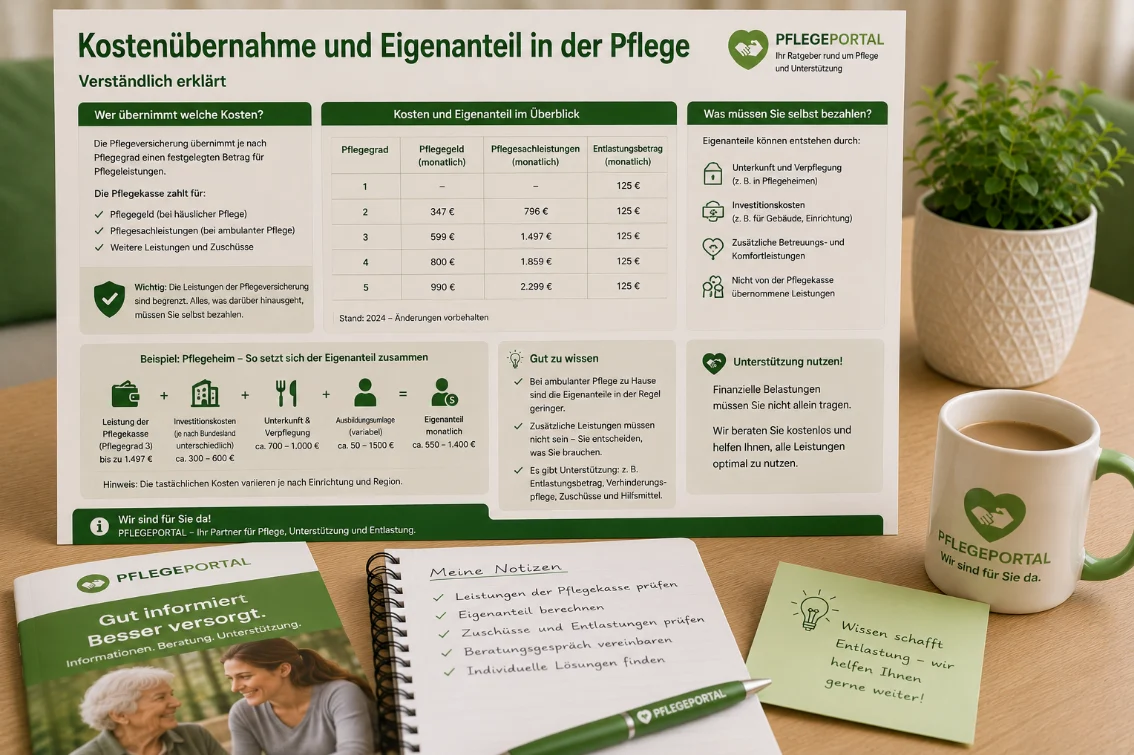
What ‘cost coverage’ and ‘co-payment’ mean in the context of care
The term ‘cost coverage’ sounds reassuring at first. It sounds like a clear promise: someone else will pay. In the context of care, however, this idea is unfortunately only half true. Long-term care insurance covers many services, but rarely all costs. It does not operate like comprehensive insurance, but rather like partial cover. This means that, depending on the care level, type of care and specific circumstances, the long-term care insurance fund contributes fixed amounts or grants. Any costs exceeding these amounts are borne by the person in need of care or their family as a personal contribution.
This is precisely where the practical challenge begins. Care costs do not arise from a single source. There are expenses for home care, residential care, day care, short-term care, respite care, care aids, home adaptations, transport, advice, domestic help and, sometimes, private supplementary services. Each service has its own rules, its own budgets and its own billing procedures. Anyone dealing with this for the first time quickly feels as though someone has crossed a household budget book with a law book and turned the result into a form.
Cost coverage therefore always involves the following questions: Which authority is responsible? Which service is being referred to? Is there a care level? Does an application need to be submitted in advance? Is the cost settled directly with a provider, or is the person in need of care paid a cash sum? And what is the remaining balance at the end? These questions determine whether care costs remain financially predictable or whether there is a new surprise in the letterbox every month.
This page explains the key rules regarding cost coverage and personal contributions. It sets out which costs are covered by the long-term care insurance fund, which costs must be paid privately, what specific arrangements apply in care homes, and how relatives can avoid common pitfalls. The focus is on providing clear guidance, not on bureaucratic jargon. There is already plenty of that in the care system as it is.
Depending on the level of care and the type of service, the long-term care insurance fund contributes towards recognised care costs.
Anything not covered by the long-term care insurance fund, health insurance fund, social security office or other agencies must be paid for privately.
By combining benefits and submitting applications on time, you can manage financial burdens much more effectively.
Long-term care insurance is not comprehensive insurance
One key point is often overlooked: social care insurance does not cover care costs in full. It was deliberately designed as a partial cover scheme. This is a deliberate political choice and is often a bitter pill for those affected to swallow. The term ‘care insurance’ conveys a sense of security, but in reality it only covers fixed benefit amounts. If the actual costs rise more sharply than these amounts, the amount the individual has to pay out of pocket increases.
In the case of home care, this is reflected in care benefits in kind. The long-term care insurance fund provides a monthly budget depending on the care level. If a care service charges for more services than this budget covers, the additional costs must be paid privately. In the case of residential care, the situation is even clearer. Here, the care insurance scheme pays a fixed amount for care-related expenses, depending on the care level. Accommodation, meals, capital costs and additional services are generally not included in this capped care benefit amount.
This leads to a common misunderstanding that crops up time and again in consultations: a high care level does not automatically mean that the care home costs next to nothing. Whilst the care level does increase entitlement to benefits, the care home bill comprises several cost categories. Long-term care insurance only covers certain aspects. The remainder remains as a personal contribution.
For families, this means that care costs must be calculated realistically. It is not enough simply to know the care level. The decisive factors are the specific type of care required, the providers’ rates, the length of stay in a care home, available income, assets and any additional support available.
What costs the long-term care insurance fund can generally cover
The long-term care insurance fund is responsible for benefits arising from the need for care. This is usually subject to a recognised care level. Depending on the care level, various benefits may be available. These include care allowance, care benefits in kind, day care, night care, short-term care, respite care, respite allowance, care aids, grants for home adaptations and benefits for full-time residential care.
Care allowance is paid directly to the person in need of care if care at home is organised by relatives, friends or other private carers. Care benefits in kind, on the other hand, are used when an approved outpatient care service provides the care. In such cases, the service usually settles the bill directly with the long-term care insurance fund. The person in need of care often only realises that the costs have been covered when services exceed the budget and they are required to pay a co-payment.
The relief payment is intended to fund everyday assistance, care services or recognised support services. It is not normally paid out as a lump sum, but is reimbursed upon presentation of evidence or settled via approved providers. Here, too, we see a classic feature of German bureaucracy: the entitlement exists, the money is theoretically available, but it can only be used if the provider is authorised and the billing is in order. After all, if it were simple, that would be rather suspicious.
Separate rules apply to technical aids, care aids and home adaptations. Disposable care aids may be subsidised via a monthly flat-rate allowance. Measures to improve the home environment may be subsidised by up to 4,180 euros per measure, provided that this enables or facilitates home care. It is almost always important to apply in advance, rather than asking after installation, to your surprise, whether anyone is willing to pay.
| Service | Typical cost coverage | Is a personal contribution possible? |
|---|---|---|
| Care allowance | Direct monthly cash benefit for home care | No, but additional private costs may still apply |
| Care benefits in kind | Budget for home care services | Yes, if the costs exceed the budget |
| Tax relief amount | Reimbursement for approved respite care services | Yes, in the case of non-approved offers or higher costs |
| Home adaptations | A grant of up to €4,180 per installation | Yes, if the conversion is more expensive |
| Full-time residential care | A fixed benefit amount plus a supplementary allowance on top of the care-related personal contribution | Yes, usually considerably |
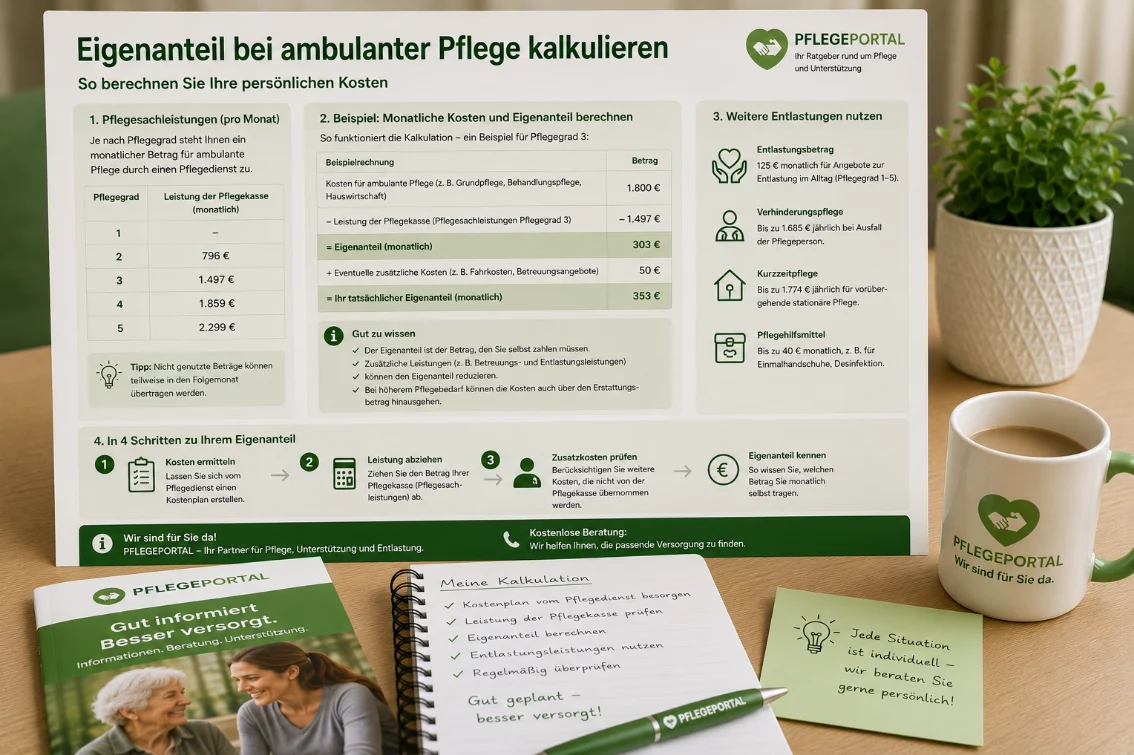
Co-payment at home: calculating the cost of home care correctly
With home care, the personal contribution works differently to that in a care home. Anyone who relies solely on care allowance receives a monthly cash payment and organises their care privately. Additional costs may then arise, for example, for private care, domestic help, transport, assistive devices, home modifications or supplementary services. These costs are not automatically covered by the care allowance, but must be paid for out of one’s own budget.
Anyone who commissions an outpatient care service is making use of care benefits in kind. The care service bills for individual services at agreed rates. These include, for example, help with washing, getting dressed, repositioning, eating, mobility or domestic support. Depending on how often the service visits and which services are provided, the monthly budget can quickly be used up.
A personal contribution arises when the costs of the care service exceed the amount covered by the long-term care insurance fund for the relevant care level. In such cases, the service provider bills the remainder privately. This is not an error, but a consequence of the system. Anyone who requires several visits a day must therefore check at an early stage whether their budget is sufficient or whether another form of care would be more appropriate.
The ‘combined benefit’ is important. This combines care allowance with care benefits in kind. If the budget for benefits in kind is only partially used, a proportionate amount of care allowance may be paid out. This is particularly useful if relatives continue to provide some of the care and the care service is specifically relieved of some of the burden. The calculation isn’t exactly romantic, but it is practical, at least.
- Request a quote from the care service
- Compare your monthly budget for benefits in kind with your planned visits
- Check the combined benefit
- Make additional use of the tax relief allowance
- Check invoices and statements of services regularly
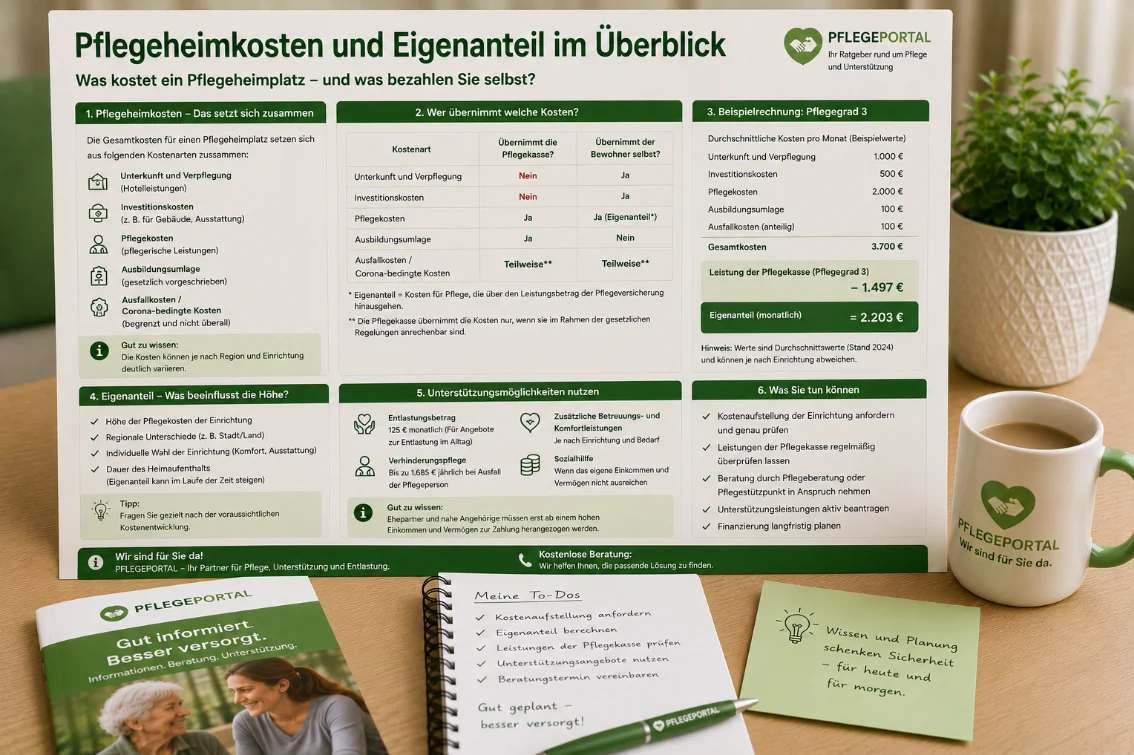
Personal contribution towards a care home: Why the bill consists of several parts
For many families, the personal contribution towards a care home is the biggest shock. This is because the care home bill does not consist solely of care costs. It comprises several cost categories: care-related expenses, training levy, accommodation, meals, capital costs and any additional services. Long-term care insurance primarily covers care-related costs. Accommodation and meals, on the other hand, are essentially living expenses and must generally be paid for privately.
In many descriptions, the care-related personal contribution is referred to as a ‘facility-standard personal contribution’. Within a single care home, it is generally the same for care levels 2 to 5. This means that, within the same care home, a person with care level 2 does not automatically pay less for the care-related co-payment than a person with care level 5. Although long-term care insurance pays different benefit amounts depending on the care level, the care home calculates the remaining care-related personal contribution at a standard rate.
In addition, there are costs for accommodation and meals. Residents must pay these costs themselves. The same applies to capital expenditure. The care home uses this to fund, for example, buildings, equipment or maintenance. These amounts can vary significantly depending on the federal state, the care home and the operating body. So, if you only look at the care level, you’re only getting half the picture when it comes to care home fees.
To protect against rising care-related personal contributions, a benefit supplement has been in place since 2022, which was increased in 2024. However, it does not reduce the total care home bill, but only the care-related personal contribution, including certain levies. Accommodation, meals and capital costs remain unaffected. This detail is important because it is regularly misunderstood.
| Cost section | What does this mean? | Who pays? |
|---|---|---|
| Care-related expenses | Care, support and assistance in care homes | Partially covered by the long-term care insurance fund; the remainder is the individual’s own contribution |
| Training levy | Costs of funding care training | Partially covered by the patient’s contribution towards care costs |
| Accommodation | Rooms, general living costs | Private residents |
| Catering | Food and drink | Private residents |
| Investment costs | Buildings, fittings, maintenance | Residents (private individuals or, where applicable, social care providers) |
| Additional services | Comfort or optional services | Private residents |
The care home service surcharge
The care allowance is an additional form of financial relief for people with care levels 2 to 5 who are in full-time residential care. It is based on the length of stay in the care home. The longer a person has been receiving full-time residential care, the higher the allowance. Since January 2024, the long-term care insurance fund has covered 15 per cent of the care-related personal contribution in the first year, 30 per cent in the second year, 50 per cent in the third year and 75 per cent from the fourth year onwards.
The key point is what this reduction applies to. It is not applied to the entire care home bill. It only reduces the care-related personal contribution. Accommodation, meals and capital costs remain unchanged. Anyone reading a care home invoice should therefore check carefully which items have been reduced and which remain unchanged.
The subsidy is usually settled directly between the care home and the long-term care insurance fund. Residents will see it on their bill as a relief amount or a reduced personal contribution. When moving to a new care home, periods of eligibility already accrued may generally remain valid, provided the conditions are met. Details should be clarified with the long-term care insurance fund and the care home.
The service allowance is important, but it does not fully cover the costs. It does not prevent the overall financial burden from remaining high. Accommodation, meals and capital costs, in particular, can still represent a significant expense. Nevertheless, the allowance can provide noticeable relief after a longer stay.
| Length of stay in a care home | Surcharge on the care-related personal contribution |
|---|---|
| Up to 12 months | 15 % |
| More than 12 months | 30 % |
| More than 24 months | 50 % |
| More than 36 months | 75 % |
Care Level 1: Special case regarding cost coverage and personal contribution
Care Level 1 occupies a special position. People with Care Level 1 have only a minor impairment to their independence and therefore do not receive the same benefit amounts as those with Care Levels 2 to 5. Care allowance and standard care benefits in kind are not available in the same form for Care Level 1. Nevertheless, there is support available that may be of financial significance.
The relief allowance is particularly important. It can be used for Care Level 1 to fund recognised services providing support with everyday life. In addition, care aids, advice, care courses and grants for home adaptations may also be available. Particularly at the start of a person’s need for care, these benefits can help them maintain their independence for longer.
In a care home, care level 1 is often financially disadvantageous. The inpatient benefit payments from long-term care insurance are very limited for care level 1. Anyone receiving full residential care at care level 1 must therefore expect to pay a significantly higher private contribution. In many cases, it is worth checking whether the current classification still reflects the actual situation or whether an application should be made for a higher care level.
The specific case of Care Level 1 illustrates just how important a realistic assessment is. Anyone who needs significantly more support in their daily life should not, out of politeness, shame or false modesty, underestimate their need for assistance. The long-term care insurance fund does not assess resilience, but rather independence.
Even those with care level 1 can make use of recognised respite care services.
Grants may be available for accessibility improvements.
If the need for assistance increases, an upgrade should be considered.

Short-term care, respite care and day care: there are limits to what is covered
In addition to long-term care at home or in a care home, there are intermediate options and supplementary arrangements. Short-term care helps when temporary residential care is needed, for example following a hospital stay or in a crisis situation. Respite care comes into play when the private carer is unavailable, unwell or needs a holiday. Day care and night care complement home care by providing semi-residential support.
These services can provide significant relief, but they are subject to budgetary constraints. The long-term care insurance fund only covers costs up to certain limits and only for specific components. Accommodation, meals or capital costs may still need to be paid for privately in some cases for semi-residential and residential transitional care services. Anyone who focuses solely on the term ‘cost coverage’ can easily overlook the associated costs.
Short-term care can be particularly important following discharge from hospital. It gives families time to prepare for care at home, organise aids or find a care service. Respite care, on the other hand, is a safeguard for family carers. It prevents carers from having to function continuously without a break, as if they were household appliances with a pulse.
Day care is often a good solution if relatives are in work or if the person requiring care needs supervision, structure and stimulation during the day. This service is provided in addition to care allowance or care benefits in kind and can help stabilise care arrangements at home. Nevertheless, travel costs, meal allowances and any remaining costs should be clarified in advance.
- Request a cost breakdown from the organisation before admission
- Find out which costs are covered by the care insurance scheme
- Check accommodation, meals and investment costs separately
- Bear in mind travel costs for day care
- Don’t wait until a crisis arises to look into budgets
Health insurance or long-term care insurance: who covers which costs?
Many questions about costs arise because people confuse health insurance and long-term care insurance. Although they are often organised under the same umbrella, they are legally distinct areas of provision. Health insurance is responsible for medical treatment. Long-term care insurance is responsible when long-term assistance with everyday tasks is required due to a need for care.
An example: A medical aid prescribed by a doctor to compensate for a disability or to ensure treatment may be the responsibility of the health insurance fund. A care aid that facilitates care or alleviates symptoms tends to fall within the remit of the long-term care insurance fund. In practice, there are overlaps, and this is precisely where the ‘ping-pong’ of responsibility begins – that elegant German sport involving the back-and-forth of rejection letters.
Home nursing care is also funded by health insurance if it is prescribed by a doctor. This may include, for example, administering medication, changing dressings or giving injections. Basic care and domestic help, however, are often covered by long-term care insurance. This distinction is important because different application forms, prescriptions and supporting documents apply.
Those affected should therefore read rejection letters carefully. Sometimes an organisation does not reject an application because there is no need for a stairlift, but because it does not consider itself responsible. In such cases, it should be checked whether the application needs to be forwarded to another organisation or whether a doctor’s prescription is required.
| Cost centre | Rather professional |
|---|---|
| Medical treatment, medication, hospital | Health insurance |
| Home nursing care as prescribed | Health insurance |
| Care allowance and care benefits in kind | Long-term long-term care insurance fund |
| Tax relief amount | Long-term long-term care insurance fund |
| Care aids | Long-term care insurance, partly distinct from health insurance |
| Medical aids | Health insurance |

Home adaptations: grants and personal contributions towards the cost of conversion
When people receive care at home, their home often needs to be adapted. Barriers, narrow doorways, high baths, steps or a lack of grab rails can make care more difficult and increase the risk of falls. The long-term care insurance fund may subsidise home adaptations if these enable home care, make it considerably easier or help restore a more independent lifestyle.
The grant can amount to up to 4,180 euros per measure. If the conversion costs more than this, the difference must be paid as a personal contribution. If several eligible people in need of care live in the same home, grants may be combined under certain conditions. This is relevant, for example, in shared accommodation. For the typical family, however, the focus is usually on bathroom conversions, stair access solutions, door widening, ramps or other safety measures.
The order of events is important. The application should be submitted before work begins. Anyone who carries out the alterations first and then applies for funding risks having their application rejected. Cost estimates, photographs, supporting statements and, where applicable, recommendations from specialist organisations can be helpful. In the case of major alterations, it is also worth checking whether KfW programmes, local authority grants or tax relief are available.
The personal contribution required for home adaptations depends heavily on the project. A handrail costs very little, whilst a bathroom refurbishment or a stairlift costs considerably more. It is therefore important not only to ask whether a grant is available, but also to consider what the realistic total costs will be and what funding gaps remain.
Care support: When income and assets are insufficient
If care costs cannot be covered from personal funds, care assistance under social welfare law may be an option. The social services department is responsible for this. This benefit may apply to both home care and residential care. However, it only comes into effect once priority benefits have been exhausted and income and assets are insufficient.
The social security office assesses the financial situation. This includes pensions, income, assets, insurance policies, property and ongoing financial obligations. Maintenance issues may also be a factor. Since the reform of the Act on Relief for Family Carers, in many cases the children of parents in need of care are only required to contribute to their parents’ maintenance if their gross annual income exceeds 100,000 euros. Nevertheless, families should seek advice at an early stage, as individual cases can be complicated.
Many people find visiting the social security office a stressful experience. That is understandable, but care allowance is a statutory benefit, not a personal failure. Nobody likes to plan for a financial emergency. Nevertheless, it is better to act in good time than to let care home bills pile up and end up under pressure later on.
It is important to submit applications early and to provide all the necessary supporting documents. Social security benefits are often not paid retrospectively at will. Anyone who realises that care costs are no longer affordable should therefore seek advice immediately and prepare their application.
- Have your care home contract and cost breakdown to hand
- Gathering proof of pension and income
- Preparing statements of assets
- Please enclose notifications from the long-term care insurance fund
- Submit your application to the social services department in good time
Reducing your co-payment: Which measures really help
It is not always possible to avoid co-payments entirely, but they can often be better managed. The most important step is choosing the right benefits. Anyone receiving care at home should not consider care allowance, care benefits in kind, combined benefits, the relief allowance and day care in isolation. The best solution often arises from a combination of these. Whilst the system is not exactly a test of one’s patience, it does offer some flexibility.
When it comes to home care, it is worth taking a close look at the care service’s care plan. Some services are urgently needed, whilst others may be able to be supplemented by relatives or through respite care services. Switching between care allowance, benefits in kind and combined benefits can also have financial implications. However, it is important not to base decisions solely on cost. Care must remain safe.
When choosing a care home, it helps to compare different facilities. The personal contributions vary considerably. In addition to the care-related personal contribution, accommodation, meals and capital costs should be checked. Additional services must also be clearly specified. A monthly fee that appears affordable at first glance may become less attractive when ancillary costs are taken into account.
In addition, tax options should be explored. Under certain conditions, care costs may be recognised as exceptional expenses or household-related services. Anyone paying high personal contributions should keep receipts and seek tax advice.
Co-ordinating care allowance, benefits in kind, the relief allowance and day care.
You only pay for services that have been agreed and actually provided.
Involve care centres, care advice services and social welfare advice at an early stage.
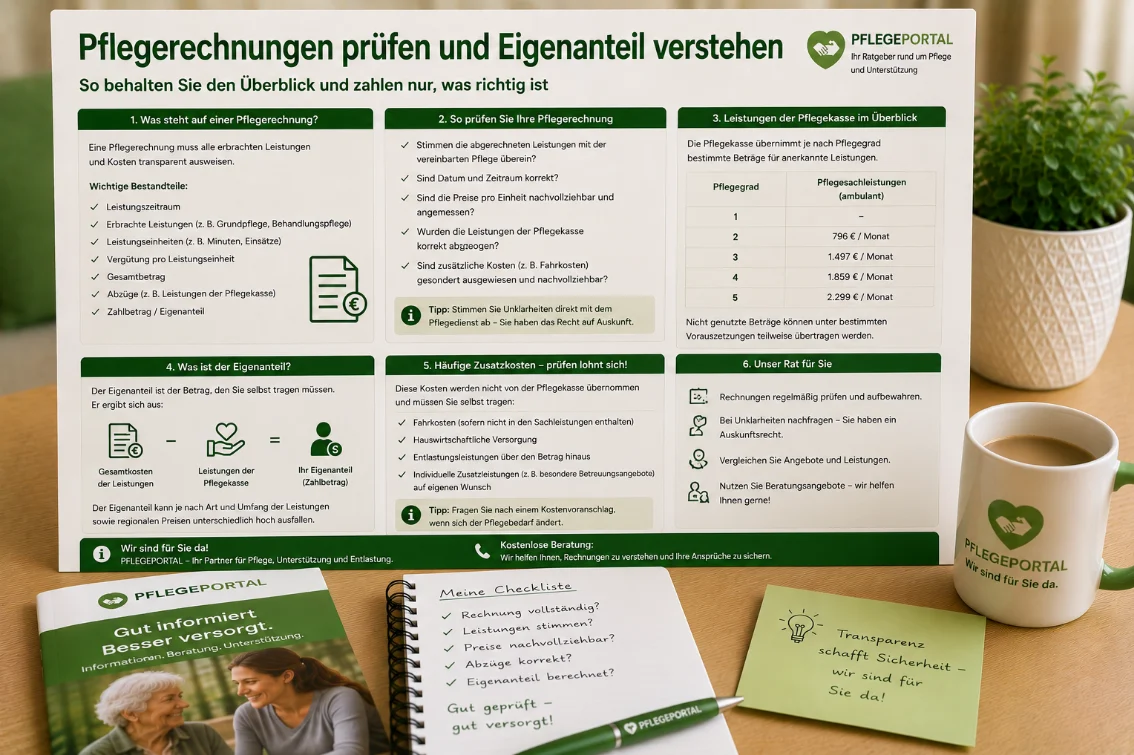
Understanding and checking bills
Care bills should not be paid without being checked first. This applies to home care services as well as to care homes. The services provided must be clearly itemised on the bill. For home care services, the service records should correspond to the visits actually carried out. For residential care, the cost categories should be clearly separated.
A common mistake is to look only at the final amount. It is more informative to break the figure down. How much is allocated to care? How much goes towards accommodation and meals? How much towards capital costs? Has the service surcharge been taken into account? Have any additional services been invoiced that were actually agreed upon? Are there any retrospective adjustments?
If anything is unclear, relatives should enquire in writing. Care homes and care services must be able to explain how invoices are broken down. The long-term care insurance fund can also help if it is unclear which costs have been covered. Anyone who simply pays an invoice without understanding it may, in case of doubt, be throwing money away.
Particularly when moving into a care home, it is worth obtaining a sample invoice before signing a contract. This shows what monthly costs can realistically be expected. You should also keep an eye out for any increases. Care costs can rise, but residents have the right to information and to review these costs. The same applies here: paperwork is a nuisance, but sometimes it’s the only defence against even more annoying paperwork.
- Check cost items separately
- Check the service surcharge
- Only accept additional services if agreed in advance
- Compare care service records with actual care provided
- Ask for written clarification of unclear positions
Application: Why applying at the right time saves money
Many long-term care insurance benefits do not start automatically, but only once an application has been submitted or following approval. Therefore, the timing of the application can be financially crucial. Anyone who applies for a care level too late may lose out on months during which they were already in need of assistance. Whilst benefits can be granted retrospectively from the month the application was submitted, this does not apply indefinitely to periods long past for which no application was made.
This also applies to reassessments. If the need for care increases significantly, an application for a reassessment should not be delayed. Relatives often wait in the hope that the situation will improve again. This is understandable in the case of temporary crises. However, in the event of a permanent deterioration, waiting costs money and delays relief.
For certain grants, such as those for home adaptations, it is particularly important to submit an application in advance. Work should not begin before the long-term care insurance fund has had the opportunity to assess the application. Assistive devices should also, where possible, be applied for properly or prescribed by a doctor, depending on who is responsible.
So the right time is rarely ‘sometime’. It is usually: as soon as it becomes apparent that care is needed or costs are incurred. That sounds obvious, but it is often overlooked in everyday life because families want to keep things running smoothly first and foremost. Keeping things running smoothly is commendable, but it is no substitute for submitting an application.
Private supplementary care insurance and provision for the future
Private supplementary care insurance can help to cover co-payments. It does not replace statutory care insurance, but supplements it. Depending on the policy, a daily care allowance, a care annuity or reimbursement of costs is paid should the need for care arise. Whether such insurance is worthwhile depends on your age, state of health, premium, scope of cover and financial situation.
For people who are already in need of care, taking out cover is usually difficult or no longer possible. That is why care provision is a topic that really ought to be discussed at an early stage. However, people are reluctant to do so, because old age, illness and the need for care are about as popular as a tax assessment notice with a surprise attachment.
Anyone with existing supplementary insurance should check early on, should they require care, what supporting documents are required. Often, the care level assessment must be submitted. Some policies only pay out from certain care levels onwards or distinguish between outpatient and inpatient care. The insurance terms and conditions should be read carefully.
As well as insurance, general planning plays an important role: powers of attorney, care plans, living wills, and an overview of bank accounts, contracts and ongoing expenses. Good financial organisation won’t prevent all out-of-pocket expenses, but it makes decision-making quicker and less chaotic.
Common mistakes regarding cost coverage and the patient’s contribution
The first major mistake is assuming that the long-term care insurance fund will cover everything. That rarely happens. The second mistake is failing to apply for benefits, even though you may be entitled to them. The third mistake is failing to check your invoices. These three mistakes invariably lead to a fourth: an unnecessary financial burden.
Many families are unaware of the relief allowance or do not make use of it because they cannot find an approved provider. Others pay privately for assistance that could, in some cases, be funded through care benefits. Still others sign care home contracts without understanding the total monthly cost. This is not a sign of stupidity, but the result of a system that apparently treats its users as if they were part-time social welfare experts.
Responsibilities are also frequently confused. Health insurance, long-term care insurance, social security, pension insurance, state allowances or private supplementary insurance may all be involved. Anyone who approaches the wrong organisation and gives up after receiving a rejection may forfeit their entitlements. Rejections should therefore be reviewed and not simply filed away.
Another mistake is a lack of documentation. Without official notices, invoices, proof of services rendered, quotes and correspondence, it becomes difficult to assert claims or claim expenses for tax purposes. A simple, consistently maintained care file may be tedious, but it is effective.
- Confusing ‘cost coverage’ with ‘full cost coverage’
- Submitting applications too late
- Do not claim the tax relief
- Do not allow the home assessment to be broken down
- Misunderstanding the service surcharge
- Do not collect receipts
- Do not press the matter if the request is declined
Checklist: Calculating your personal contribution realistically
A realistic calculation starts with the type of care. Is care provided at home, on an outpatient basis, on a semi-residential basis or on a full-time residential basis? The appropriate benefits from the long-term care insurance fund must then be identified. Only then can it be determined what costs remain.
In the case of home care, care allowance, care benefits in kind, combined benefits, respite care allowance, care aids and any necessary home adaptations should be assessed. For residential care, a full breakdown of costs from the care home is required. This should clearly show care costs, accommodation, meals, capital costs, training contributions, additional services and service surcharges.
This is followed by a look at income and assets. State pensions, private pensions, private insurance, housing benefit, social security entitlements or maintenance issues may be relevant. Where costs are high, it is important to check in good time whether care support will be necessary. This is not something to be left until the day before a payment reminder is issued.
Finally, you should keep a record of all supporting documents. Invoices, official notices and proof of payment are important for the long-term care insurance fund, social security office, tax return and any subsequent enquiries. Keeping things organised might not win you any friends at parties, but it will save you a lot of stress in day-to-day care situations.
At home, receiving home care, in day care or in a residential care home.
Distinguish between long-term care insurance, health insurance, social security and private funds.
Realistically estimate the monthly and one-off personal contribution.
Everyday care costs: small amounts can quickly add up
Not every out-of-pocket expense seems dramatic at first glance. Many costs seem manageable when taken individually: a trip to day care, a private domestic helper, extra care at the weekend, a co-payment for assistive devices, minor adaptations to the home or regular deliveries of care products. Added together, however, these can quickly amount to several hundred euros a month. It is precisely these hidden costs that are often overlooked in many care plans.
Relatives in particular often bear additional costs. They do the shopping, provide transport, cut back on working hours, organise private help or replace items that wear out more quickly in the day-to-day routine of care. Not all of these expenses can be reimbursed directly by the long-term care insurance fund. Nevertheless, such expenses should be documented, as they may be relevant for tax purposes, social security assessments or the sharing of costs within the family.
A simple monthly overview is helpful. This should list regular costs, one-off expenses and expected reimbursements separately. This makes it clear whether the care allowance is actually sufficient, whether benefits in kind have been fully utilised, or whether it would be sensible to apply for additional support. Without such an overview, financial difficulties are often only noticed once the bank account is already politely begging for mercy.
Care is not just a medical or organisational task, but also a financial risk. If you keep track of actual expenses from an early stage, you can make more realistic decisions: Is home care still sufficient? Is day care a sensible option? Does a care service need to visit more often? Or will residential care become necessary? Such decisions should not be left until bills start to pile up.
Keep a regular record of all care costs, reimbursements and private payments.
Make a note of even small expenses if they are related to care.
If costs are rising, check for advice, a higher care level or social security benefits.
Advice and appeals: If a claim for reimbursement is rejected
Not every application for cost coverage is approved straight away. Rejections can be for various reasons: lack of a care level, incorrect jurisdiction, incomplete documentation, lack of medical justification, providers not recognised by the scheme, or a measure which the health insurance fund does not consider necessary. A rejection therefore does not automatically mean that you are not entitled to the service.
It is important to read the decision carefully. It must state why the application was rejected and what the deadline for appealing is. Often, the deadline for lodging an appeal is one month from the date of notification. Anyone who allows this deadline to pass is making things unnecessarily difficult for themselves. The appeal can initially be submitted briefly and the grounds provided later. The main thing is to ensure the deadline is met.
To support the application, specific evidence should be gathered: medical reports, care assessments, photographs of the home environment, cost estimates, proof of benefits or written assessments from care professionals. The more specifically the need is outlined, the better. General statements such as ‘is urgently needed’ are less helpful than a precise description of why the measure facilitates care or reduces risks.
Seeking advice is not a sign of weakness. Care support centres, social welfare organisations, consumer advice centres, care advisers and, in some cases, specialist solicitors can help you make sense of official decisions. The care system is complicated enough as it is; no one should have to face a wall of legal provisions on their own. The system often wins. Seeking advice improves your chances. This step is particularly worthwhile where high monthly co-payments are involved, as even a single corrected decision can have a significant financial impact over months or years.
- Read the decision and the reasons in full
- Make a note of the withdrawal period
- Gathering documents and supporting evidence
- Check which organisation is responsible: the long-term care insurance fund or the health insurance fund
- Seek advice from a care adviser or social worker
Frequently asked questions about cost coverage and personal contributions
Does the long-term care insurance cover all care costs?
No. Long-term care insurance is a partial-cover insurance scheme. It covers fixed amounts or provides subsidies. The remaining costs are borne by the individual as a co-payment.
What is included in the personal contribution at a care home?
The personal contribution usually comprises the remaining care-related personal contribution, accommodation, meals, capital costs and any additional services.
Is the service surcharge applied to the entire care home bill?
No. It only reduces the care-related personal contribution, not accommodation, meals or capital costs.
Who pays if your pension isn’t enough to cover the cost of a care home?
If your income and assets are insufficient, you can apply to the social security office for care assistance. Eligibility is assessed on a case-by-case basis.
Can I reduce my personal contribution by being assigned a higher care level?
A higher care level can increase the benefits you receive. In a care home, however, the care-related personal contribution remains the same across the whole of the facility for care levels 2 to 5. Nevertheless, being assigned a higher care level can be important in other respects.
What costs does the health insurance fund cover?
The health insurance fund covers medical services, treatments, medically prescribed aids and home nursing care. Care services in everyday life are usually the responsibility of the long-term care insurance fund.
Do I need to apply for home adaptations in advance?
Yes, this is strongly recommended. You should apply for the grant before work begins.
Can I claim care costs against tax?
Under certain conditions, care costs may be taken into account for tax purposes. You should keep all receipts and seek tax advice.
Conclusion
Cost coverage in long-term care rarely means that all costs are covered. The long-term care insurance fund contributes towards key services, but the personal contribution remains a key issue. Anyone organising care at home needs to be aware of the budgets for care allowance, benefits in kind, the respite allowance and additional support. Anyone looking for a place in a care home needs to understand the full care home bill, not just the care level.
It is particularly important to distinguish between care-related costs, accommodation, meals and capital costs. The care home service surcharge helps, but only reduces the care-related personal contribution. Many misunderstandings arise because this very point is overlooked.
You can manage your finances wisely by submitting applications early, checking invoices, combining benefits, seeking advice and, if you find yourself struggling financially, applying for care support in good time. Care remains expensive and organisationally challenging. But having a clear overview prevents families from being left in a fog of uncertainty about costs, particularly during what is already a stressful phase of life.
The best protection against unnecessary out-of-pocket costs is not a single measure, but a well-thought-out strategy: check the care level, choose the right care, secure grants, calculate remaining costs realistically and understand every invoice. That may sound dry, but ultimately it’s very practical: fewer surprises, better planning and greater peace of mind for those in need of care and their relatives.