

Table of contents
- Why assistive devices and support are so important
- What counts as a care aid
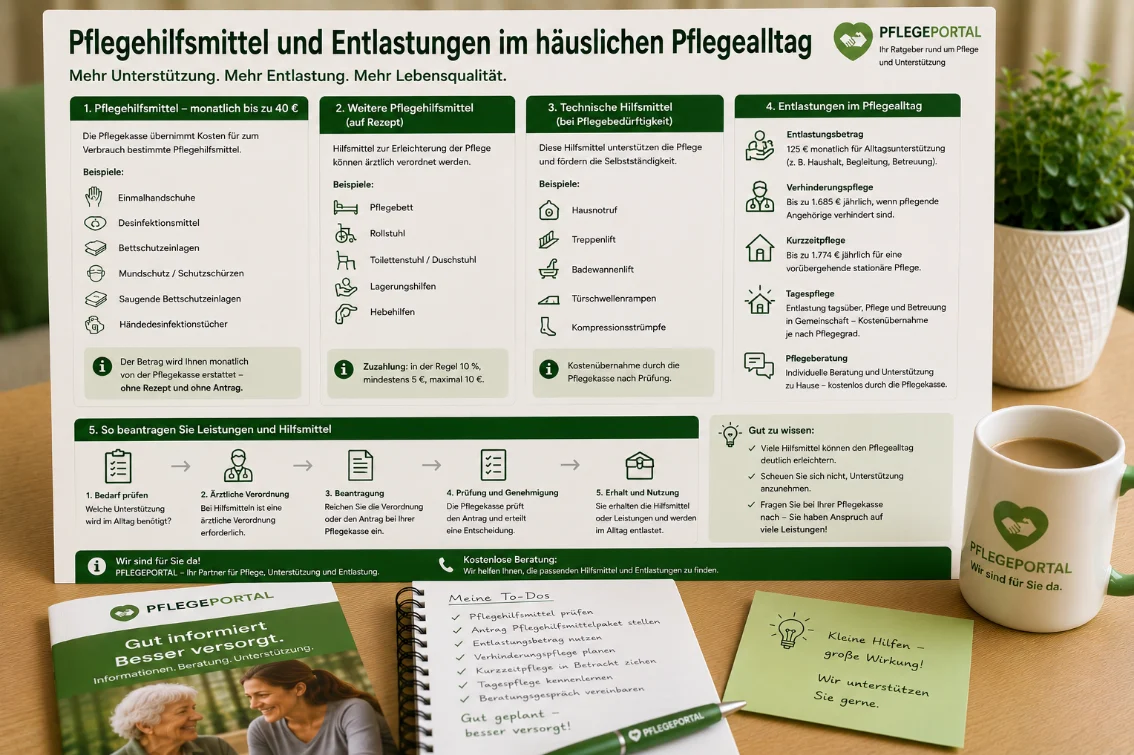
- Disposable care aids and €42 per month
- Tax relief: €131 per month
- Assistive technology, home emergency call systems and bathroom safety
- Relief for relatives
- Applications, billing and common mistakes
- FAQ
Why assistive devices and support are so important
In many families, care does not take place in a perfectly equipped model home, but in perfectly ordinary flats, in cramped bathrooms, on slippery shower trays, on stairs, in bedrooms with too little space and in kitchens that were never designed for someone to use a walking frame, a carer and a medicine box all at the same time. Assistive devices and respite care services bridge precisely this gap between care needs and everyday life. They ensure that care is not only theoretically possible, but actually works in practice.
It’s not just about large technical devices. A care bed, a rollator or a bath lift are visible and easy to understand. But the little things are just as important: disposable gloves, disinfectant, bed pads, positioning cushions, a home emergency call system, grab rails or a certified home help service covered by the care allowance. For relatives, it is sometimes precisely this seemingly minor support that determines whether care at home remains stable or slowly crumbles away like a form after its third round of circulation through the authorities.
By combining services in the right way, you can protect those in need of care, ease the burden on relatives and avoid unnecessary costs. The key point is this: assistive devices are not a luxury, but part of safe care provision. Respite care services are not simply ‘nice to have’, but are often essential for relatives to be able to cope in the long term.
What counts as a care aid?
Care aids are products and technical aids that make caregiving easier, alleviate symptoms or enable people to lead more independent lives. Long-term care insurance generally distinguishes between technical care aids and consumable care aids. This distinction is important because the application process, cost coverage and billing procedures differ.
Technical care aids are durable products. These include, for example, care beds, patient lifts, wheelchairs, positioning aids, home emergency call systems and special toilet and shower aids. Many of these aids are provided on loan. The long-term care insurance fund covers the costs in full or in part if the aid is necessary and the eligibility criteria are met.
Consumable care aids are products that are used up on a regular basis. These include disposable gloves, disinfectants, face masks, protective aprons and absorbent bed pads. There is a monthly maximum amount for these consumable products. Since 2026, this amount has remained at up to €42 per month. Important: this is not a cash benefit, but a benefit in kind. The health insurance fund therefore pays for the products or reimburses the relevant invoices; it does not simply transfer the amount for the sake of bureaucracy.
Entitlement to care aids
Entitlement to care aids generally applies if a care level has been assessed and the person requiring care is being looked after at home, in a shared accommodation facility or in a comparable domestic setting. The key factor is that the aid must serve the purpose of care, promote independence or alleviate symptoms. Different rules apply in the case of full-time residential care in a care home, as many aids are provided by the care home itself.
A care level is the key to accessing many benefits provided by the long-term care insurance fund. Without a care level, it becomes significantly more difficult to obtain care aids through care insurance. In some cases, however, the health insurance fund may be responsible, for example if an aid is medically necessary and serves to treat an illness. This is precisely where the usual buck-passing begins: the long-term care insurance fund says ‘it’s the health insurance fund’, the health insurance fund says ‘it’s the long-term care insurance fund’, and somewhere in the middle sits a relative with three telephone notes and rising blood pressure.
It is important for those affected to know that they do not need to know exactly which health insurance fund is responsible. An application can be submitted; the health insurance funds must then clarify which one is responsible. Nevertheless, it helps to clearly describe the purpose of the aid: is it to facilitate care, ensure safety, improve mobility, maintain hygiene or provide medical care? The more precisely the need is described, the easier it is to justify the claim.

Disposable care aids: €42 per month
The monthly flat-rate allowance for consumable care aids is one of the simplest, yet often underestimated, benefits. People in need of care who have been assigned a care level and are cared for at home can receive products worth up to €42 per month. The benefit can be settled directly through approved providers or claimed via invoices submitted to the long-term care insurance fund.
Typical products include disposable gloves, hand sanitiser, surface disinfectant, protective aprons, face masks and bed pads. These items may seem unremarkable, but they are essential in day-to-day care. Hygiene protects both those in need of care and carers. Regular supplies are essential, particularly in cases of incontinence, wound care, susceptibility to infection or intensive personal hygiene.
Many suppliers advertise so-called ‘care boxes’. These can be practical, provided the contents actually meet your needs. Not every box is automatically a good idea. If you only receive products that end up gathering dust in a cupboard, you’re not making the most of the service. A better approach is a selection that is regularly reviewed: Are more gloves needed? Is there enough sanitiser? Are bed pads necessary? Care is a dynamic process, so the supply of consumables shouldn’t be left to run on autopilot.
Technical care aids: safety and independence
Technical care aids can make a significant difference to everyday life. A care bed makes it easier to get up, carry out personal hygiene and change position. A patient lift protects carers from back injuries. A home emergency call system can ensure that people living alone who require care receive help quickly in an emergency. A shower stool or commode chair can prevent falls before they even happen.
The preventative nature of many assistive devices is particularly important. People often only apply for them once something has already happened: a fall, feeling overwhelmed, or a decline in mobility. It makes more sense to identify risks at an early stage. If someone is already feeling unsteady when getting into the bath, the right time to find a solution is not after they’ve suffered a femoral neck fracture. But, as we know, people tend to adopt a ‘it’ll be fine’ attitude – until it isn’t.
As a rule, applications for assistive technology must be justified. Medical recommendations, assessments by the care service or advice from care advisers are helpful. The more specifically you describe which everyday situations are dangerous or stressful, the more convincing your application will be.
Tax relief: €131 per month
The care relief allowance is a means-tested benefit for people in care levels 1 to 5 who are cared for at home. Since 2025, it has amounted to €131 per month, or up to 1,572 euros per year. It is granted in addition to other care benefits and is intended to relieve the burden on family carers and promote the independence of the person in need of care.
Unlike care allowance, the respite allowance is not paid out freely. It can be used for approved services, such as care, support with daily living, domestic help, day care, short-term care or certain outpatient services. The approved services vary from one federal state to another. This is precisely where Germany shows its creative side: the very same form of assistance may be approved in one federal state, whilst in the next it is only authorised after a bureaucratic odyssey involving a stamp card.
The relief amount is particularly valuable because it is paid out regularly. Unused amounts can be carried forward and used until 30 June of the following year. After that, they lapse. Many households requiring care fail to make use of this benefit because they do not know of any providers or are unsure how the billing works.
What the relief amount can be used for
The relief amount can be used for various services, provided these are recognised or eligible for reimbursement. It is frequently used for domestic help, support with daily living, care groups, accompaniment to appointments, assistance with shopping or hourly care at home. It can also be used to supplement day and night care as well as short-term care.
It is important to note that the funds are earmarked for a specific purpose. The amount is not intended to cover any private expenditure. A cleaner from the neighbourhood can only be paid for using the relief allowance if the requirements of the relevant federal state are met. Some federal states permit low-threshold neighbourhood assistance under certain conditions, whilst others require formal recognition. In such cases, it is worth calling the long-term care insurance fund or the care advice centre.
For relatives, the care allowance is often the first step towards seeking external help. Those who have managed everything on their own up to now can start by organising small-scale support: a weekly visit from a domestic helper, an escort to the doctor’s, or two hours of care. Small-scale support often leads to greater stability. Care rarely fails because of a single major problem, but rather because of many small demands that pile up like unanswered letters from the authorities.
Entitlement to conversion: Up to 40 per cent of care benefits in kind
As well as the relief allowance, there is another way to fund support with everyday living: the conversion entitlement. People in need of care from care level 2 onwards can use up to 40 per cent of the outpatient care benefit allowance for recognised services providing support with everyday life, provided that this portion has not already been used for care services.
This is particularly relevant if not the entire amount of benefits in kind for physical care or nursing care provided by an outpatient service is required. The unused portion can, in some cases, be channelled into respite care services. This allows for more extensive funding of domestic help, care or support with daily living.
In practice, this option is often overlooked. Many families are familiar with care allowance and care benefits in kind, but not with the conversion scheme. Yet it is precisely this combination that can help to make care arrangements more flexible. It is important to coordinate matters clearly with the long-term care insurance fund and the care service provider to ensure that benefits are settled correctly.
Home emergency call systems: providing peace of mind and a safety net
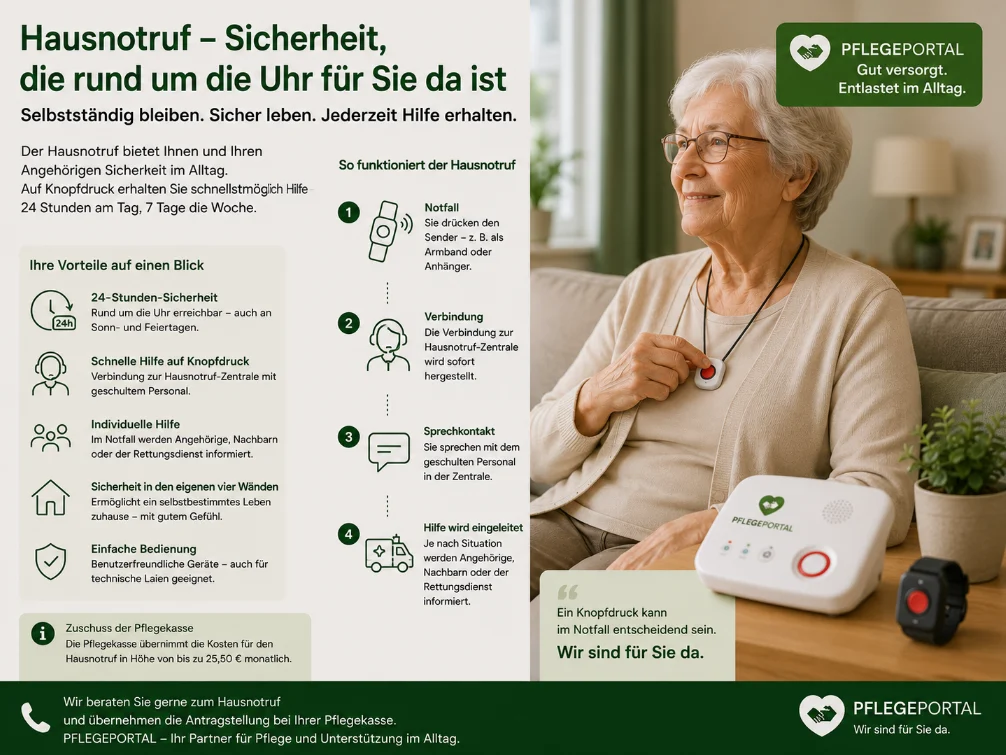
A home emergency call system is one of the best-known forms of technical assistance. It enables people in need of care to call for help at the touch of a button in an emergency. A home emergency call system can be particularly useful for people living alone who are at risk of falling, have cardiovascular problems, early-stage dementia or limited mobility.
The long-term care insurance fund may contribute towards the costs if a care level has been assessed and the eligibility criteria are met. Basic monthly costs are often covered or subsidised. Additional services, such as key holding, extended call-out services or specialised equipment, must be paid for separately, depending on the provider.
The benefit of a home emergency call system lies not only in its technical function. It gives relatives peace of mind. People who do not answer every call in a state of panic have a measurably better quality of life. Those in need of care also gain greater freedom of movement because they know that, should anything happen, they are not completely on their own.
Assistive devices in the bathroom: the most dangerous room in the home
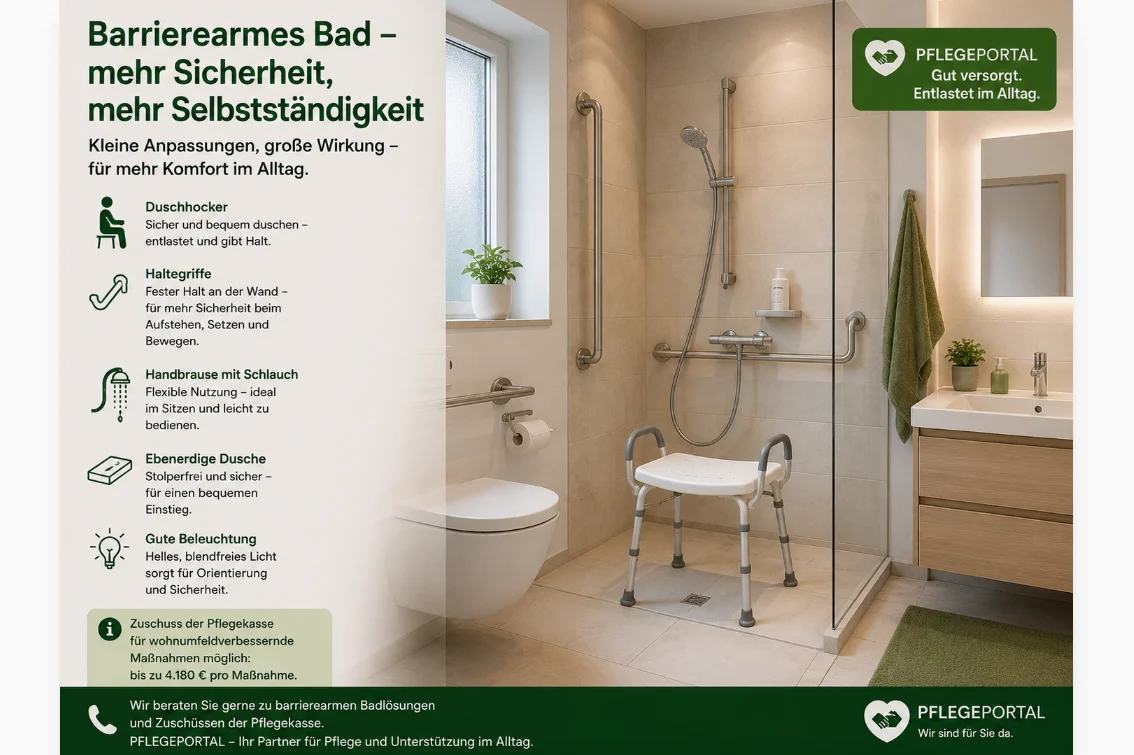
The bathroom is one of the most common places for accidents to occur in the home. Wet tiles, confined spaces, high thresholds and a lack of handrails make the bathroom a risky place for people in need of care. Assistive devices can make a particularly big difference here.
The most important bathroom aids include shower stools, shower chairs, toilet seat raisers, grab rails, non-slip mats, bath boards, bath lifts and floor-level shower solutions. Some products are classified as assistive devices, whilst others are considered home adaptation measures. Which category they fall into depends on the specific product and its intended purpose.
Anyone wishing to make the bathroom safer should not just consider a single aid. It is the interplay of factors that is crucial: Can the person get to the bathroom safely? Can they sit down? Are there places to hold on? Is the shower accessible? Can a carer help without putting themselves at risk? A shower stool on its own is a nice idea, but if the path to it leads over a slippery threshold, the problem remains.
Mobility aids: rollators, wheelchairs and transfer aids
Mobility is a key issue in care. Anyone who cannot move about safely loses their independence, social contacts and quality of life. Walkers, wheelchairs, walking sticks, transfer boards and standing aids can help to facilitate movement and take the strain off carers.
A rollator is not simply a shopping trolley with a medical twist. It must be suited to the user’s height, strength and environment. Models that are too wide are impractical in cramped flats; models that are too light can be unstable; and incorrect handle heights can lead to poor posture. Professional fitting is therefore essential.
The situation is similar with wheelchairs. There are standard wheelchairs, lightweight wheelchairs, care wheelchairs and electric models. Which type is suitable depends on the user’s strength, ability to sit, intended duration of use and environment. Anyone who chooses solely on the basis of the cheapest model may well be saving in the wrong place.
Care beds and positioning: relief for everyone involved
A care bed is often one of the most important aids for those with advanced care needs. It makes it easier to get up, allows for better positioning, supports personal care whilst in bed and protects relatives from physical strain. Height-adjustable beds are particularly helpful as they make care tasks more ergonomic.
Positioning aids can prevent pressure sores, reduce pain and make breathing easier. These include special cushions, mattresses, heel-relief supports and positioning aids. If there is a risk of pressure ulcers, a special anti-decubitus mattress may be necessary. In such cases, a professional assessment by nursing staff or doctors is advisable.
Many families are reluctant to get a care bed because it visibly changes the look of the home. That’s understandable. Nobody wants their bedroom to suddenly look like a mini hospital ward. Nevertheless, what matters most is what helps in everyday life. Dignity, safety and relief are more important than the illusion that everything is still the same as it used to be.
Applying for assistance: How to ensure assistive devices reach the right person
Applications for care aids can be made directly to the long-term care insurance fund. Medical supply shops, care services or suppliers often assist with the application process. For certain aids, a doctor’s prescription may be helpful or necessary, particularly where the health insurance fund is responsible.
A good application describes not only the desired product, but also the specific need. Instead of ‘We need a shower chair’, it is better to say: ‘The person requiring care is unable to shower safely due to limited mobility and balance; a shower chair is needed to prevent falls and enable personal hygiene.’ Authorities love justifications. Without them, they apparently feel lost.
Once an application has been submitted, the health insurance fund will assess the claim. If the claim is rejected, an appeal may be lodged. Many rejections are based on unclear reasoning, missing documentation or issues of jurisdiction. An appeal should objectively explain why the aid is necessary and, where possible, include additional supporting evidence.
Support for relatives: care shouldn’t take over everything
Family carers are often under enormous pressure. They organise appointments, medication, personal care, household chores, finances and emotional support. Many cut back on their working hours or put their own needs on hold. That sounds heroic, but in the long run it’s a fairly sure-fire route to exhaustion.
Support services are therefore by no means a minor matter. Domestic help, day care, care services, respite care, short-term care, care training courses and advisory services can prevent relatives from becoming permanently overburdened. Technical aids also play a part in this, as they reduce physical strain.
It is important to plan for support early on. Anyone who only seeks help once all their reserves have been exhausted has less room for manoeuvre. Care is a long-distance run, not a dramatic sprint with sad music playing in the background. Protecting relatives also protects the person in need of care.
Day care, care services and assistance with daily living
Day care can offer people in need of care structure, social interaction and support, whilst relieving the burden on relatives during the day. It is particularly suitable when the intention is to continue providing care at home, but professional support is required on certain days.
Care services and support with everyday activities can also be valuable. They provide assistance with walks, conversations, keeping occupied, accompanying people to appointments or simply helping them find their way around in daily life. Regular care can significantly ease the burden on relatives, particularly in cases of dementia.
Everyday assistance often includes domestic support: cleaning, laundry, shopping, meal preparation or minor organisational tasks. Not every service can be billed in the same way everywhere. It is therefore important to clarify, before commissioning a service, whether the provider is accredited and which funding scheme can be used for billing.

Regional differences and recognised providers
Regional differences are a particularly tricky issue. The eligibility of services offering support with everyday life is governed by state law. Consequently, the providers, neighbourhood support schemes or forms of care that can be claimed against the care allowance may vary from one federal state to another.
Long-term care insurance funds can provide information on which providers are approved. Care support centres and local advice centres can also help with the search. Anyone commissioning a provider should clarify in writing beforehand whether direct billing to the long-term care insurance fund is possible. Verbal assurances are all very well, but in the event of a dispute, they’re about as reliable as an umbrella made of kitchen roll.
This topic is particularly important for care portals: users are not just looking for information, but for practical guidance. A good website therefore not only explains the service, but also how to access it: finding a provider, checking eligibility, submitting a claim and meeting deadlines.
Common mistakes regarding assistive devices and support services
Many entitlements go unclaimed because families make common mistakes. The most common mistake is a lack of knowledge. Benefits are not applied for at all because nobody has explained that they exist. The second mistake is doing things in the wrong order: buying first, then asking. This can work, but it isn’t guaranteed. It is safer to clarify whether the costs will be covered before making any major purchases.
Another mistake is confusing care aids, medical aids and home adaptations. A care bed is not the same as a bathroom conversion, and a toilet seat raiser is assessed differently from a complete bathroom refurbishment. Anyone who confuses the different funding streams will quickly face rejections or delays.
Claims are also lost when it comes to the relief amount. Many people do not use approved providers, submit invoices too late or are unaware that amounts can be carried over until 30 June of the following year. As a result, money goes unused, even though urgent support is needed at home.
Checklist: What you should check now
Anyone wishing to make good use of assistive devices and support services should take a structured approach. The first step is to clarify the care level and the current care situation. It is then worth taking stock: where are the risks? Where are relatives feeling overwhelmed? Which everyday situations are no longer safe?
The next step is to identify which benefits may be available. Consumables are covered by the care aids allowance. Technical aids are applied for individually. Assistance with daily living and care can be funded via the respite allowance. Major alterations are often part of home adaptations. Day care, short-term care and respite care have their own rules, but can be combined with respite benefits.
It is also a good idea to keep invoices and official notices neatly organised. Caring for someone is chaotic enough as it is; a loose pile of papers in the kitchen drawer is not a strategy, but a cry for help on paper.
FAQ: Frequently asked questions about assistive devices and financial support
Who is eligible for consumable care aids? Entitlement generally applies to those with a recognised care level who receive care at home. The products must be used for day-to-day care and must not exceed the maximum monthly allowance.
Can you have the €42 paid out in cash? No. This is a benefit in kind or a reimbursement for suitable products. There is no provision for a cash payout.
Who is eligible for the care allowance? Anyone in need of care with care levels 1 to 5 who is cared for at home can claim the care allowance. It amounts to €131 per month.
Do you need to apply for the relief payment? You are entitled to it once you have been assigned a care level, but the actual reimbursement is made via invoices or direct billing by approved providers. It is advisable to check with your long-term care insurance fund beforehand to find out which providers are approved.
Can the relief amount be carried forward? Yes. Unused amounts can be carried forward within certain time limits. Usually, any remaining amounts can be used until 30 June of the following year.
What should you do if your application for an assistive device is rejected? Check the reasons given, gather evidence and lodge an appeal within the specified time limit. A statement from a doctor, care service or care advice centre may help.
Which aids are particularly important? That depends on the individual case. Commonly relevant aids include nursing beds, rollators, home emergency call systems, shower aids, toilet aids, positioning aids and consumables for hygiene and protection.
Conclusion: Small aids, big impact
Assistive devices and respite care allowances are among the most important components of home care. They make care safer, more dignified and more sustainable. Everyday consumables provide protection, technical aids facilitate mobility and care, whilst the respite care allowance creates scope for care, household tasks and support.
It is crucial not only to be aware of the support available, but also to actually make use of it. People in need of care and their relatives should check at an early stage which forms of support are appropriate, which providers are recognised and what deadlines apply. Taking a structured approach helps to avoid unnecessary costs and reduces stress.
The key insight is this: good care does not come from persevering at any cost. It comes from appropriate support, clear information and the courage to accept help before everyday life starts to unravel.
Practical planning for everyday care
Another practical point is the order in which decisions are made. First, the need should be described, then the appropriate service sought. Many families do it the other way round: they see a product, buy it and then hope to be reimbursed. This often leads to unnecessary discussions. It is better to draw up a brief care plan for everyday life: what daily activities need to be carried out, where are the risks, who takes on which tasks, and which aid would specifically improve the situation?